China’s entry rules for Canadians can change quickly, and the safety situation can also shift without warning. The Government of Canada currently advises Canadians to exercise a high degree of caution in China, and it updated its China page on February 20, 2026.
This update matters if you are planning a short trip, visiting family, or transiting through mainland China.
What changed for Canadians in 2026?
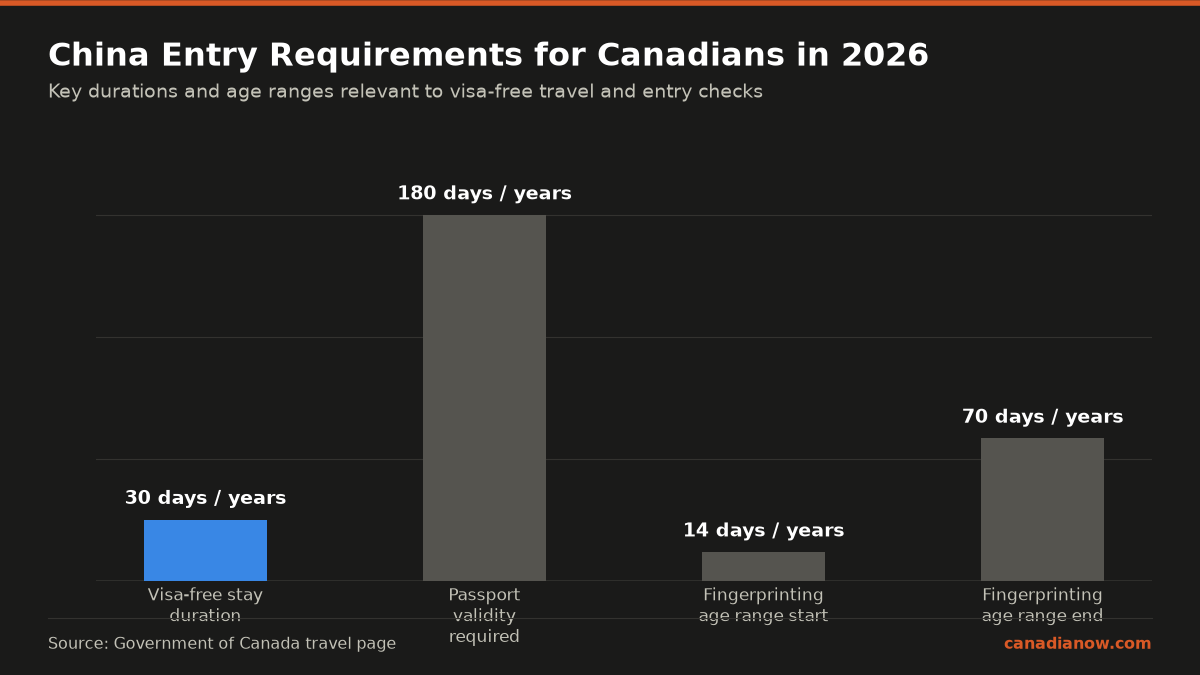
Canada’s official travel page says Canadian passport holders may be eligible for visa-free entry for up to 30 days from February 17 to December 31, 2026, for tourism, business, family visits, or transit. You should still verify your situation with the nearest Chinese embassy or consulate.
Do you still need a visa?
It depends on your purpose:
-
Tourism / business (short stay): may be visa-free for up to 30 days during the 2026 waiver window
-
Study: a student visa is still required
-
Work: a work visa is still required
Entry checks Canadians should expect
Based on the Government of Canada’s China page, travellers should plan for these common requirements:
-
Passport validity: at least 6 months on entry
-
Proof of onward travel: you may be asked to show it
-
Fingerprints: generally taken for Canadians aged 14–70 when entering
-
Device screening: border officials may review content on your electronic devices (especially when crossing between mainland China and Hong Kong)
-
Residence registration: foreigners must register their address with local police within 24 hours (hotels often do this at check-in; private stays usually must self-register)
Higher-risk regions and legal enforcement concerns
Canada highlights increased security and detention risks in Xinjiang, especially for travellers with family or ethnic ties to the region. It also notes special permit rules and restrictions for Tibet (organized tours and permits; entry can be denied).
China can also impose exit bans, including in business disputes, and travellers may only learn about them when trying to leave.
Internal guidance for readers in Canada
If you are living in Canada on a study permit or work permit, don’t only plan China’s entry rules—also confirm you have the correct documents to return to Canada (for example, the right visa/eTA for re-entry and valid status documents). Travel plans can also affect timelines if you are in the middle of an immigration application.
FAQ
Can I stay more than 30 days without a visa?
Not under the visa waiver. If you need longer, you usually need the correct visa type.
Does visa-free entry allow me to work in China?
No. Work requires a work visa.
Do I need to register my address after arrival?
Yes, within 24 hours (hotel or self-registration rules apply).
Can officials check my phone or laptop?
Canada notes that border officials may review digital content on devices, particularly at certain crossings.
Reality check
Visa-free entry can reduce paperwork, but it does not reduce real-world risks like strict enforcement, regional security issues, and possible exit bans. Rules can change fast, and enforcement can be unpredictable. Before booking, re-check the official Canada travel page close to departure and consider registering with the Government of Canada’s travel registration service.
Sources:
- Travel.gc.ca — China travel advisory
- Travel.gc.ca — Registration of Canadians Abroad
- Embassy of China in Canada — official visa-free notice
For official, up-to-date details, see IRCC.
Related Reading
- Offering Multiple-Entry Visa for FIFA World Cup 2026
- 5 New Travel Rules Canadians Must Know Before Entering The U.S. In 2026
- Canadians can travel to China visa-free for up to 30 days (from Feb 17, 2026)
If you'd rather have this mapped out for your exact situation instead of piecing it together yourself, our personalized report covers eligibility, CRS score, and next steps.