If you are planning to work in Canada, one of the first things you need to understand is the difference between an open work permit and an employer-specific (closed) work permit. Choosing the wrong one — or not understanding which one you have — can create serious problems.
What Is an Open Work Permit?
An open work permit allows you to work for any employer in Canada, in any location, in almost any occupation. You are not tied to a specific company or job.
With an open work permit, you can:
- Change jobs without updating your permit
- Work part-time or full-time
- Work for multiple employers at the same time
- Quit and find a new job without losing your legal work status
Who Can Get an Open Work Permit?
Open work permits are not available to everyone — they are issued in specific circumstances, including:
- Spouses or common-law partners of skilled workers or international students in certain programs
- International graduates who have completed a Canadian post-secondary program (Post-Graduation Work Permit / PGWP)
- Refugee claimants and protected persons in certain stages of their claim
- Applicants for permanent residence who are waiting for a decision and qualify under a bridging open work permit (BOWP)
- Working holiday program participants (International Experience Canada / IEC)
What Is an Employer-Specific Work Permit?
An employer-specific work permit — also called a closed work permit — ties you to a specific employer. Your permit lists the company name, the job location, and sometimes the specific position.
With a closed work permit, you cannot:
- Switch employers without getting a new work permit
- Work for a different company even temporarily
- Change your job location if it is specified on the permit
Working outside the conditions of your closed permit is a violation of your permit conditions — even if the work is similar or the employer is related.
How Does an Employer-Specific Permit Work?
Typically, your employer must first obtain a positive Labour Market Impact Assessment (LMIA) from Employment and Social Development Canada (ESDC), which confirms there is no Canadian worker available to fill the role. You then use that LMIA to apply for your work permit.
Some employer-specific work permits are LMIA-exempt — for example, those issued under free trade agreements (CUSMA/USMCA, CETA) or intra-company transfers.
Key Differences at a Glance
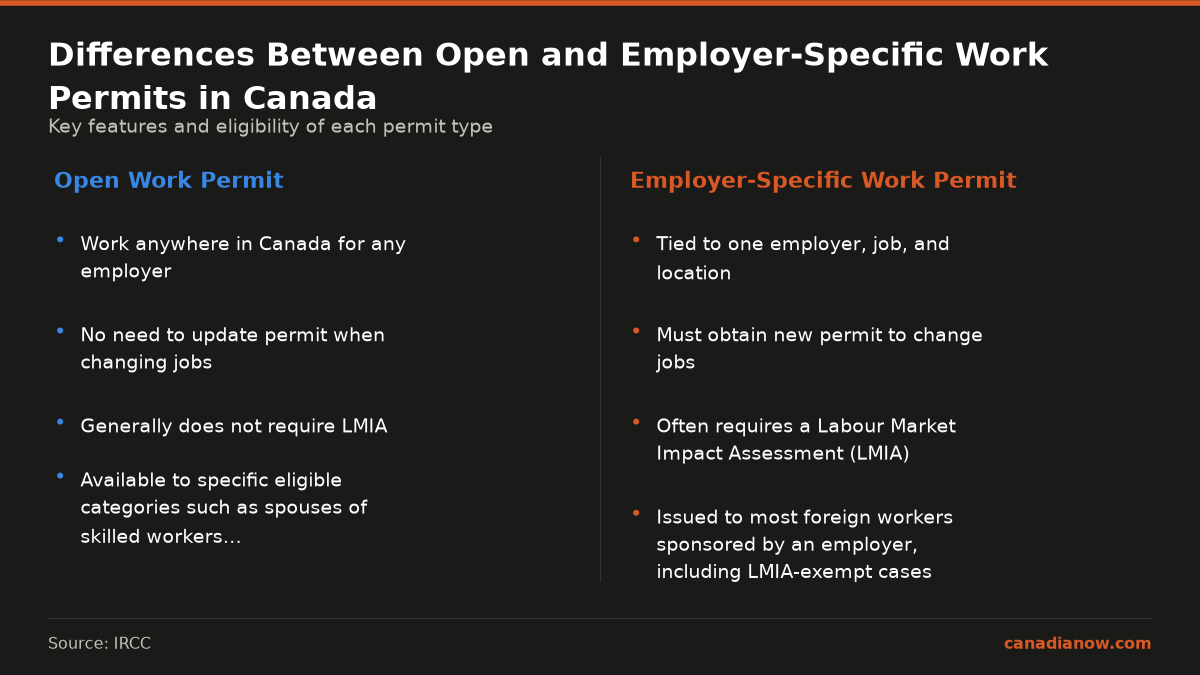
- Flexibility: Open = work anywhere; Closed = one employer only
- Changing jobs: Open = no action needed; Closed = new permit required
- LMIA requirement: Open = generally not required; Closed = often required
- Who gets it: Open = specific eligible categories; Closed = most foreign workers sponsored by an employer
Can You Switch From a Closed to an Open Work Permit?
Sometimes — but only if you become eligible for an open work permit category. For example, if you apply for PR and qualify for a Bridging Open Work Permit while you wait for a decision, you can transition from a closed to an open permit.
Frequently Asked Questions
Q: If I have an open work permit, can I work any job in Canada?
A: Almost any job. There are some restrictions — for example, open work permits typically do not allow work in certain regulated professions (like medicine or law) without the proper provincial licensing, and some open permits restrict work in sexually oriented businesses.
Q: My employer-specific permit shows my old employer. Can I start a new job?
A: Not legally without a new work permit. You must apply for a new employer-specific permit for the new employer before starting work there.
Q: Does my spouse get an open or closed work permit?
A: Spouses of certain skilled workers and students may qualify for an open work permit — but only under specific conditions. It depends on your own permit type and the program you are in.
Bottom Line
An open work permit gives you freedom. An employer-specific permit ties you to one company. Know which one you have, understand its conditions, and never work outside those conditions. If your situation changes — a new job offer, a PR application in progress, a spouse visa — check whether you now qualify for an open permit before making any moves.
You can find the current official information on IRCC.
Related Reading
- How to Apply for a Work Permit in Canada in 2026
- Understanding Canada’s Self-Employed Persons Program
- LMIA Explained for 2026: What It’s Worth, What It Costs, and How to Spot the Scams
Not sure how this affects your own eligibility? Get a personalized report on your CRS score and which Express Entry or PNP category actually fits your situation.