One of the most frustrating experiences for skilled newcomers is arriving in Canada with legitimate qualifications and finding employers or licensing bodies do not recognize them. This is a real and documented problem — but one with specific, actionable solutions.
Two Separate Issues: Immigration vs. Professional Licensing
Credential recognition involves two distinct processes that are frequently confused:
- Immigration ECA: For Express Entry, IRCC requires an Educational Credential Assessment from an approved organization. This affects your CRS score but does not give you the right to practice a regulated profession.
- Professional licensing: To practice a regulated profession in Canada (engineering, medicine, nursing, law, social work, teaching), you must be licensed by the relevant provincial regulatory body — a completely separate process.
ECA for Immigration
Approved ECA organizations include:
- World Education Services (WES) — most widely used
- International Credential Assessment Service (ICAS)
- Comparative Education Service (CES)
- Medical Council of Canada (for international medical graduates)
An ECA tells IRCC what level your credential is equivalent to in Canada, which affects your education points in your CRS score.
Regulated vs. Non-Regulated Professions
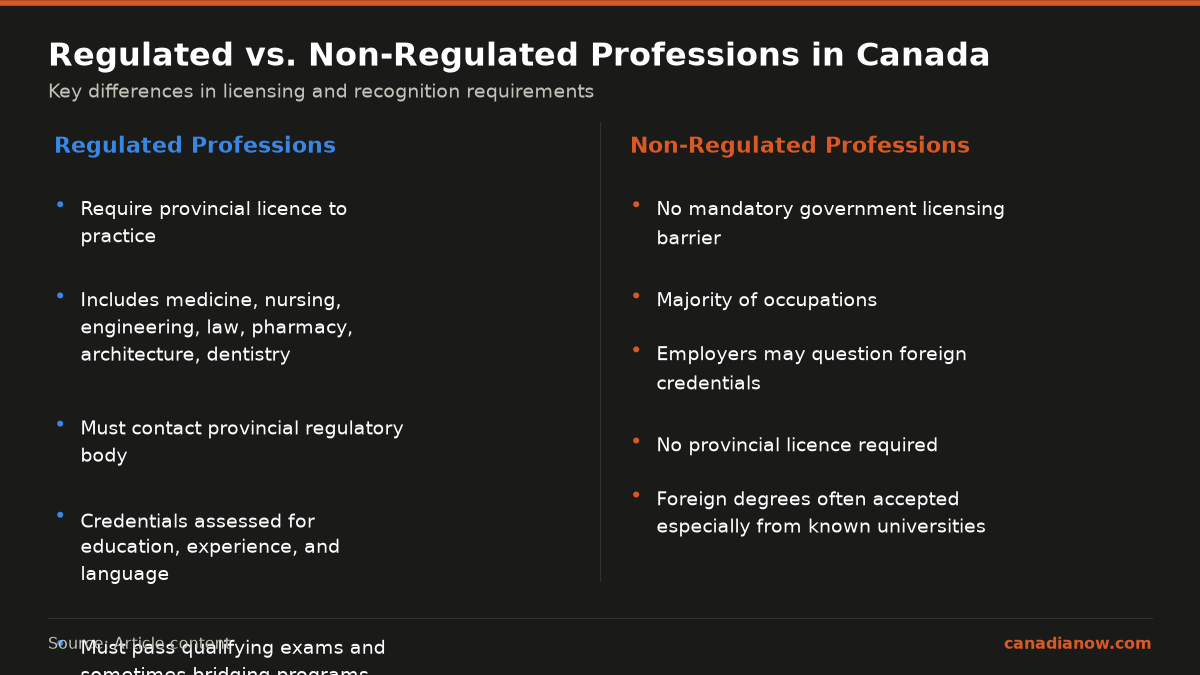
Regulated professions require a provincial licence to practice — medicine, nursing, engineering, dentistry, law, pharmacy, architecture, and others. Each province has its own regulatory body setting its own requirements.
Non-regulated professions — the majority of occupations — have no mandatory licensing barrier. Employers may question foreign credentials, but no government licence is required.
Getting a Regulated Profession Recognized
- Contact the provincial regulatory body for your profession (e.g., College of Nurses of Ontario, Engineers Nova Scotia)
- Have your credentials assessed — the body reviews education, experience, and language proficiency
- Pass qualifying exams — many professions require equivalency exams for foreign-trained candidates
- Complete bridging programs — many provinces offer bridging programs to help internationally trained professionals meet Canadian requirements
- Apply for your licence once requirements are met
Timeline and Costs
Recognition for regulated professions can take months (some nursing or engineering streams) to several years (medicine, where timelines are notoriously long). Research the specific timeline for your profession and province before you arrive — some newcomers begin the process before immigrating.
Frequently Asked Questions
Q: Will Canadian employers accept my foreign degree without an ECA?
A: For non-regulated professions, many employers accept foreign credentials — especially from well-known universities. A WES evaluation provides clarity and can strengthen your candidacy.
Q: Can I work in my profession while waiting for licensing?
A: In most regulated professions, no — you cannot practice without a licence. You may be able to work in a related non-regulated role while pursuing licensing.
Q: Is medicine the hardest field for recognition?
A: Consistently yes. Foreign-trained physicians face very competitive residency matching and long timelines. Many work in other healthcare roles while pursuing the licensing pathway.
Bottom Line
Getting foreign credentials recognized in Canada means navigating two separate systems: the immigration ECA and provincial professional licensing. Start early — ideally before you arrive. Research your specific profession’s requirements in the province where you plan to settle. The pathway exists and many internationally trained professionals navigate it successfully — but it requires time and deliberate planning.
You can find the current official information on Job Bank.
Related Reading
- Navigating Stat Holiday Pay in BC
- Employment Reference Letter for Express Entry: The Format IRCC Actually Requires
- Average Salary in Canada (2026): Province-by-Province Breakdown
Not sure how this affects your own eligibility? Get a personalized report on your CRS score and which Express Entry or PNP category actually fits your situation.