If you are planning to work in Canada, you will encounter two types of work permits: open and employer-specific. The difference between them is significant — and understanding it can change your entire Canadian work strategy.
The Simple Definition
An open work permit allows you to work for any employer in Canada, in any location, in almost any occupation. You are not restricted to a specific company, job title, or city.
An employer-specific (closed) work permit ties you to a named employer. You can only work for the company listed on your permit, in the role and location specified.
Why Open Work Permits Are So Valuable
With an open work permit, you can:
- Switch jobs without applying for a new permit
- Take on contract work or freelance projects from multiple clients
- Explore different industries and roles freely
- Leave a bad employer without losing your legal work status
- Negotiate from a position of strength — you are not trapped with one employer
Who Qualifies for an Open Work Permit in 2026
Open work permits are issued to specific groups — not to any foreign worker who wants one:
- IEC Working Holiday participants: Citizens of 35+ countries aged 18–35 (some up to 30 or 35 depending on the country) who are selected through IEC draws
- Post-Graduation Work Permit (PGWP) holders: International students who graduated from an eligible Canadian program
- Spouses/common-law partners of skilled workers (NOC TEER 0 or 1): Partners of people in high-skilled jobs in Canada
- Spouses of eligible international students: Partners of master’s, doctoral, or designated professional program students
- Bridging Open Work Permit (BOWP) holders: Workers with a PR application in progress whose current permit is expiring
- Refugee claimants: At eligible stages of the claim process
- Live-in caregiver program participants: Under certain conditions
Who Does NOT Qualify
You generally cannot get an open work permit simply because:
- You found a Canadian employer willing to hire you
- You want more flexibility than a closed permit provides
- You are on a visitor visa and want to work
In these cases, your employer needs to go through the LMIA process for an employer-specific permit, or you need to qualify for one of the above categories.
How to Apply for Each Type
IEC Working Holiday
- Check if your country has an IEC agreement with Canada
- Create a profile in the IEC pool during the open intake period (typically starts in January)
- Wait to be invited from the pool
- Once invited, apply for your work permit — you have a limited window to do so
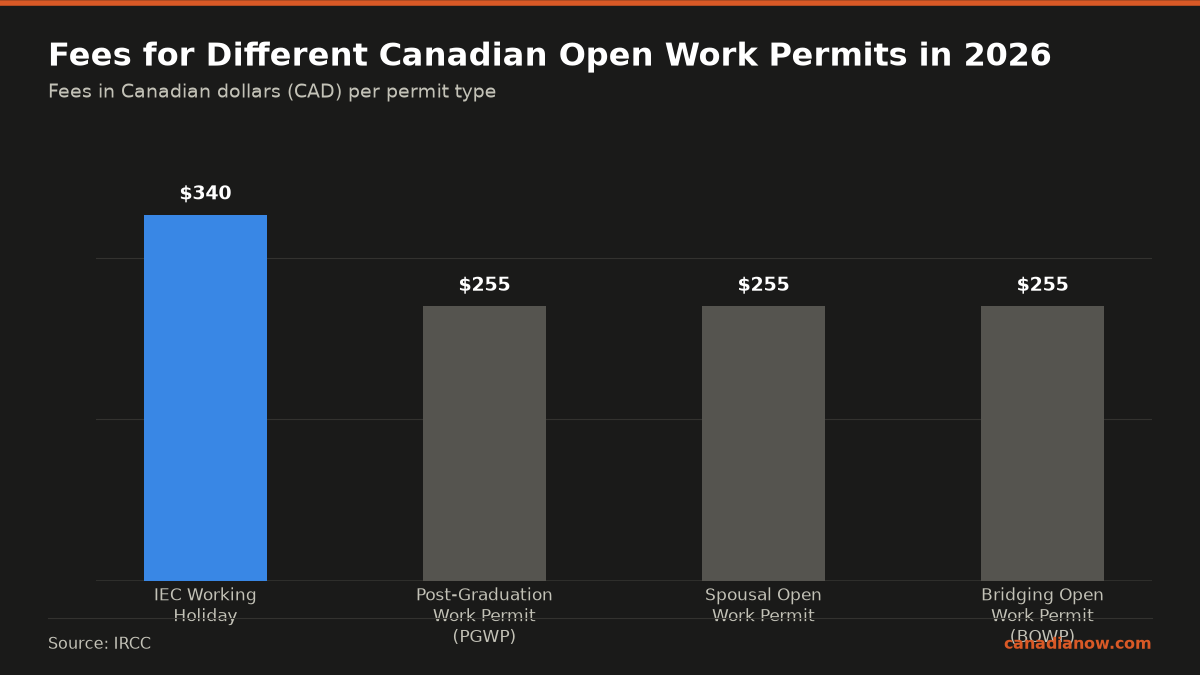
- Pay the $185 CAD IEC participation fee plus the $155 work permit fee
Post-Graduation Work Permit (PGWP)
- Complete your eligible Canadian program at a DLI
- Apply before your study permit expires (or within 90 days of receiving your final marks)
- Apply online through your IRCC account — Form IMM 5710
- Pay the $255 CAD fee
- Your PGWP will be valid for the length of your program (up to 3 years for programs of 2+ years)
Spousal Open Work Permit
- Confirm your partner qualifies as a skilled worker or eligible student
- Apply online through IRCC with Form IMM 1295
- Provide proof of your relationship and your partner’s permit/status
- Pay the $255 CAD fee
Bridging Open Work Permit (BOWP)
- Ensure you have a PR application in progress through Express Entry
- Your current work permit must be expiring within 4 months (or have already expired if you are still on maintained status)
- Apply online — Form IMM 1295
- Pay the $255 CAD fee
Restrictions on Open Work Permits
Even open work permits have some conditions. Most cannot be used to work:
- In businesses that offer striptease, erotic dance, escort services, or erotic massage
- In some cases, in roles requiring a specific professional licence you do not hold
Read the conditions on your specific permit carefully — most are clearly stated on the document itself.
How to Know If Your Permit Is Open or Closed
Look at the “Employer” field on your work permit document:
- If it says “Any employer” or “Any employer — open” — it is an open work permit
- If it names a specific company — it is a closed/employer-specific permit
Frequently Asked Questions
Q: Can my employer turn an open permit into a closed one?
A: No — your employer cannot change your permit type. Only IRCC issues and defines permit conditions.
Q: If I have an open work permit, do I need my employer’s permission to leave?
A: No — legally, you can leave any employer at any time without affecting your permit status. Your right to work is not dependent on staying with any particular employer.
Q: Does an open work permit let me start my own business in Canada?
A: Most open work permits allow self-employment. However, confirm this for your specific permit type — some IEC permits restrict self-employment.
Bottom Line
An open work permit gives you real freedom in the Canadian labour market — freedom to change jobs, negotiate, and explore. Knowing whether you qualify is the first step. If you are a recent Canadian graduate, an IEC participant, or the spouse of a skilled worker, an open permit may be available to you. If not, your path to greater employment flexibility typically runs through PR.
For the authoritative source on this topic, see IRCC.
Related Reading
- Canada Introduces New TFWP Rules for 2026: What Workers and Employers Need to Know
- Can You Study on a Work Permit in Canada?
- Understanding Canada’s Self-Employed Persons Program
If you'd rather have this mapped out for your exact situation instead of piecing it together yourself, our personalized report covers eligibility, CRS score, and next steps.