Updated July 2026. On March 2, 2026, the Prime Minister’s Office announced the Canada-India Talent and Innovation Strategy — a package of scholarships, research partnerships, and university agreements following Prime Minister Mark Carney’s late-February visit to India. Here’s what was actually announced, and what it does and doesn’t mean for prospective students.
What’s Actually on the Table
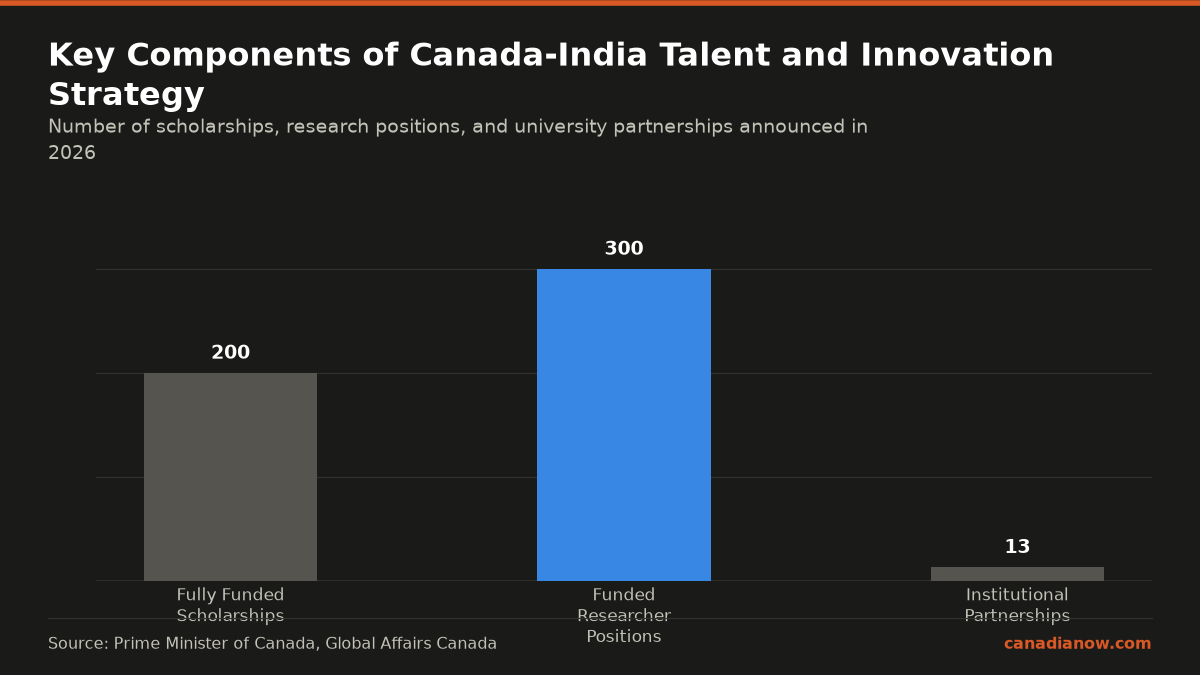
- Up to $100 million in funding from the University of Toronto, supporting up to 200 fully funded scholarships for Indian students
- 300 funded researcher positions for Indian students at Canadian universities
- 13 new institutional partnerships (MOUs) between Canadian and Indian universities
- A Dalhousie-led innovation campus partnership based in Tirupati, plus AI-focused centres of excellence at the University of Toronto and McGill
- A separate cultural cooperation MOU covering performing arts, visual arts, music, and creative industries
Global Affairs Canada confirmed the strategy and the 13 signed partnerships during the Mumbai leg of the visit on February 28, 2026.
The 13 University Partnerships
Per the Global Affairs Canada backgrounder, the signed MOUs include: UBC and Simon Fraser University with O.P. Jindal Global University; University of the Fraser Valley with Panjab University; Algoma University with Parul University and separately with Chandigarh University; Dalhousie University with SRM Institute of Science and Technology and with the Indian Council of Agricultural Research; University of Guelph, Brock University, and Royal Roads University each with O.P. Jindal Global University; Simon Fraser University with the Hydrogen Association of India; and University of Toronto with both the Indian Institute of Science and the Jio Institute.
What This Means If You’re Applying to Study in Canada
These partnerships focus on joint research, exchange programs, and shared programming — not automatic admission or a guaranteed study permit. Each university sets its own admissions criteria, and scholarships don’t bypass IRCC’s normal study permit process. To get a study permit, you still need:
- Acceptance at a Designated Learning Institution (DLI)
- Proof of sufficient financial support
- Evidence you intend to leave Canada when your permit expires
- A letter of acceptance, and in many cases a provincial/territorial attestation letter (PAL/TAL) or Quebec’s CAQ
The Bottom Line
This is a genuine expansion of Canada-India academic ties, and the scholarships and research positions are real funded opportunities worth pursuing if you’re eligible. But the practical bottleneck for most applicants remains the same as always: meeting IRCC’s standard study permit requirements, regardless of which scholarship or partnership program you’re coming through.
Sources: Prime Minister of Canada, news release (March 2, 2026); Global Affairs Canada, news release (February 28, 2026); IRCC, study permit eligibility requirements.