Quick Answer
To apply for a first Canadian work permit from inside Canada, you must qualify under an eligible category — open work permit (spousal, IEC, post-grad), LMIA-based employer-specific permit, or an LMIA-exempt category — and apply online through your IRCC secure account before your current status expires. Submitting before expiry keeps you in maintained status. Most inside-Canada applications take 3–8 months to process in 2026.
First-Time vs. Extension: The Key Difference
This guide covers applying for a work permit when you are already in Canada and do not yet have one, or are switching permit categories. If you have a work permit and want to continue the same type, see the Work Permit Extension guide.
This guide explains general application rules. It is not legal advice. Work permit eligibility is fact-specific. Before applying, consider confirming your category with a licensed RCIC or Canadian immigration lawyer, especially if you have a previous refusal or a complex employment situation.
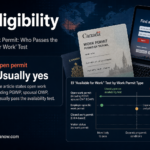
Eligibility: Which Category Fits You?
| Your situation | Permit type | LMIA required? |
|---|---|---|
| Spouse/common-law partner of a skilled worker or international student | Spousal Open Work Permit | No |
| Working Holiday / International Experience Canada (IEC) | IEC Open Work Permit | No |
| Graduated and waiting for PGWP decision | Bridging Open Work Permit (if you applied for PGWP) | No |
| Job offer from a Canadian employer who got an LMIA | LMIA-based employer-specific permit | Yes (employer gets it) |
| Intra-company transfer, CUSMA professional, performer, etc. | LMIA-exempt employer-specific permit | No — employer compliance fee required |
| Temporary public policy target group (e.g. Ukrainians, Iranians) | Specific public policy permit | No |
Step 2: Check If Your Employer Needs an LMIA
For employer-specific permits, your employer must either:
- Obtain a positive LMIA from ESDC (this takes 60–90 days and is the employer’s responsibility), OR
- Be exempt from the LMIA requirement under CUSMA, CETA, an intra-company transfer, or another exemption
You cannot apply for an employer-specific work permit until your employer has the LMIA or confirmation of LMIA exemption.
Applying From Inside vs. Outside Canada
If you are already in Canada on a valid status (visitor, student, etc.), you may be able to apply for a work permit from inside Canada — but not always. The ability to change your status inside Canada depends on your current permit type and the work permit you are applying for. Some people must apply from outside Canada and re-enter.
Documents You Need
All applicants:
- Valid passport (copies of all used pages)
- Current immigration status documents (study permit, visitor record, previous work permit, COPR)
- Digital photo meeting IRCC specifications
- Social Insurance Number
Open work permits (spousal):
- Proof of your relationship (marriage certificate or cohabitation evidence)
- Your spouse’s current immigration document (work permit, study permit, PR card)
- Proof of cohabitation in Canada
LMIA-based permits:
- Positive LMIA number (from employer)
- Original signed job offer letter matching the LMIA
- Educational credentials or trade certification if required by the job
LMIA-exempt (intra-company, CUSMA, etc.):
- Employer compliance fee receipt ($230, paid by employer through IRCC Employer Portal)
- Offer of employment confirmation number from employer portal
- Supporting documents for your exemption category (e.g. proof of Canadian entity relationship for intra-company)
Step-by-Step Application Process
- Identify your exact permit category and confirm you meet the eligibility criteria
- Have your employer complete their part (if LMIA or LMIA-exempt): employer submits job offer through the IRCC Employer Portal and pays the $230 compliance fee
- Log into your IRCC secure account and select “Apply to work in Canada”
- Answer the eligibility questions carefully — the system routes you to the correct form
- Complete the online form (usually IMM 1295 for employer-specific, IMM 5710 for open)
- Upload all documents in PDF format, each under 4 MB
- Pay fees: $155 work permit + $100 open work permit holder fee (if applicable) + $85 biometrics (if required)
- Submit and save your confirmation
Processing Times in 2026
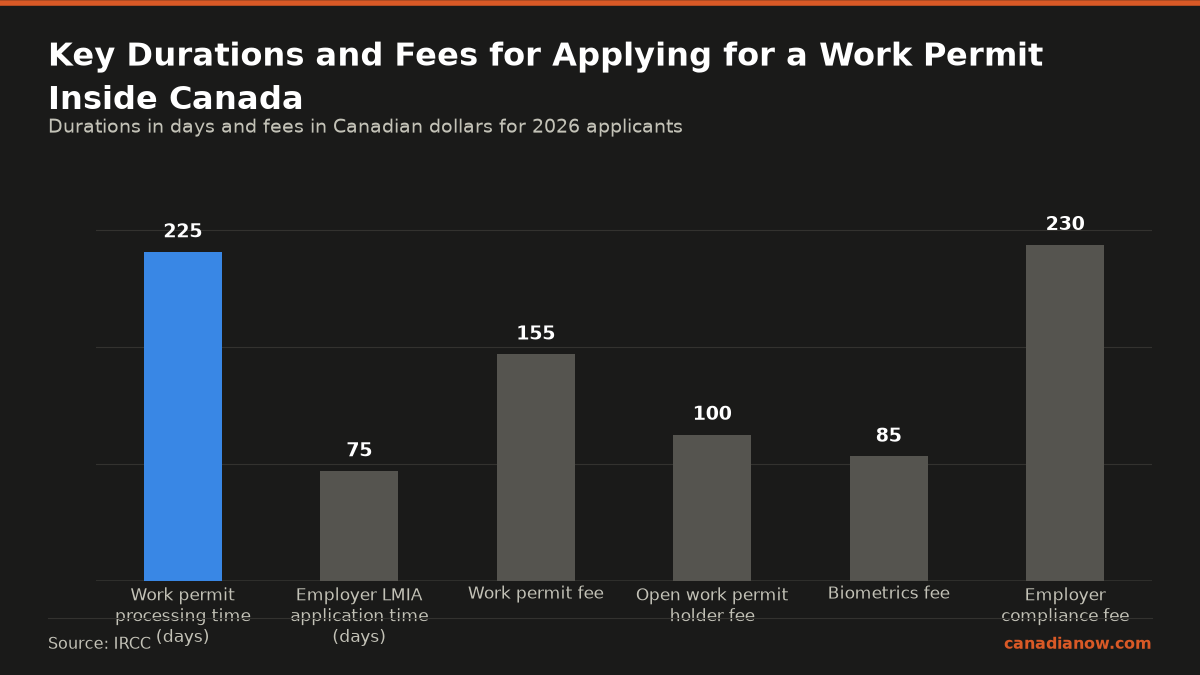
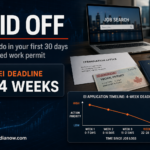
Inside-Canada work permit applications (including first-time and category changes) are currently processing in approximately 200–250 days. Apply as early as possible, ideally while your current status still has 4–6 months remaining.
If you submit before your current status expires, you enter maintained status and can remain in Canada (and in some cases continue working) while the application is processing. If you let your status expire before applying, you lose this protection.
Common Mistakes
- Applying in the wrong category. Choosing the wrong permit type leads to refusal. If unsure, consult a professional before paying fees.
- Employer not ready. For LMIA and LMIA-exempt permits, your employer must complete their IRCC portal steps before you apply. Many applicants submit before this is done and get an incomplete application.
- Wrong form version. Always use the form listed on the current IRCC webpage, not one saved from a previous application.
- Letting status lapse first. Applying after your status expires costs more (restoration fee $229.77) and means you cannot work during processing.
When to Hire an RCIC or Lawyer
- You are unsure which category applies to your job offer or relationship
- You have a prior refusal in any immigration application
- Your employer is unfamiliar with the IRCC employer portal process
- Your immigration status is complex (multiple past permits, gaps, restorations)
FAQ
Can I work while my first work permit application is processing?
Only if you are applying for an extension of the same type of permit under maintained status. For a first-time or category-change application, you generally cannot work until the permit is approved unless your current status specifically authorizes work.
Can I apply for a work permit as a visitor?
Usually no, with some exceptions. Visitors generally must apply from outside Canada unless they qualify under a specific in-Canada restoration or public policy pathway. Get advice if you are in visitor status.
Does my employer have to pay for the work permit?
For LMIA and LMIA-exempt permits, employers pay the $230 compliance fee. The work permit application fee itself ($155+) is typically paid by the applicant, though employers may reimburse it. The LMIA fee (if applicable) is the employer’s cost.
Canadianow is an independent publisher. Not legal advice. Last reviewed: June 2026.
Sources
- IRCC — Apply for a work permit inside Canada
- Immigration and Refugee Protection Regulations — LMIA-exempt categories
- IRCC Employer Portal documentation
Written by Caglar Aybas. Last reviewed: June 2026.
Check IRCC directly for the latest official guidance.
If you'd rather have this mapped out for your exact situation instead of piecing it together yourself, our personalized report covers eligibility, CRS score, and next steps.