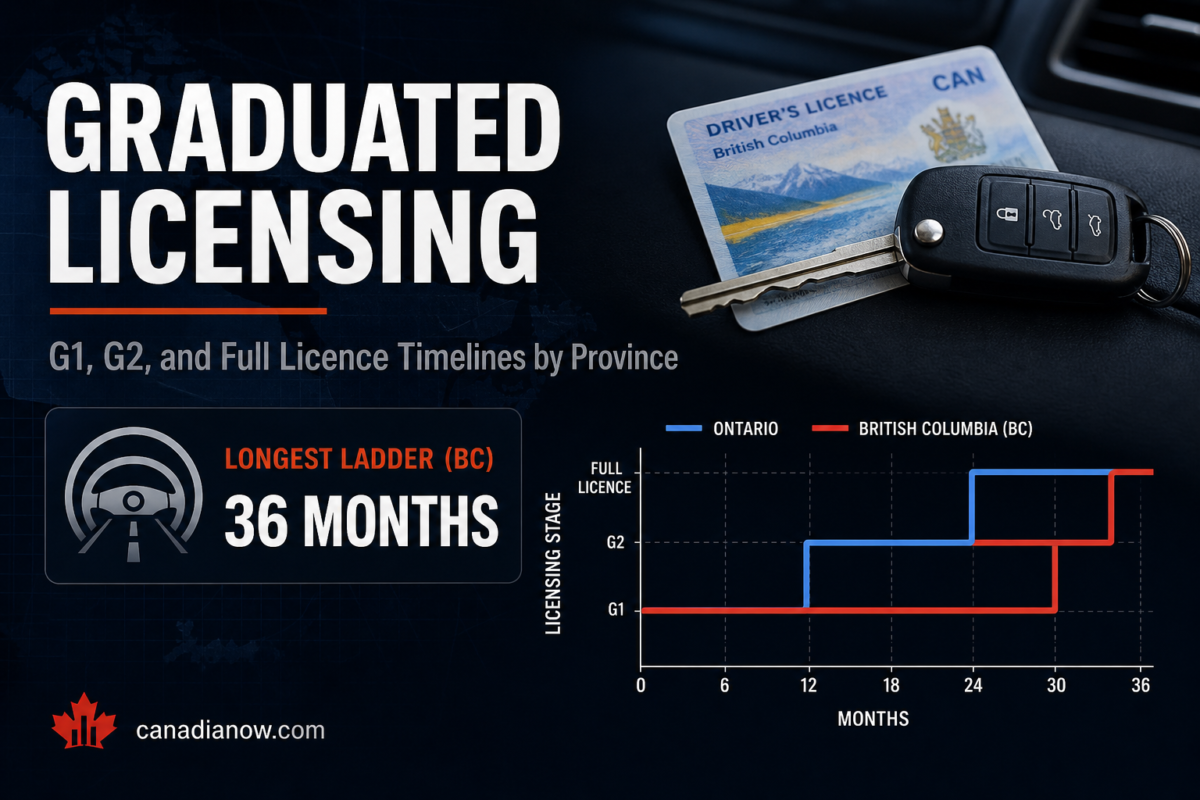
Getting a full driver’s licence in Canada isn’t a one-time test the way it is in a lot of countries — it’s a multi-stage process called graduated licensing, and it can take anywhere from about a year and a half to three years depending on the province and how quickly you move through each stage. Newcomers who assume they’ll be fully licensed within a few months of arriving are usually surprised by how long the ladder actually is, especially if their home country’s licence isn’t eligible for a direct exchange.
Why Canada Uses a Graduated System
Every province and territory phases new drivers in through at least two supervised or restricted stages before granting a full licence, on the logic that driving skill and judgment under real conditions — including winter driving, which trips up even experienced drivers from warmer climates — takes time to build regardless of how confident someone feels after passing a written test. If your home country’s licence qualifies for a direct swap, you can often skip most or all of these stages; see our guide on exchanging a foreign driver’s licence by province to check if yours qualifies before assuming you have to start from zero.
Ontario: G1 → G2 → G
| Stage | Minimum Time Held | What Changes |
|---|---|---|
| G1 | 12 months (8 months with an approved driver’s ed course) | Must drive with a fully licensed supervisor; zero blood alcohol; no highway driving alone |
| G2 | 12 months minimum, up to 5 years to advance | Can drive alone, but passenger and late-night restrictions apply for drivers under 19–20 |
| G (full) | — | No restrictions |
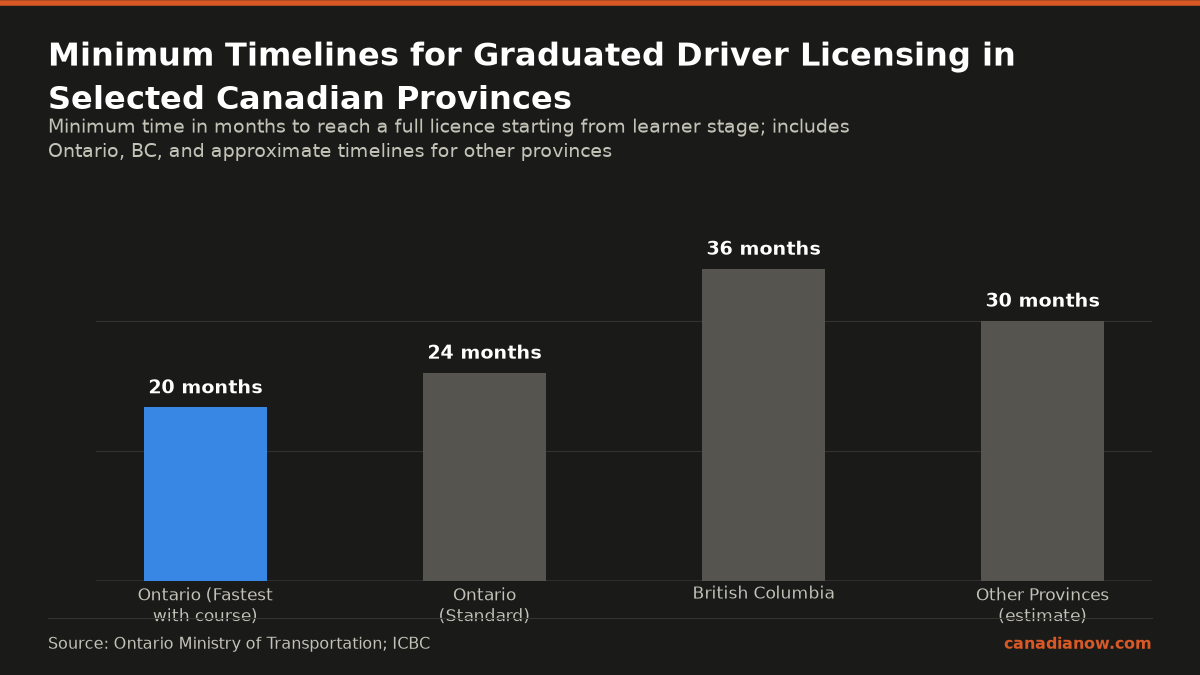
In the fastest realistic path — completing an approved driver’s education course to shorten the G1 stage to 8 months, then testing for G2 as soon as eligible — you can reach a full G licence in about 20 months. Skip the course and you’re looking at closer to 24 months minimum, assuming you pass both road tests on your first attempt. If you’re just starting the process, our Ontario G1 test guide and free G1 practice tests cover the first step in detail.
British Columbia: L → N → Class 5
BC’s system runs longer than Ontario’s. After passing the knowledge test for your Learner (L) licence, you need to hold it for a minimum of 12 months before the first road test moves you to Novice (N). The Novice stage then requires a minimum of 24 months before you’re eligible for your final road test and a full Class 5 licence — a minimum total of 36 months from a standing start, making BC’s ladder the longest of the major provinces.
Other Provinces: The Same Idea, Different Names and Timelines
Alberta, Quebec, and most of the Atlantic provinces run comparable two-stage systems (typically called Learner and Probationary, or similar), generally landing somewhere between Ontario’s and BC’s timelines — usually 24 to 36 months total if starting completely from scratch. The exact wait between stages, minimum age, and restriction details differ enough by province that it’s worth checking your specific provincial transportation ministry site rather than assuming your home province’s rules carry over from wherever you lived before, even within Canada.
What Actually Speeds This Up
Three things shorten the timeline in every province: an approved driver’s education course (which reduces the minimum hold time on your learner stage in Ontario and several other provinces), a completely clean record with no at-fault collisions or convictions during the restricted stages, and — where your home country qualifies — a foreign licence exchange that skips the ladder entirely. None of these are shortcuts around safety testing; they’re simply the legitimate ways the system rewards demonstrated competence instead of forcing everyone through the maximum wait regardless of skill.
The Insurance Angle Nobody Mentions Upfront
Every stage you’re on affects your insurance rate, and a newcomer with no Canadian driving history pays substantially more than a driver with a full licence and a clean multi-year record — often two to three times more in the first year. Getting through the graduated stages as efficiently as possible isn’t just about convenience; it’s one of the fastest legitimate ways to bring your insurance costs down, alongside the strategies covered in our guide to car insurance for newcomers.