Most “best restaurants in Toronto” lists point straight at downtown — Yonge-Dundas, King West, the Distillery District. That’s fine for a first visit, but it skips almost everything that actually feeds the city day to day. Toronto’s most interesting eating isn’t concentrated in one tourist strip; it’s spread across dozens of neighborhoods where waves of immigration have quietly built entire parallel food cultures, many of which newcomers living just a few subway stops away never stumble onto. This guide is a map of where to look, not a list of specific addresses — the goal is to point you toward the right blocks, markets, and food scenes so you can do the fun part yourself: finding your own favourite spot.
Why Toronto’s neighborhoods each have their own food story
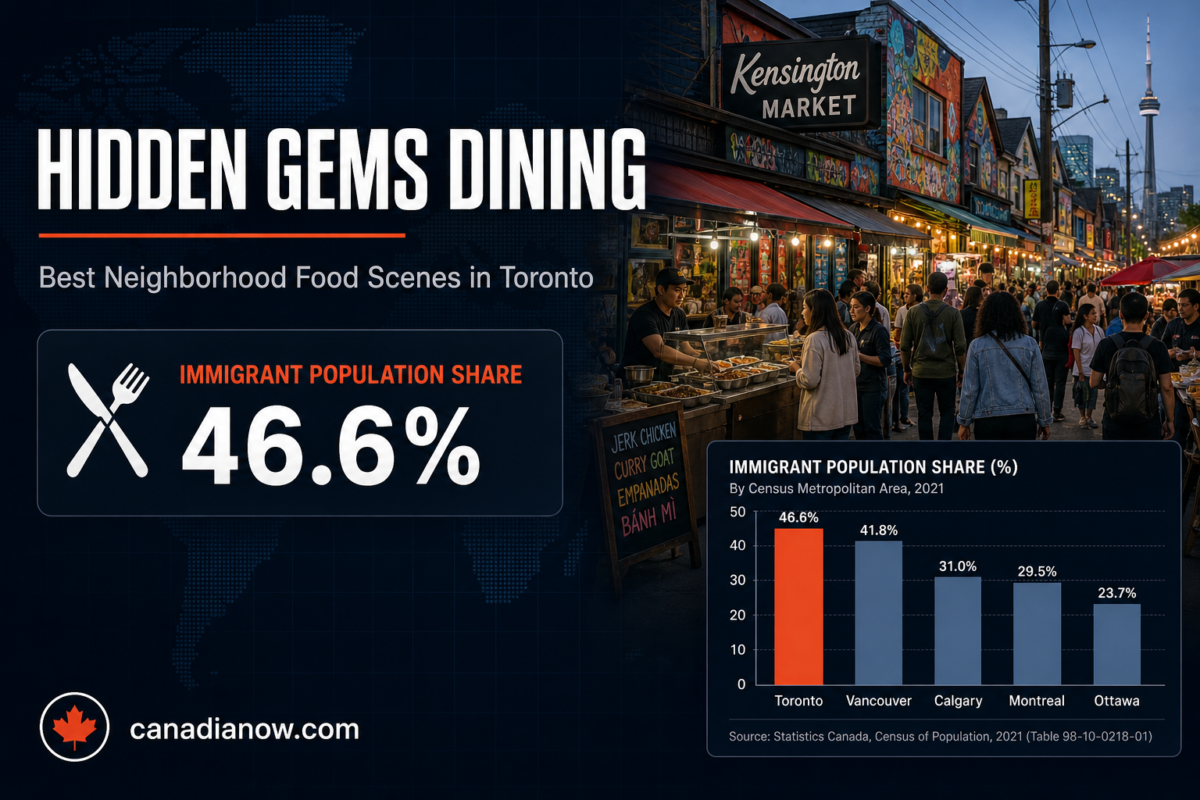
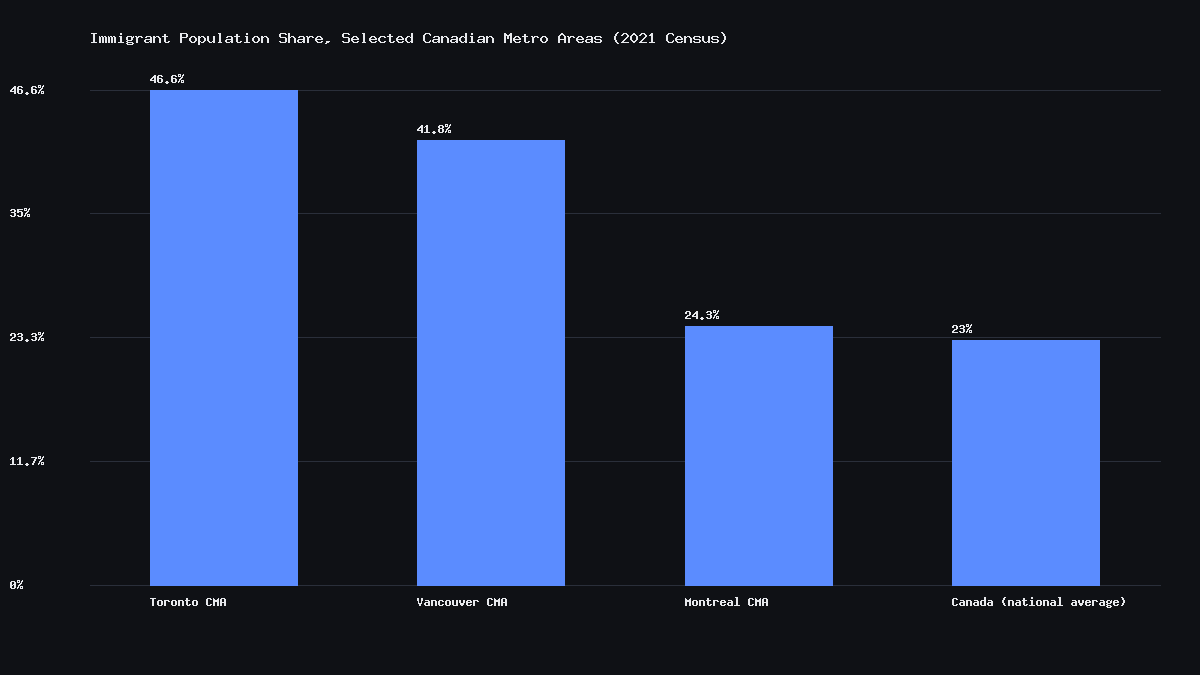
Toronto’s hyper-local food scenes exist because the city’s immigrant population is unusually large relative to other major North American cities. According to Statistics Canada’s 2021 Census, immigrants made up roughly 46.6% of the Toronto census metropolitan area’s population — among the highest shares of any large metro area in Canada, well above the national average. That density of first- and second-generation communities is exactly why a single subway line can take you from Sri Lankan short-eats to Ethiopian injera to northern Chinese hand-pulled noodles in under an hour, often in modest storefronts with no marketing budget and no interest in showing up on a “top 10” list.
A useful rule of thumb: the neighborhoods with the least English signage and the most independent, family-run storefronts are usually where the most authentic and least “adapted for tourists” cooking is happening. That’s a pattern, not a promise — quality still varies block to block — but it’s a better starting filter than restaurant-ranking apps built around ratings volume.
Kensington Market: the original patchwork
Kensington Market, just west of downtown, is the closest thing Toronto has to a single neighborhood summarizing its entire immigration history. Over the past century it’s been shaped in turn by Jewish, Portuguese, Caribbean, Latin American, Vietnamese, and East Asian communities, and remnants of every wave are still operating side by side rather than one replacing the next. In a single short walk you can typically find Jamaican patty shops, Latin American empanada counters, Vietnamese bánh mì spots, vegan and vegetarian cafés, and small grocers selling spices and produce you won’t find in a mainstream supermarket. It’s dense, walkable, and one of the few places in the city where “just wander and follow your nose” genuinely works as a strategy.
Scarborough: Toronto’s most underrated dining borough
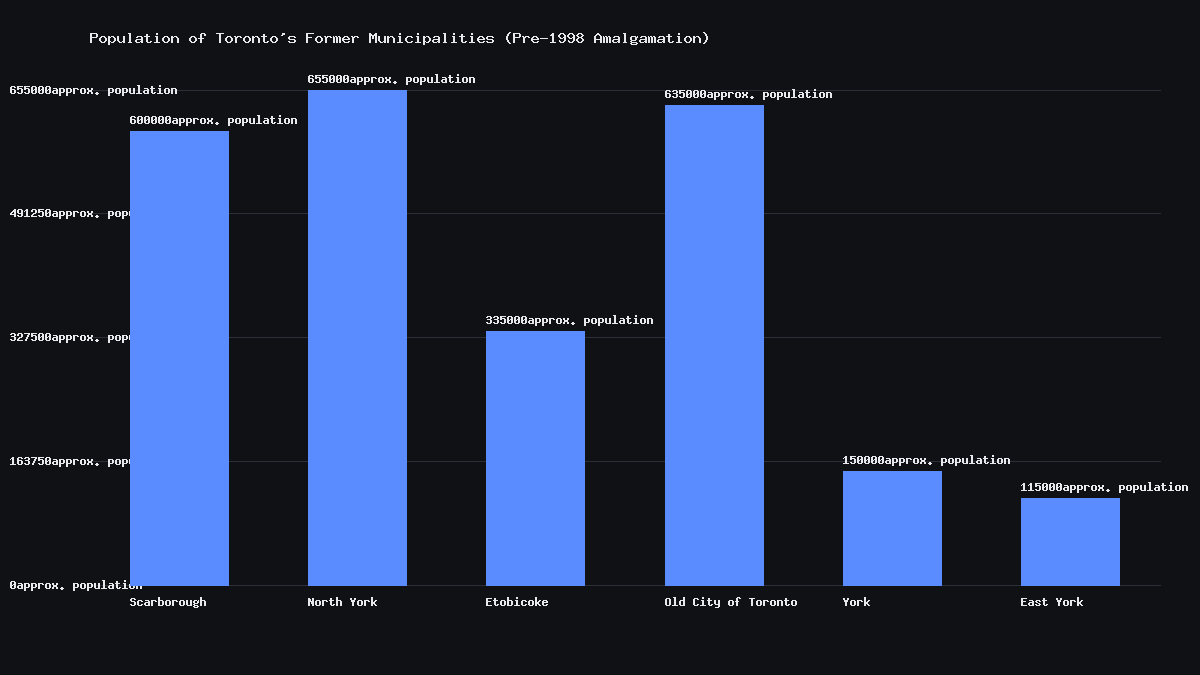
Scarborough gets treated as a footnote in most tourist-facing guides, which is a mistake — it’s arguably the most ethnically diverse dining destination in the entire Greater Toronto Area. Before amalgamation in 1998 folded six municipalities into the current City of Toronto, Scarborough was itself a mid-sized city with a population in the hundreds of thousands, and that scale is part of why it now supports so many distinct, fully-developed food cultures rather than a handful of token restaurants.
Neighborhoods within Scarborough are worth exploring individually rather than treated as one block: areas around Agincourt and Milliken have a strong Cantonese and Hong Kong-style food scene (dim sum, congee, roast meats), Tamil and Sri Lankan cooking is concentrated in pockets along Markham Road and Eglinton Avenue East, and there are strong Filipino and Caribbean food scenes woven through the same stretches. Large Asian shopping centres in the area — Pacific Mall being the best-known — are worth a visit for their food courts alone, which tend to serve street-food-style dishes rarely found on menus in standalone restaurants.
East York and Thorncliffe Park: dense, walkable, and underexplored
East York, one of the smaller former municipalities absorbed into Toronto, and the adjacent Thorncliffe Park neighborhood have some of the highest population density in the city, largely made up of South Asian and Middle Eastern communities. Thorncliffe Park in particular has a strong reputation among locals for halal dining and South Asian sweets and snacks, much of it in strip-mall storefronts that don’t attract food-media attention but have loyal, longstanding customer bases. Just south of East York, the Danforth strip (Greektown) still has a genuinely strong Greek food scene, though it’s mixed today with newer Ethiopian, Ukrainian, and East Asian spots as the neighborhood has diversified over time.
Gerrard India Bazaar: North America’s oldest “Little India”
Gerrard Street East, between Coxwell and Greenwood, is home to one of North America’s longest-established South Asian commercial strips, often referred to locally as Gerrard India Bazaar or Little India. It’s a good destination specifically for South Asian sweets shops, sari and jewelry stores alongside food vendors, and casual restaurants serving regional South Asian cuisine that’s harder to find represented downtown. Like Kensington Market, it rewards slow walking over pre-planned destinations.
Corso Italia and St. Clair West: old-school Italian Toronto
West of downtown along St. Clair Avenue West, Corso Italia remains one of the city’s most intact Italian immigrant neighborhoods, dating back to postwar Italian immigration in the 1950s and 60s. Espresso bars, bakeries, and delis in this stretch tend to be generational family businesses rather than newer openings, and the neighborhood still hosts an annual Ferragosto street festival celebrating that heritage. It’s a useful contrast to the more polished, higher-priced “Italian” dining found in more central, tourist-facing parts of the city.
Chinatown East: the quieter alternative to downtown Chinatown
Downtown Chinatown around Spadina and Dundas gets most of the visitor traffic, but the smaller Chinatown East strip along Gerrard Street and Broadview Avenue, closer to Riverdale, tends to be quieter, more residential, and worth checking for regional Chinese cooking styles that differ from what’s concentrated downtown. It’s a good example of the broader pattern in Toronto: the “second” version of a given ethnic enclave is often less commercialized and closer to what the community itself actually eats day to day.
How to actually find the good spots yourself
Since this guide is intentionally steering clear of naming specific restaurants — storefronts open, close, and change hands constantly, and what’s excellent this year may not be next year — here’s how to do your own research once you’re in one of these neighborhoods:
- Read reviews in the original language. On Google Maps, a restaurant with many reviews written in Tamil, Cantonese, Amharic, or Gujarati rather than English is usually being reviewed by the community it actually serves, not by tourists.
- Check community-specific subreddits and forums. r/toronto and neighborhood-specific Facebook groups regularly have detailed, opinionated threads about where locals actually eat, updated more often than most published “best of” lists.
- Go near places of worship and community centres. Restaurants and bakeries near active temples, mosques, gurdwaras, and churches serving a specific community are a strong signal of an established, food-literate customer base nearby.
- Visit during a weekday lunch rush, not a Saturday dinner. Weekday lunch crowds in a given neighborhood are usually people who live or work there, which tells you more about a spot’s everyday quality than a weekend evening crowd that may include out-of-neighborhood visitors.
- Ask coworkers and classmates from that background directly. If you know someone from the community whose cuisine you’re trying to explore, their recommendation will consistently beat any app or list.
A few practical notes for newcomers
Most of the neighborhoods above are accessible by TTC subway or bus without a car, though Scarborough in particular is large enough that a specific destination is worth mapping out in advance rather than assuming everything is walkable from one station. If you keep halal, kosher, vegetarian, or other dietary requirements, note that many of these neighborhoods — especially Thorncliffe Park, Gerrard India Bazaar, and pockets of Scarborough — have a high density of halal and vegetarian options specifically because they serve communities with those requirements as a matter of course, not as a special accommodation. Prices in these neighborhood food scenes also tend to run noticeably lower than equivalent dishes served downtown, since rents and overhead are typically lower outside the core.
The bigger picture
Toronto’s best dining, in the sense of most distinctive and most reflective of the city’s actual population, rarely shows up on generic “top restaurants” lists built around a single downtown-centric idea of what a destination restaurant looks like. It’s spread across Scarborough, East York, Kensington Market, Gerrard Street, Corso Italia, and dozens of neighborhoods like them, each shaped by a specific community that settled there and kept cooking the way it always had. The most reliable way to find it isn’t a list — it’s picking one of these neighborhoods, going on a weekday, and following the crowd that actually lives there.