Quick Answer
There is no single “Government of Canada scholarship” that international students or newcomers can apply to directly — funding is spread across federal research agencies, an independent foundation, one non-profit council, and individual universities. Two programs you may have heard of, the Vanier Canada Graduate Scholarships and the Banting Postdoctoral Fellowships, were retired in 2025 and replaced by new Tri-Agency awards with different names and amounts. Below is what’s actually open in 2026, what’s fully funded, what’s closed, and where to verify current deadlines before you plan around any of it.
What Changed: The 2025 Tri-Agency Overhaul
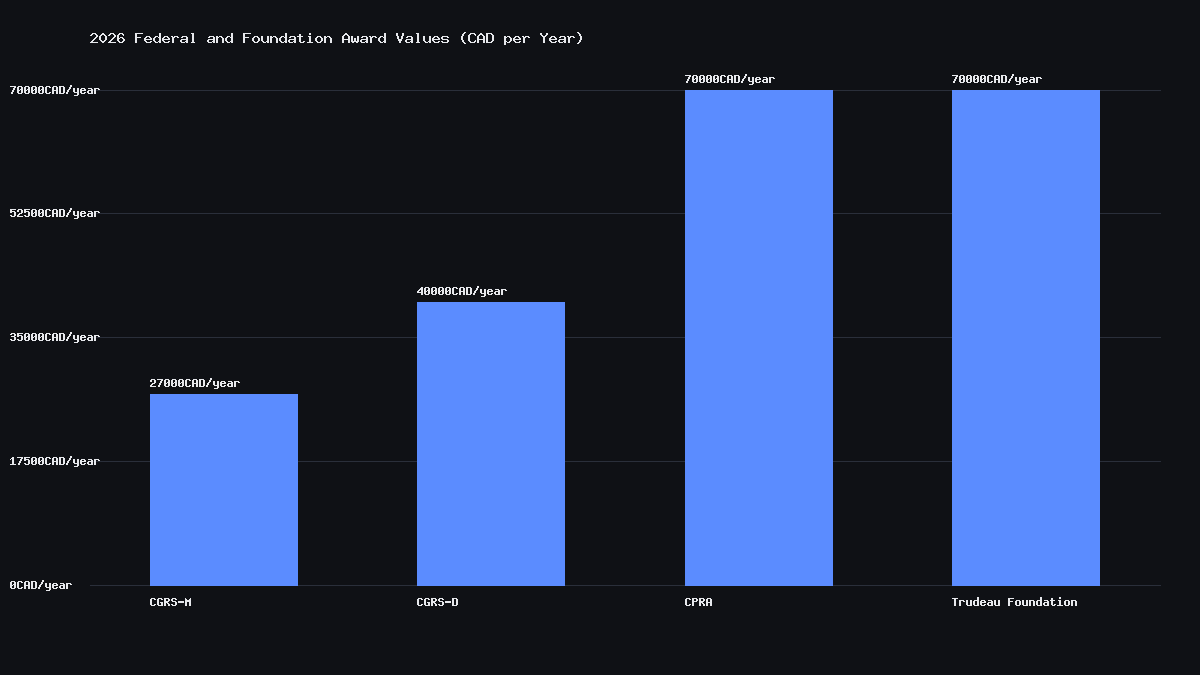
In 2025, Canada’s three federal research funders — NSERC, SSHRC, and CIHR — merged their overlapping scholarship and fellowship programs into a single harmonized system. If you were told to look for “Vanier” or “Banting,” search for their replacements instead:
| Old Program (Retired) | New Program (2026) | Funding | Who Can Apply |
|---|---|---|---|
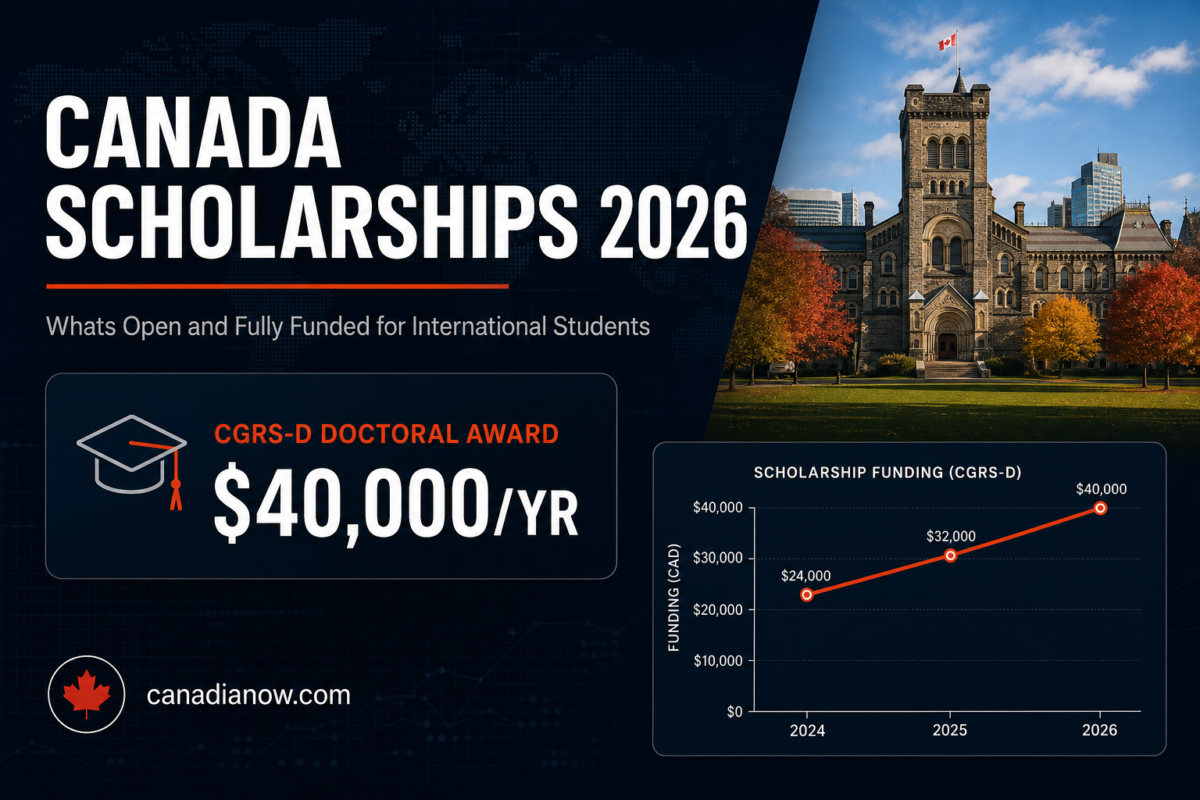
| Vanier CGS (doctoral) | Canada Graduate Research Scholarship – Doctoral (CGRS-D) | $40,000/year for up to 3 years | Canadian citizens, permanent residents, and international students (international spots are capped at roughly 15% of awards) |
| Canada Graduate Scholarships – Master’s | Canada Graduate Research Scholarship – Master’s (CGRS-M) | $27,000, one-time, 12 months | Canadian citizens, permanent residents, and protected persons only — not open to international students |
| Banting Postdoctoral Fellowships | Canada Postdoctoral Research Award (CPRA) | $70,000/year for up to 24 months | Open worldwide; roughly 20% of awards reserved for candidates coming to a Canadian institution from abroad |
The final Vanier competition released results in April 2025, and the final Banting competition released results in February 2025 — both names now redirect to their CGRS/CPRA replacements on the Government of Canada research funding sites. Deadlines for the new awards typically fall between September 10 and October 17 depending on which agency (NSERC, SSHRC, or CIHR) you apply through — check the official program page for the current year’s exact date before you build a timeline around it.
Federal and Foundation Programs Open in 2026
Pierre Elliott Trudeau Foundation Scholarship
This is an independent, government-chartered foundation (not a federal department), and despite a governance controversy in 2023, it is operating normally: the 2026 cohort of scholars was announced in late April 2026, and the next competition cycle opens in September 2026 with an application deadline in mid-November 2026. It funds doctoral research in the humanities and social sciences: a $50,000/year stipend plus a $20,000/year research and travel allowance (up to $70,000/year, roughly $210,000 total across three years). It is open to both Canadian and international doctoral students studying at a Canadian university. Check trudeaufoundation.ca for the exact 2026-27 deadline before you start an application.
International Council for Canadian Studies (ICCS) Graduate Student Scholarships
The ICCS is an independent non-profit (not a government body), but it’s still active and running its 2026 awards cycle, including a graduate student scholarship for students conducting research related to Canada. It’s a smaller award than the federal programs above, but it’s genuinely open and often overlooked. Check iccs-ciec.ca for the current call for applications and deadline.
Ontario Graduate Scholarship (OGS)
Funded jointly by the Ontario government and participating universities, OGS is open to international graduate students, but through a fixed number of spots allocated to each Ontario university rather than one central application. Typical value is around $5,000 per academic session. Because each university’s graduate office runs its own OGS competition and deadline, apply through your specific school’s graduate awards office — there is no single ontario.ca application page.
University-Based International Student Scholarships
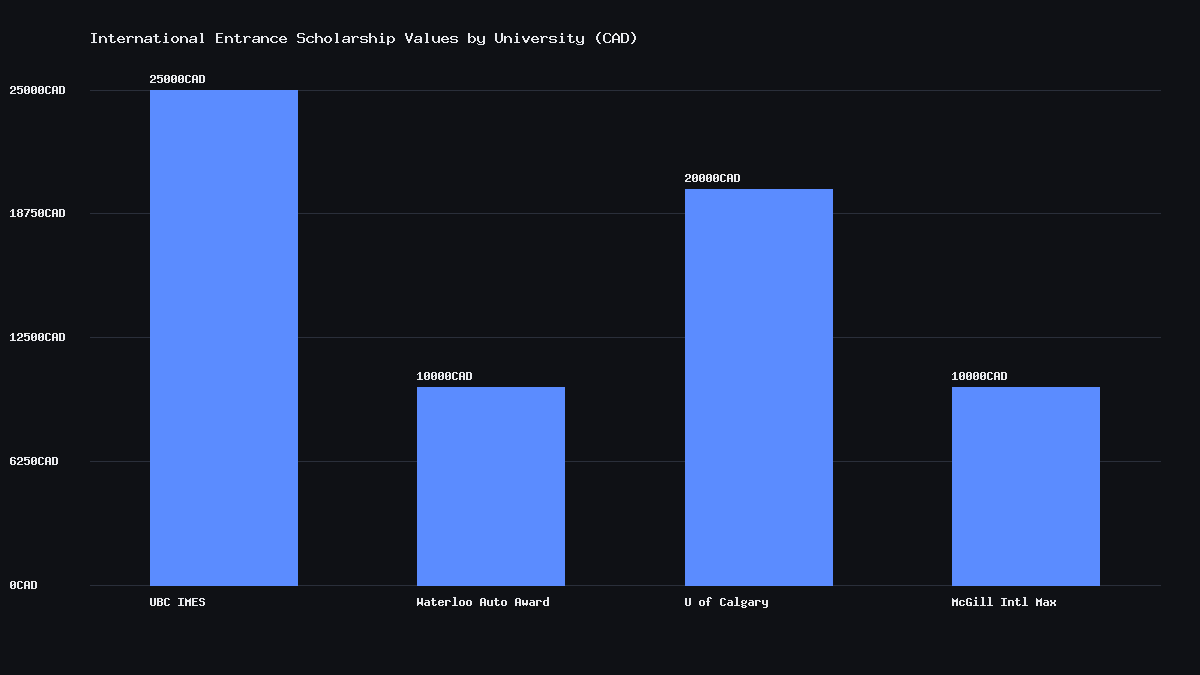
Most of what’s actually “fully funded” for international students in Canada comes from individual universities, not Ottawa. These are genuinely open for future intakes, but always confirm the live deadline on the university’s own page — several major entrance deadlines for a given fall intake fall as early as the preceding December.
| University | Program | Typical Value | Notes |
|---|---|---|---|
| University of Toronto | Lester B. Pearson International Scholarship | Full tuition, books, and residence for 4 years | Around 37 scholars selected per year; school nominates you, you don’t apply directly. Check future.utoronto.ca for the current nomination window. |
| University of British Columbia | International Major Entrance Scholarship (IMES) | $10,000–$25,000/year, renewable up to 4 years | Automatic consideration with your admission application — no separate form. |
| McGill University | Entrance scholarships for international students | $3,000–$10,000 tiers | The top $12,000+ “Major” tier is reserved for Canadian citizens and permanent residents. |
| University of Waterloo | International Student Entrance Scholarship + faculty awards | $10,000 automatic; some faculty-specific awards up to $80,000 | The larger faculty awards usually require a separate application on top of admission. |
| University of Alberta / University of Calgary | President’s/International Entrance Scholarships | Up to $120,000 over 4 years (U of A); $20,000 renewable (U of C, limited to 2 awards/year) | Deadlines are early and competitive — often the January before the following fall intake. Confirm the current cycle’s date directly on the university site. |
Recent Announcement: Canada-India Talent and Innovation Strategy
In March 2026, following a federal visit to India, the Government of Canada and the University of Toronto announced a package that includes up to $100 million in funding supporting up to 200 fully funded scholarships for Indian students, plus 300 funded researcher positions across partner universities. This is real, confirmed funding — but it flows through specific university admissions processes and doesn’t bypass the normal study permit requirements. We covered the full breakdown, including the 13 university partnerships involved, in our dedicated article on the Canada-India scholarship announcement.
Funding for Refugees, Not “Newcomers” Broadly
It’s a common misconception that Immigration, Refugees and Citizenship Canada (IRCC) hands out education scholarships to newcomers directly — it doesn’t. IRCC’s settlement funding goes to service organizations, not individual students. The closest thing to a personal, government-adjacent education fund for a newcomer is the World University Service of Canada (WUSC) Student Refugee Program, a non-profit (not a federal program) that resettles refugee students as permanent residents while covering tuition and living costs for their first year of study. It runs active intake cycles for both current and upcoming academic years — check srp.wusc.ca for open country-specific streams.
Short-Term Exchange Funding: Study in Canada Scholarships (SICS)
Global Affairs Canada’s Study in Canada Scholarships program funds short-term exchanges (not full degrees) worth roughly $10,200–$14,000, but only for students from a specific list of eligible countries (including Bangladesh, Nepal, Türkiye, Ukraine, and a number of African nations) and only through your home or host institution — you can’t apply as an individual. The most recent cycle’s deadline already passed as of mid-2026; if this applies to you, watch educanada.ca for when the next call opens. Don’t confuse this with the separate ELAP program (Latin America and the Caribbean) or SEED program (Indo-Pacific), which have different eligible countries and timelines.
Common Mistakes to Avoid
- Applying for “Vanier” or “Banting” by name — both were folded into CGRS-D and CPRA in 2025
- Assuming CGRS-Master’s is open to international students — it currently isn’t; only the doctoral-level CGRS-D reserves international spots
- Treating a university partnership announcement (like the Canada-India strategy) as a guaranteed scholarship or fast-tracked study permit — admission and IRCC requirements still apply in full
- Applying directly to Global Affairs Canada for SICS, ELAP, or SEED funding instead of going through your institution
- Skipping the study permit financial-support requirement because you expect to win a scholarship you haven’t been awarded yet
- Missing early entrance-scholarship deadlines — several major university awards close months before the general admission deadline
FAQ
Is there one central website to apply for all Government of Canada scholarships?
No. Federal research awards are applied for through your university’s graduate studies office, which submits to NSERC, SSHRC, or CIHR depending on your field. Foundation and non-profit awards (Trudeau Foundation, ICCS) have their own separate application portals. University entrance scholarships are handled entirely by each school.
Are Vanier and Banting scholarships still being awarded?
Not under those names. Both were retired after their 2024-25 competitions and replaced by the Canada Graduate Research Scholarship – Doctoral (CGRS-D) and the Canada Postdoctoral Research Award (CPRA), which fund similar work at revised amounts.
Can international students get the Canada Graduate Scholarship – Master’s?
No — as of 2026, CGRS-Master’s funding is restricted to Canadian citizens, permanent residents, and protected persons. International students at the master’s level should look to university-specific entrance scholarships instead.
Does winning a scholarship guarantee my study permit will be approved?
No. A scholarship can help you meet the financial-support requirement for a study permit, but you still need a letter of acceptance from a Designated Learning Institution, proof you’ll leave Canada when authorized status ends, and — for most institutions — a valid Provincial Attestation Letter.
Canadianow is an independent publisher, not a government agency or law firm. Verify current deadlines and amounts directly on each program’s official page before applying. Last reviewed: July 2026.
Sources
- NSERC — Canada Graduate Research Scholarship – Doctoral (CGRS-D) and Master’s (CGRS-M) program pages
- NSERC — Canada Postdoctoral Research Award (CPRA) program page
- Tri-Agency — Launch of the new harmonized scholarship and fellowship programs (2025)
- Pierre Elliott Trudeau Foundation — trudeaufoundation.ca
- International Council for Canadian Studies — iccs-ciec.ca
- University of Toronto, UBC, McGill, University of Waterloo, University of Alberta, University of Calgary — official scholarship and financial aid pages
- World University Service of Canada — Student Refugee Program, srp.wusc.ca
- Global Affairs Canada — Study in Canada Scholarships, educanada.ca
- Prime Minister of Canada and Global Affairs Canada — Canada-India Talent and Innovation Strategy news releases (February–March 2026)
Written by Caglar Aybas. Last reviewed: July 2026.
You can find the current official information on Canada.ca.
If you’d rather have this mapped out for your exact situation instead of piecing it together yourself, our personalized report covers eligibility, CRS score, and next steps.