Quick Answer
Both Credit Karma Canada and Borrowell offer free credit monitoring using soft credit pulls, so checking your score with either does not lower it. Credit Karma pulls from Equifax and updates weekly; Borrowell pulls from Equifax as well but focuses more on personalized product recommendations and a slightly cleaner newcomer-friendly interface. Neither shows your TransUnion file, which matters because some lenders (especially several major banks) pull TransUnion instead. For newcomers building a thin file, the practical move is to use one of these apps for free ongoing tracking, and pull your TransUnion report directly and separately every few months to catch the full picture.
Why This Matters More for Newcomers Than It Sounds
If you’re new to Canada, you already start with no credit file at either bureau. Once you open a secured card or a newcomer credit product, your file starts building — but it builds at both bureaus, not just one. Most people only ever look at Equifax because that’s what the two biggest free apps show them. That creates a blind spot exactly when it matters most: your first 12–18 months, when small reporting errors or a missed data point can quietly hold your file back without you seeing it.
Credit Karma Canada: What You Actually Get
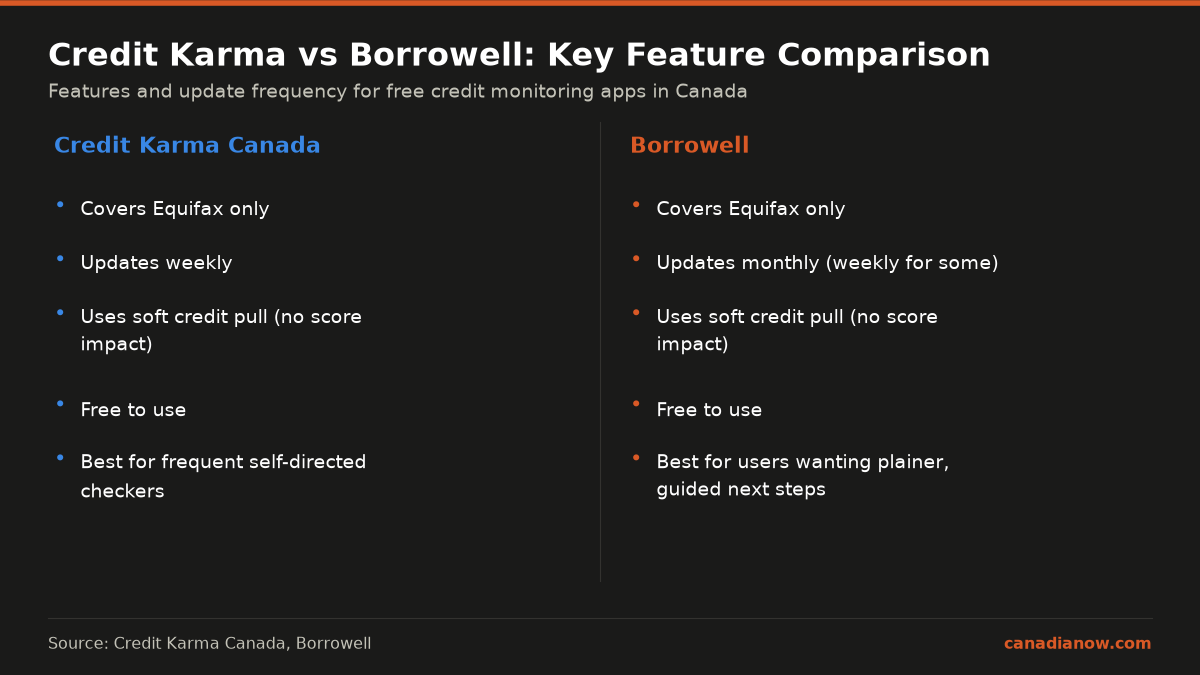
- Free Equifax score and full report summary, updated weekly
- Score change alerts and factor breakdown (utilization, payment history, age of file, inquiries)
- Marketplace of credit card and loan offers matched to your score range
- No TransUnion data
Credit Karma’s factor breakdown is genuinely useful for newcomers because it shows which single lever will move your score fastest — for most thin-file newcomers, that’s utilization, not payment history (since there isn’t much payment history yet to score).
Borrowell: What You Actually Get
- Free Equifax score and report, updated monthly (weekly for some users)
- “Credit Coach” recommendations that are more prescriptive than Credit Karma’s
- Product marketplace, similar to Credit Karma’s
- No TransUnion data
Borrowell’s advantage for newcomers specifically is its recommendation copy tends to explain why a product is suggested in plainer language, which is a small but real advantage if Canadian credit terminology is new to you.
| Feature | Credit Karma Canada | Borrowell |
|---|---|---|
| Bureau covered | Equifax only | Equifax only |
| Update frequency | Weekly | Monthly (weekly for some accounts) |
| Score impact | None — soft pull | None — soft pull |
| Best for | Frequent self-directed checkers | Users who want plainer, guided next steps |
| Cost | Free | Free |
The Gap Neither App Fills: Your TransUnion File
Some major Canadian lenders pull TransUnion instead of Equifax, or both. If you’ve only ever checked Credit Karma or Borrowell, you may be looking at a good Equifax score while your TransUnion file has a reporting gap or error you don’t know about — a returned application can be the first time you find out. TransUnion Canada lets you request your full credit report directly for free by mail, and a paid subscription for ongoing online monitoring. For a newcomer building a file from zero, pulling your free TransUnion report once every 3–4 months during year one is worth the extra step.
Which One Should You Actually Use?
- Use Credit Karma if: you want to check frequently and don’t mind a busier, offer-heavy interface.
- Use Borrowell if: you want fewer, clearer recommendations and a calmer layout.
- Use both, free, side by side — there’s no cost or score risk to running both simultaneously, and cross-checking two Equifax pulls occasionally catches a data entry error faster than relying on one.
- Either way, pull TransUnion separately — neither app substitutes for seeing your full two-bureau picture.
FAQ
Does checking my score on Credit Karma or Borrowell lower it?
No. Both use soft inquiries, which are visible only to you and never affect your score.
Why do my Credit Karma and Borrowell scores sometimes differ?
They use different scoring models built on the same Equifax data, so small differences are normal even on the same day.
Do lenders see the score shown in these apps?
No. Lenders pull their own score directly from the bureau at the time of application, which may differ slightly from the app’s estimate.
Is there a Canadian app that shows both bureaus for free?
Not currently combined into one free app. Getting the full picture as a newcomer means using a free Equifax app (Credit Karma or Borrowell) and requesting your TransUnion report separately.
Sources
- Equifax Canada — How credit scores work
- TransUnion Canada — Credit score basics
- Financial Consumer Agency of Canada — Credit reports and scores
- Credit Karma Canada and Borrowell — public product documentation
Written by Caglar Aybas. Reviewed for accuracy and currency. Last reviewed: July 2026.
If you’d rather have this mapped out for your exact situation instead of piecing it together yourself, our personalized report covers eligibility, CRS score, and next steps.