Quick Answer
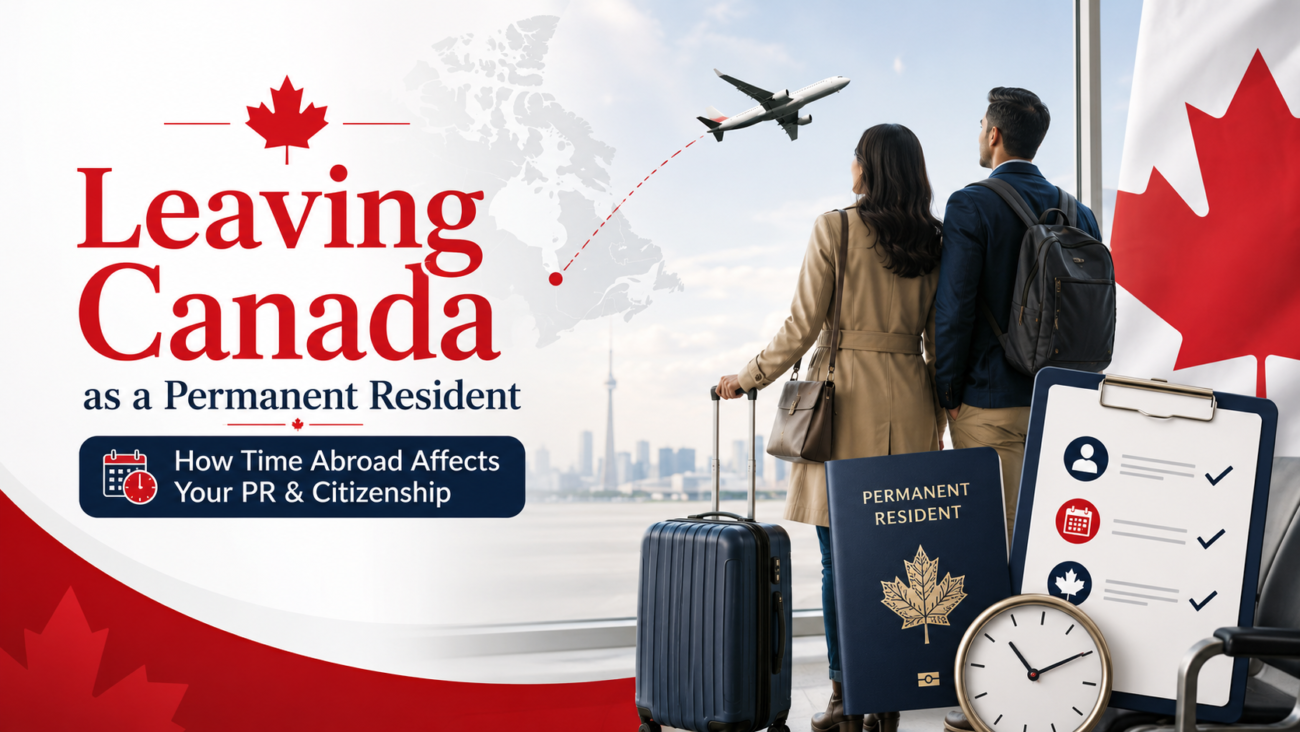
A record 30,092 Canadian citizens and permanent residents emigrated from Canada in Q1 2026 — the highest first-quarter emigration ever recorded. If you’re a permanent resident thinking about leaving, the stakes are real: time outside Canada counts against your residency obligation (730 days in every 5 years), and extended absence can cost you your PR status and your path to citizenship. Here’s what leaving actually does to your immigration status — and how to protect it if you must go.
The Trend: Why It Matters to You
Statistics Canada recorded the highest Q1 emigration count in its data history in early 2026. Behind the headline is a practical reality many PRs face: jobs, family, or cost of living pull them abroad — but PR status comes with a residency obligation that doesn’t pause just because you left. Understanding the rules before you go protects the status you worked for.
This guide explains residency-obligation basics. It is not legal advice. Losing PR status, abandoning it, and the tax consequences of leaving are all serious and individual. Before a long-term move abroad — especially if you’re close to the 730-day line or near a citizenship application — consult an immigration lawyer and a cross-border tax professional. The wrong move can cost you PR or trigger an unexpected tax bill.
The PR Residency Obligation (730 Days)
To keep permanent resident status, you must be physically present in Canada for at least 730 days within every rolling 5-year period. Key points:
- The 730 days do not need to be continuous
- Some time abroad can still count — e.g. accompanying a Canadian-citizen spouse, or working abroad full-time for a Canadian business (specific conditions apply)
- Falling short can lead to a removal order and loss of PR status, often discovered when you try to renew your PR card or re-enter Canada
What Counts Toward the 730 Days
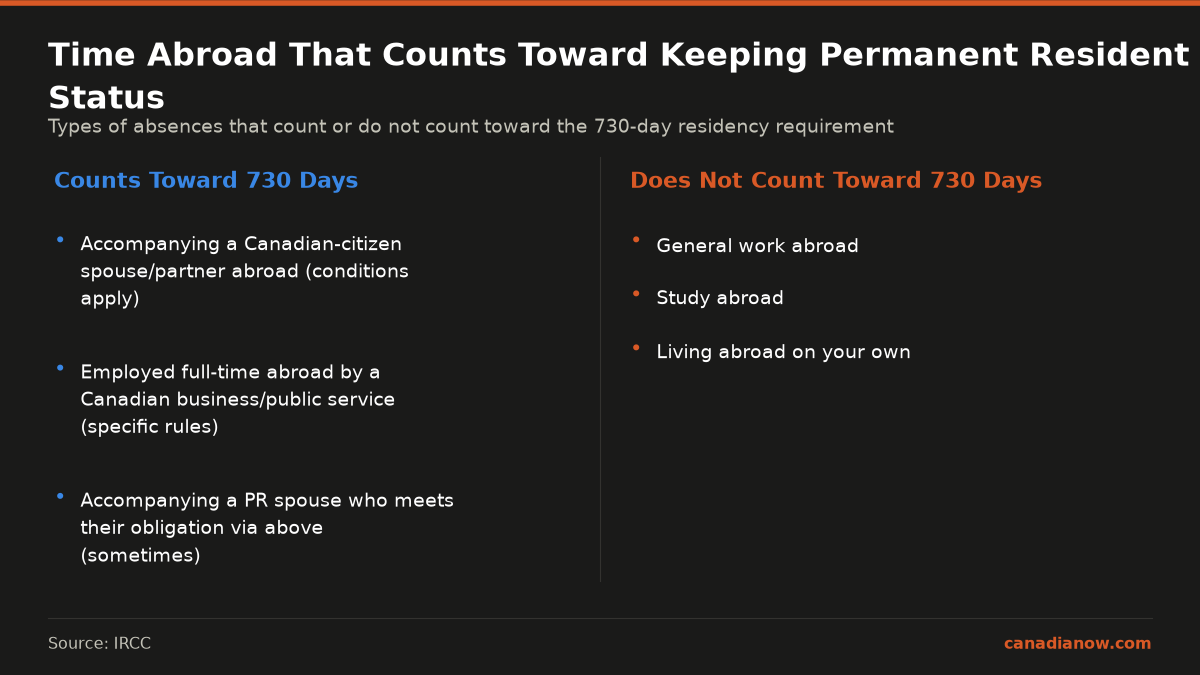
| Time abroad | Counts toward 730? |
|---|---|
| Accompanying a Canadian-citizen spouse/partner abroad | Yes (conditions apply) |
| Employed full-time abroad by a Canadian business/public service | Yes (specific rules) |
| Accompanying a PR spouse who meets their obligation via the above | Sometimes |
| General work, study, or living abroad on your own | No |
Don’t assume your situation qualifies for an exception — the rules are specific and officers interpret them strictly.
Leaving and Your Path to Citizenship
Time outside Canada also affects citizenship eligibility. To apply, you generally need 1,095 days of physical presence in Canada within the 5 years before applying. IRCC even recommends applying with a buffer (more than 1,095 days) in case a calculation issue arises. Long absences reset your clock and push citizenship further away — something to weigh if you’re close to qualifying.
If You Must Leave: How to Protect Your Status
- Track your days. Keep a precise log of entries and exits — you’ll need it for PR card renewal and citizenship.
- Know your 5-year window. Calculate whether you can afford the absence without dropping below 730 days.
- Check exception eligibility if you’re abroad with a Canadian spouse or a Canadian employer.
- Don’t let your PR card expire abroad without a plan — you may need a Permanent Resident Travel Document (PRTD) to return.
- Get tax advice. Leaving can make you a non-resident for tax purposes, with departure-tax implications on certain assets.
The Tax Side of Leaving
Becoming a non-resident for tax purposes isn’t automatic just because you moved — it depends on residential ties. If you do sever residency, Canada may apply a departure tax (a deemed disposition) on certain assets. This is complex and individual; a cross-border tax professional is worth the fee before a permanent move.
Abandoning PR vs. Losing It
If you’ve decided not to maintain Canadian residency, you can voluntarily relinquish PR status (sometimes useful for cleaner travel later). This is different from losing PR involuntarily through a residency-obligation failure. Don’t relinquish without understanding the consequences — it’s usually irreversible.
FAQ
Can I keep PR if I live abroad?
Only if you still meet the 730-days-in-5-years rule or qualify for an exception (e.g. accompanying a Canadian-citizen spouse). Otherwise, extended absence puts your PR at risk.
What happens if my PR card expires while I’m abroad?
You generally need a Permanent Resident Travel Document to board a flight back to Canada. An expired card abroad doesn’t automatically mean lost status, but it complicates return — plan ahead.
Does leaving cancel my Express Entry profile?
No — an Express Entry profile stays valid for 12 months regardless of where you are, though you must still meet eligibility when you submit a PR application.
Canadianow is an independent publisher, not a law or tax firm. Verify residency rules on canada.ca and get professional tax advice. Last reviewed: June 2026.
Sources
- Statistics Canada — quarterly demographic estimates (Q1 2026 emigration data)
- IRCC — permanent resident residency obligation
- IRCC — citizenship physical presence requirement
Written by Caglar Aybas. Last reviewed: June 2026.
For the authoritative source on this topic, see IRCC.
Not sure how this affects your own eligibility? Get a personalized report on your CRS score and which Express Entry or PNP category actually fits your situation.