Quick Answer
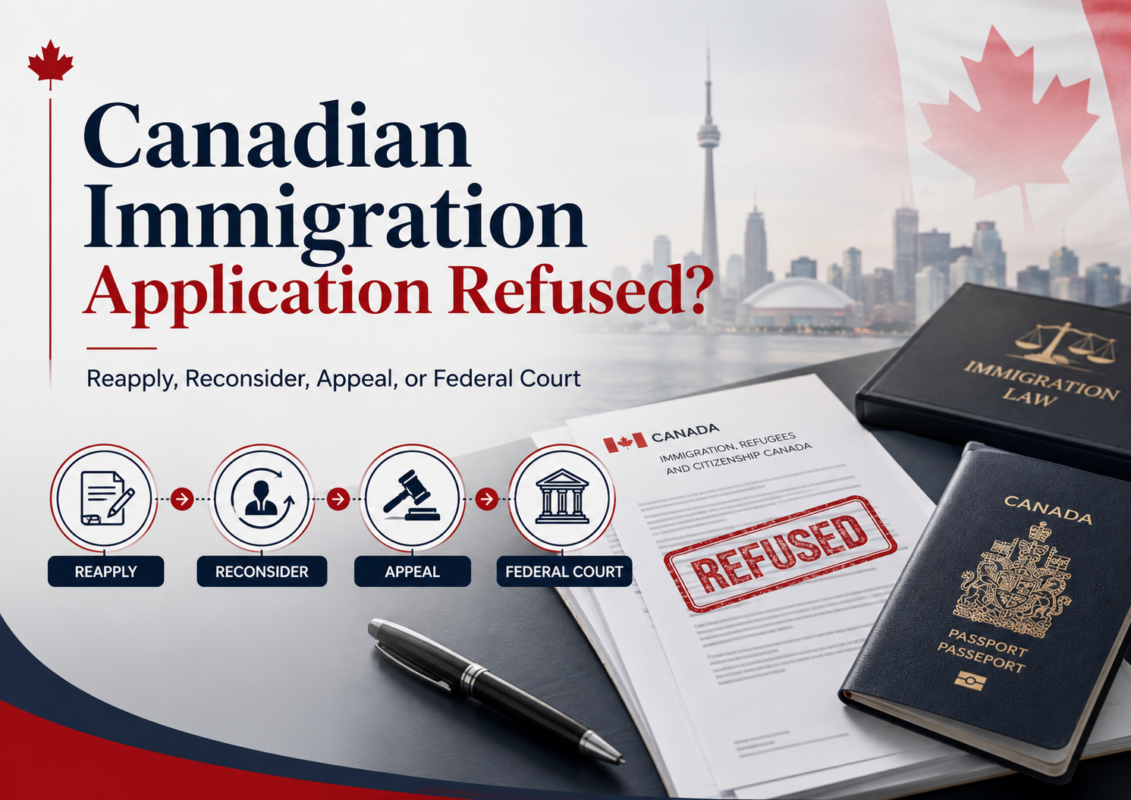
If your Canadian immigration application is refused, you usually have options: reapply with a stronger application, request reconsideration, appeal to the Immigration Appeal Division (for eligible cases), or apply for judicial review at the Federal Court. The right path depends entirely on why you were refused. The first step is always to get your GCMS notes — the officer’s actual reasons — before deciding anything.
First: Get the Real Reason (GCMS Notes)
The refusal letter gives a generic reason. The GCMS notes (Global Case Management System) contain the officer’s actual assessment — the specific concerns that sank your application. You request them through an ATIP (Access to Information and Privacy) request for about $5. Canadian citizens, PRs, and people inside Canada can file; those abroad usually use a Canadian representative.
Do not reapply or appeal until you know the real reason. Reapplying with the same weakness gets the same result.
This guide explains your general options. It is not legal advice. Refusals are highly fact-specific, deadlines are strict (some as short as 15–60 days), and choosing the wrong remedy can waste your one real chance. For any refusal you care about — especially PR, sponsorship, or anything involving misrepresentation — consult a licensed immigration lawyer promptly. The deadline clock starts immediately.
Your Four Possible Paths
| Option | When it fits | Deadline |
|---|---|---|
| Reapply | The refusal was due to a fixable weakness (weak documents, missing proof) | No deadline, but address the actual issue |
| Reconsideration request | The officer made a clear error or overlooked submitted evidence | Usually ASAP; discretionary |
| Immigration Appeal Division (IAD) | Sponsorship refusals, removal orders, residency obligation appeals (eligible cases) | Typically 30 days |
| Judicial review (Federal Court) | The decision was legally unreasonable or procedurally unfair | 15 days (inside Canada) / 60 days (outside) |
Reapplying: The Most Common Path
For many temporary applications (study permit, work permit, visitor visa), reapplying is faster and cheaper than appealing — if you fix the actual problem. Common refusal reasons and fixes:
- “Not satisfied you will leave Canada” — strengthen ties to home country (job, property, family, return plan)
- “Insufficient funds” — provide clearer, better-documented financial proof
- “Purpose of visit not established” — clearer letter of explanation, itinerary, purpose
- “Study plan not reasonable” — a stronger statement of purpose tying the program to your goals
Reconsideration: When the Officer Got It Wrong
If the officer overlooked evidence you clearly submitted, or made an obvious error, you can write a reconsideration request asking them to review the decision. This is discretionary — the officer doesn’t have to agree — but it’s fast and cheap. It works best when you can point to a specific, demonstrable mistake, not just disagreement with the outcome.
Appeal to the Immigration Appeal Division
The IAD handles specific appeal types:
- Refused family sponsorship applications
- Removal orders against PRs and protected persons
- Residency obligation appeals (PRs who didn’t meet the 730-day rule)
Not every refusal can go to the IAD — visitor, study, and most work permit refusals cannot. The deadline is typically 30 days, and the process can take many months. Legal representation is strongly advised here.
Judicial Review at Federal Court
This is not a re-decision — the Federal Court reviews whether the officer’s decision was reasonable and procedurally fair. If the court agrees there was an error, it usually sends the application back to IRCC for a new decision by a different officer; it doesn’t grant the visa itself. Deadlines are very short (15 days inside Canada, 60 outside) and you almost always need a lawyer.
The Misrepresentation Trap
If your refusal involves misrepresentation (a finding that you provided false information), the stakes are far higher: a 5-year ban from Canada. These cases need a lawyer immediately. Never try to “fix” a misrepresentation finding by quietly reapplying — it can make things worse.
Common Mistakes After a Refusal
- Reapplying immediately without getting GCMS notes or fixing the real issue
- Missing the short judicial review or appeal deadline
- Choosing the wrong remedy (e.g. reapplying when you should appeal, or vice versa)
- Hiding the previous refusal on the new application (this is misrepresentation)
- Using an unlicensed agent who promises to “overturn” the refusal
FAQ
Should I appeal or reapply?
Depends on the refusal type and reason. Temporary permit refusals usually mean reapply (fix the issue). Sponsorship and residency cases go to the IAD. Get the GCMS notes first, then decide — ideally with a lawyer.
How long does judicial review take?
Often 12–18 months, and it doesn’t grant the visa — it sends the case back for a fresh decision. It’s about legal errors, not a second opinion.
Do I have to disclose a past refusal?
Yes, always. Every Canadian (and many other countries’) application asks about prior refusals. Hiding one is misrepresentation — a 5-year ban.
Canadianow is an independent publisher, not a law firm. Deadlines are strict — seek timely legal advice. Last reviewed: June 2026.
Sources
- IRCC — Access to information and personal information (GCMS notes)
- Immigration and Refugee Board — Immigration Appeal Division
- Federal Court of Canada — judicial review process
Written by Caglar Aybas. Last reviewed: June 2026.
For the authoritative source on this topic, see IRCC.
Not sure how this affects your own eligibility? Get a personalized report on your CRS score and which Express Entry or PNP category actually fits your situation.