
What a Co-op Work Permit Actually Is
A co-op or internship work permit is a separate work permit required when your study program includes a mandatory work placement as part of the curriculum — not optional part-time work on the side, but a co-op term, practicum, or internship that’s genuinely built into your program and required for you to graduate. Unlike the standard 24-hour-per-week off-campus work allowance available to eligible study permit holders, this permit specifically authorizes the co-op placement itself, and it needs a letter from your Designated Learning Institution confirming the work placement is a mandatory program requirement before IRCC will issue it. This is a work permit application layered on top of your study permit, not a replacement for it, and applying for it typically happens well before the placement is scheduled to start, since processing takes time and you can’t legally begin the placement without the permit already approved.How This Differs From the Post-Graduation Work Permit
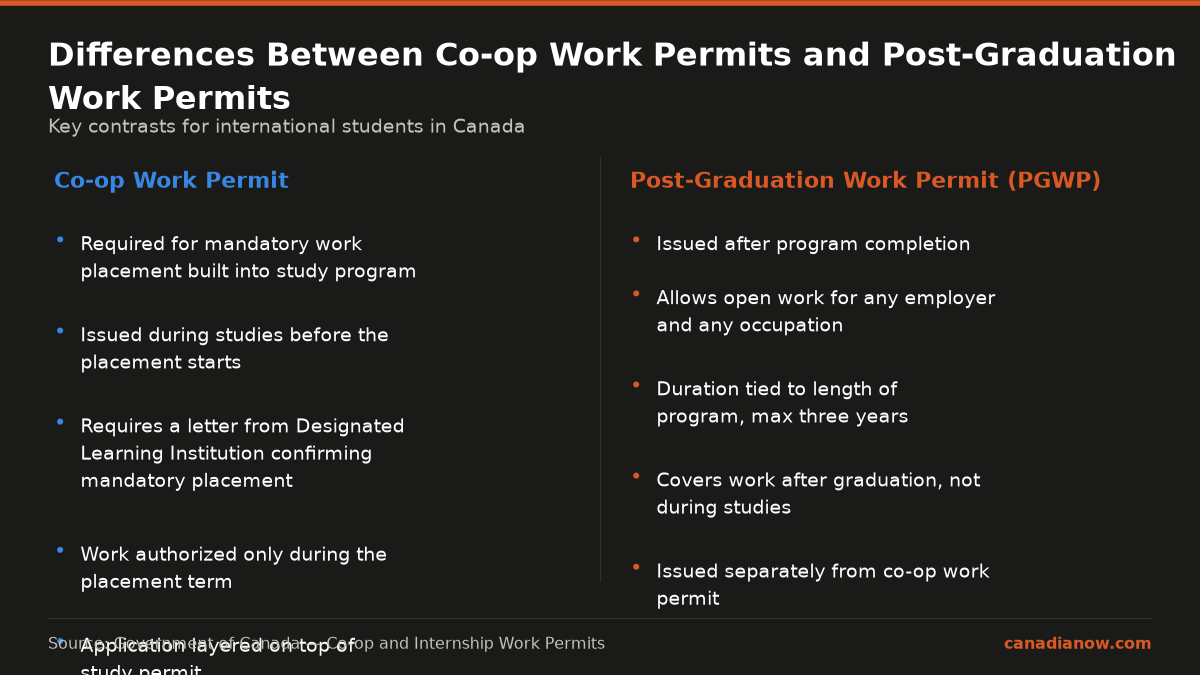
Why the Distinction Has Become More Important Recently
IRCC has tightened its position on what counts toward PGWP eligibility in terms of your study program’s structure and duration, and unauthorized work — including working during a co-op placement without the correct permit in place — can jeopardize PGWP eligibility down the line, since it can be treated as a violation of your study permit conditions. Students who assume the general off-campus work allowance covers a mandatory co-op placement, and skip applying for the dedicated co-op work permit because they think they’re already covered, are the ones who run into this problem, and it’s a completely avoidable one if you check what your specific placement requires before it starts.How to Apply and What You Need
The application requires the co-op work permit letter from your DLI confirming the placement is mandatory for your credential, proof of enrollment, and the standard work permit application fee. It’s generally processed alongside or shortly after your study permit application if you know at that point that your program includes mandatory co-op terms, though it can also be applied for separately later in your studies if the placement requirement becomes relevant partway through the program.Which Programs Actually Require This
Not every program with the word “co-op” in its name necessarily requires a separate work permit — the determining factor is whether the placement is mandatory for graduation, not whether it’s branded as a co-op stream. Some programs offer optional co-op terms that aren’t required for the credential, in which case regular off-campus work rules may apply instead. Checking directly with your DLI’s international student office about your specific program’s requirement is the reliable way to confirm which situation applies to you, rather than assuming based on the program’s marketing materials.Frequently Asked Questions
Can I work off-campus and do a co-op placement at the same time?
Yes, these are separate authorizations that can run concurrently, but it’s worth tracking your total hours carefully so the two don’t combine in a way that puts you offside your study permit conditions.
Does time spent on a co-op placement count toward PGWP length?
Generally, co-op terms that are a required part of an eligible program don’t shorten your PGWP length, but the specific calculation depends on your program’s structure u2014 confirm with your DLI if you’re unsure.
What if my DLI doesn’t provide a co-op work permit letter?
Without that letter confirming the placement is mandatory, IRCC won’t issue the co-op work permit. Follow up directly with your international student office well before the placement start date, since this document is required for the application.