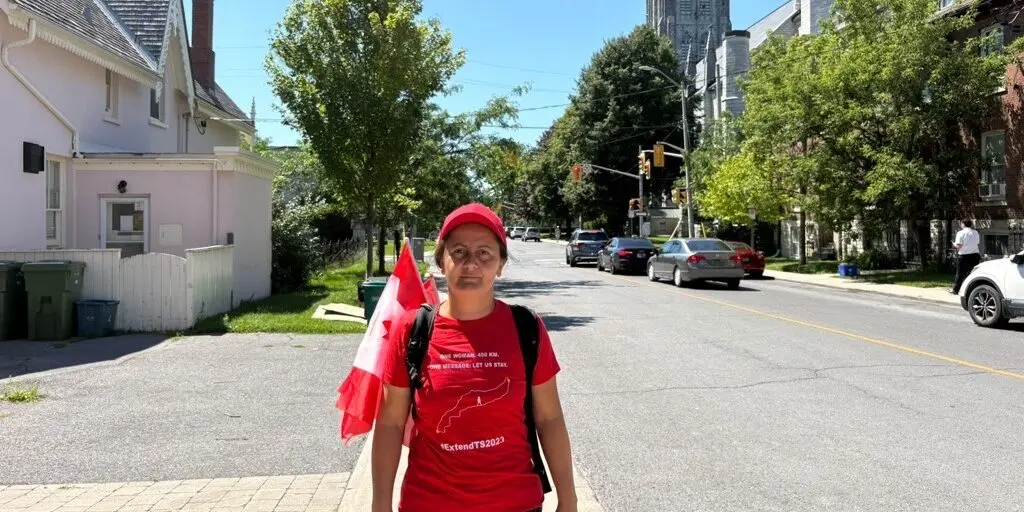
TORONTO — A Toronto mother is walking 491 kilometres to Parliament Hill as roughly 9,000 open work permits issued to Turkish and Syrian nationals after the February 2023 earthquakes begin to expire. Ottawa formally refused a 24-month extension on June 12, 2026. This report sets out what the programme was, what the government said, why the refusal is weaker on the merits than on the calendar, and what permit holders should be doing in the meantime.
Key Facts
| Item | Detail |
|---|---|
| Programme | TS2023 — temporary public policy for Türkiye–Syria earthquake-affected nationals in Canada |
| Benefit | Fee-exempt three-year open work permit; status extensions; permit-type changes |
| Intake window | March 2023 – January 3, 2024 (closed as scheduled) |
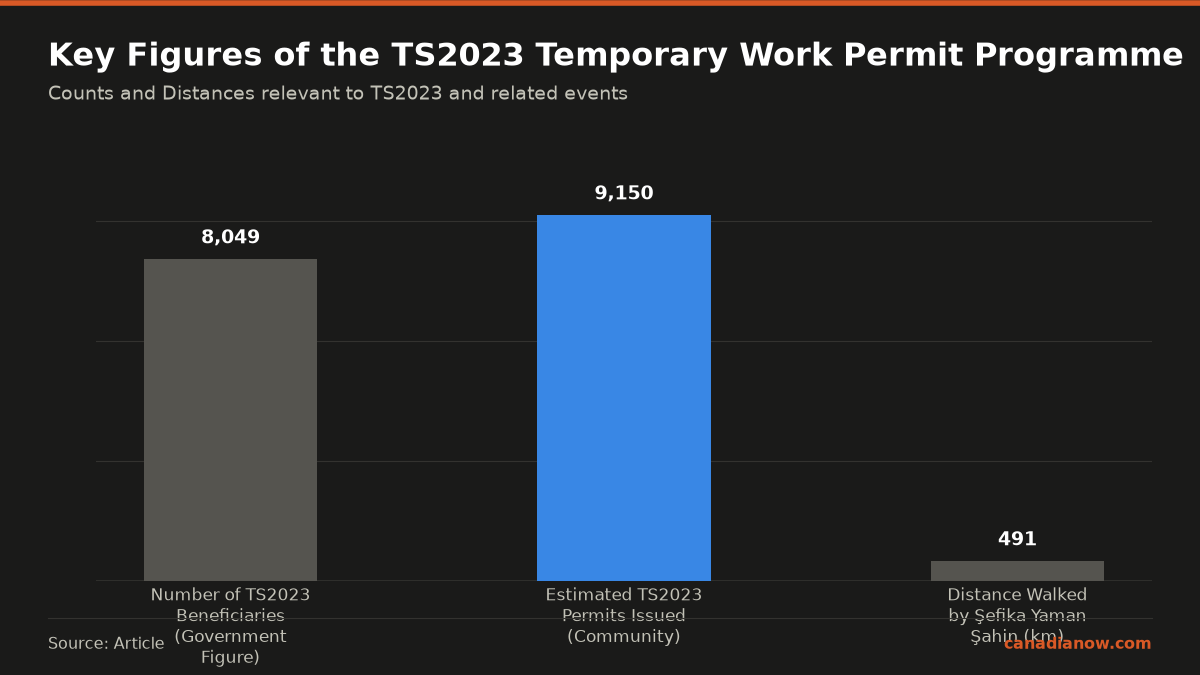
| People helped | 8,049 (government figure cited in Parliament); community estimate of permits issued ≈ 9,000–9,300 |
| Expiry | Majority of permits expire during 2026 |
| Petition | e-7288 — 8,089 verified signatures; sponsored by MP Sima Acan (Oakville West, Lib.) |
| Government response | Tabled June 12, 2026 — all three requests declined |
| The walk | 491 km, 25 staged legs over 28 days; departed Toronto July 19, 2026; due at Parliament Hill August 15, 2026 |
On July 19, Şefika Özlem Yaman Şahin, 47, left David Pecaut Square in downtown Toronto on foot and began walking east. Her route covers 491 kilometres in 25 staged legs over 28 days, ending at Parliament Hill on August 15. Her 12-year-old son joins her for sections of it — she has said she is walking on behalf of the adults in limbo, and that he is there to represent the children.
She is not walking for a cause in the abstract. The open work permit that allowed her family to rebuild in Canada after the 2023 earthquakes is running out, as are the permits held by roughly 9,000 other people, and the federal government has already answered the request for more time.
What TS2023 Actually Was
On February 6, 2023, earthquakes measuring 7.8 and 7.5 struck southern Türkiye and northern Syria, killing more than 53,000 people, injuring over 107,000 and destroying housing across 11 provinces. The United Nations characterised it as one of the largest disasters to affect the region in recent times.
Canada’s response for people already inside the country was a temporary public policy known by its IRCC code, TS2023. Eligible Turkish and Syrian nationals in Canada could extend their stay, change permit types, and — the operative provision — obtain a fee-exempt three-year open work permit rather than being tied to a single employer through a Labour Market Impact Assessment. The measures opened in March 2023 and closed to new applications on January 3, 2024, on the date the original policy specified.
Government figures cited in the parliamentary response put the number of people helped at 8,049. Community organisations estimate the number of TS2023 open work permits issued at closer to 9,000–9,300; IRCC told The Canadian Press it could not immediately provide a figure. The two numbers measure slightly different things and neither has been reconciled publicly, but the consequence is the same in either case: three-year permits issued predominantly in 2023 expire predominantly in 2026, with a concentration in the autumn and winter.
Timeline
| Date | Event |
|---|---|
| Feb 6, 2023 | Magnitude 7.8 and 7.5 earthquakes strike Türkiye and Syria; 53,000+ killed |
| March 2023 | Canada opens TS2023 temporary measures for affected nationals already in Canada |
| Jan 3, 2024 | TS2023 closes to new applications, as originally scheduled |
| Mar 24 – Apr 23, 2026 | Petition e-7288 open for signature; 8,089 verified signatures collected |
| June 12, 2026 | Government response tabled; all three requests declined |
| July 19, 2026 | Yaman Şahin departs David Pecaut Square, Toronto |
| Aug 15, 2026 | Scheduled arrival at Parliament Hill, Ottawa |
| Through 2026 | Bulk of TS2023 open work permits reach expiry |
The Petition, and Ottawa’s Answer
Petition e-7288 was sponsored by Liberal MP Sima Acan (Oakville West) and collected 8,089 verified signatures between March 24 and April 23, 2026 — 5,084 of them from Ontario. It was organised with the involvement of Ali Demircan of the Federation of Canadian Turkish Associations, and asked for three things:
- Access to LMIA-exempt work permits, so holders would not be dependent on a single employer’s paperwork
- A minimum 24-month extension of existing TS2023 work permits
- Development of a pathway to permanent residence for beneficiaries already established in Canada
The government’s response, tabled June 12, 2026 by Parliamentary Secretary Peter Fragiskatos, declined all three. Its reasoning was that the earthquake measures were designed as temporary, ended as scheduled on January 3, 2024, and that affected nationals “can apply, through regular programs, to renew their status” or pursue permanent residence through existing streams. The response situated the decision within the 2026–2028 Immigration Levels Plan and its commitment to reduce Canada’s temporary resident population to below 5% of the total population by the end of 2027.
What the Walk Is Asking For
Yaman Şahin’s framing is deliberately narrow. She is not proposing a new immigration category, and she has been explicit that the ask is not at anyone else’s expense.
“I am not asking Canada for a favour. I am asking Canada to let our family finish what we started here — my son’s school year, our jobs, our life.”
On the group she is walking for, she told reporters: “They came in here, they worked hard, they paid taxes, followed the rules, became part of their communities, and they created hope in here.” She has also pressed the point that the cohort is defined by loss rather than opportunity — “they came here after a big disaster in Türkiye and they have lost homes, they lost their business and, in some cases, they lost a family member.”
Her own family has not yet been able to apply for permanent residence, and is waiting for an invitation to apply rather than holding a pending decision. Her request is time: “We just need extra time to complete our process here.”
Can Ors, a supporter walking part of the route, holds a permit that expires in December. “Right now, our future seems dark,” he said, “and if I return to my country, I don’t have a home.”
Asked about the march, Prime Minister Mark Carney said the government continually looks for ways to help people find pathways to permanent residence, while weighing provincial capacity for housing and services.
Analysis: The Case Against Sending These Families Back
The section below is analysis rather than reporting. It sets out the strongest case for a time-limited extension, and then the strongest case against it.
The government’s position is procedurally sound. A temporary measure ended on the date it said it would, and there is a legitimate public interest in temporary programmes actually being temporary. But “the policy expired” answers a question about the calendar, not a question about policy. On the substance, four arguments run against removal.
1. The condition that triggered the measure has not resolved
Three years on, 360,455 people were still living in container housing in the earthquake region as of January 2026, more than 150,000 of them in Hatay province alone. Türkiye’s reconstruction effort is genuinely enormous — roughly $91.5 billion spent by the end of 2025, more than 350,000 homes delivered and 455,000 units targeted by the close of 2026 — but unemployment across the affected provinces remains elevated and incomes still trail the national average. A humanitarian bridge that ends before the far bank is complete is an interrupted policy, not a finished one.
2. Canada set the precedent in the same fiscal year, at twenty times the scale
This is the strongest argument, and the government has not publicly answered it. In March and April 2026, IRCC introduced a public policy allowing Ukrainian nationals who arrived under CUAET to extend their open work permits, with the measure running to March 31, 2027 and extensions of up to three years available. It covers roughly 190,000 temporary residents. The stated rationale was to avoid disruptive loss of status and to preserve employer access to workers — reasoning that applies to TS2023 holders identically, at roughly one twenty-first the population.
Scale matters here because scale is the government’s own stated objection. The 2026–2028 plan targets 385,000 new temporary resident arrivals in 2026 alone. Extending status for a closed cohort of about 9,000 people who are already counted in the temporary population does not add a single new arrival to that figure; it defers exits. Against the 5% target, the effect is a rounding error.
3. The integration cost has already been paid
This cohort is not newly arrived. They have three years of Canadian employment history, Canadian tax filings, Canadian employer references, children part-way through Canadian school years, and in many cases publicly funded language training already completed. Removal does not free up a job or a housing unit in any straightforward way — it vacates a filled position and a leased home while writing off settlement investment already made. Whatever the argument for removal is, the economic one is the weakest part of it.
4. “Apply through regular programs” is a sequencing problem, not a merit problem
The regular-programs answer is stronger on paper than in a calendar. Permanent residence capacity is not the binding constraint — the 2026–2028 plan actually raises the Provincial Nominee Program target to 91,500 admissions in 2026, up 66% from the previous plan. The constraint is time and control. Nominations are allocated by provinces against their own occupation priorities, Express Entry selection increasingly runs through category-based draws and French-language advantage, and an LMIA-supported employer permit requires an employer willing to run a months-long process for a worker whose status lapses first. A permit expiring in December cannot realistically be rescued by a PNP nomination started in October.
That is precisely the gap a 24-month bridge closes, and precisely why a permanent programme is not required to close it.
The case on the other side
Three counter-arguments deserve to be stated plainly rather than dismissed. First, credibility: if temporary measures are routinely extended, “temporary” ceases to mean anything, and future governments lose a policy tool that depends on being believed. Second, queue fairness: an extension advantages one cohort over others waiting through regular streams, including people with comparable humanitarian circumstances and no organised advocacy behind them. Third, capacity: Carney’s reference to provincial housing and services capacity is not rhetorical — provinces set their own absorption limits and the federal government does not control them.
The first two of those arguments are considerably weaker in this specific case than in general, because the programme is already closed to intake. No one can newly qualify for TS2023, which means an extension creates no incentive effect and no incoming queue — it applies to a fixed, countable, already-admitted group. The refusal issued in June rests principally on the fact that a date passed, and a date is not, by itself, a reason.
What TS2023 Holders Should Do Now
Regardless of how the walk ends on August 15, no one should plan around a policy change that has not happened. If a TS2023 permit expires in 2026:
- File to extend before the current permit expires. Applying from inside Canada before the expiry date puts you on maintained status, which allows you to keep working under the same conditions while the application is processed. Missing that date moves you into restoration — a 90-day window with no right to work.
- Pursue permanent residence streams in parallel, not in sequence. Express Entry, relevant PNP streams, the Rural Community Immigration Pilot and family sponsorship all run on different clocks. Working through them one at a time is how people run out of runway.
- If a PR application is already submitted, check eligibility for a Bridging Open Work Permit. A BOWP is the standard instrument for preserving work authorisation while permanent residence processes.
- Open the employer conversation early. An LMIA-supported employer-specific permit is slower and more restrictive than what TS2023 provided, but it is a genuine pathway and it requires lead time.
- Assemble the record from the past three years. Employment letters, tax filings, children’s school enrolment and evidence of community ties are relevant both to PR applications and to any humanitarian and compassionate submission.
- Get advice from a regulated professional. Only an RCIC or a lawyer licensed in a Canadian province can give case-specific advice. This article is general information, not legal advice.
What Remains Unverified
Two points in this story are not settled on the public record, and are reported here as unresolved rather than smoothed over. First, the number of TS2023 open work permits actually issued: the government’s parliamentary response cites 8,049 people helped, community organisations estimate 9,000–9,300 permits, and IRCC did not provide a figure when asked by The Canadian Press. Second, the government has not published a substantive rationale distinguishing the TS2023 cohort from the CUAET cohort whose permits were extended in 2026; the June response addresses the temporary nature of the measure but does not engage the comparison.
Where the Walk Stands
Yaman Şahin has been moving through eastern Ontario in staged daily legs — Quinte West and Sidney in late July, Belleville the following day — with local supporters joining for sections. She is due at Parliament Hill on August 15. Whether that arrival changes anything is an open question. What it has already done is attach a measurable figure to something otherwise abstract: 491 kilometres, 28 days, one family, and roughly 9,000 people whose Canadian lives currently carry an expiry date.
Frequently Asked Questions
What is a TS2023 work permit?
TS2023 is the IRCC code for the temporary public policy Canada created after the February 2023 Türkiye-Syria earthquakes. Eligible Turkish and Syrian nationals already in Canada could obtain a fee-exempt three-year open work permit, extend their stay, or change permit types. The measures closed to new applications on January 3, 2024.
When do TS2023 work permits expire?
Most TS2023 open work permits were issued for three years during 2023, so the majority expire during 2026, concentrated in the autumn and winter. The exact date is printed on the permit. An extension application must be filed before that date to preserve the right to work under maintained status.
Did Canada extend TS2023 work permits?
No. Petition e-7288 requested a 24-month extension, LMIA-exempt permits and a permanent residence pathway. The government response tabled on June 12, 2026 declined all three, stating that the measures were always temporary and that affected nationals should use regular immigration programs.
What options do TS2023 permit holders have now?
Regular in-Canada status extensions, Express Entry, Provincial Nominee Programs, the Rural Community Immigration Pilot, family sponsorship, an LMIA-supported employer-specific work permit, a Bridging Open Work Permit where a PR application is already submitted, or a humanitarian and compassionate application. Filing before the current permit expires preserves maintained status.
Why were Ukrainian work permits extended but not TS2023 permits?
IRCC introduced a public policy in 2026 allowing CUAET work permit holders to extend, running to March 31, 2027 and covering roughly 190,000 people. The government has not published a substantive distinction between the two cohorts beyond the fact that the TS2023 policy carried a fixed end date that has passed.
How many people hold TS2023 work permits?
The figure is disputed. The government cited 8,049 people helped in its parliamentary response, while community organisations estimate 9,000 to 9,300 permits issued. IRCC could not immediately provide a number when asked by The Canadian Press in August 2026.
Related Guides
Sources
- House of Commons — Petition e-7288 and Government Response, tabled June 12, 2026
- The Canadian Press — “Mother, son march in protest as Turkish, Syrian nationals face immigration limbo,” August 8, 2026
- The Lanarkist — Route detail and staged legs, July 28, 2026
- IRCC — “Canada extends certain work permit measures for Ukrainians,” March 2026
- IRCC — Open work permit extension public policy for Ukrainian nationals
- IRCC — Supplementary Information for the 2026–2028 Immigration Levels Plan
- Türkiye Today — Reconstruction progress and container housing figures, 2026
Editor’s Note
Reporting in this article is drawn from the Government of Canada’s published response to petition e-7288, IRCC public policy documents, Canadian Press coverage of the march, and regional reporting on the route. Figures attributed to community organisations are identified as estimates where the government has not confirmed them. The analysis section is clearly labelled and separated from the reporting. Canadianow is not a law firm; nothing here constitutes legal advice, and readers with permits expiring in 2026 should consult a regulated Canadian immigration consultant (RCIC) or a licensed lawyer. Corrections: info@canadianow.com.