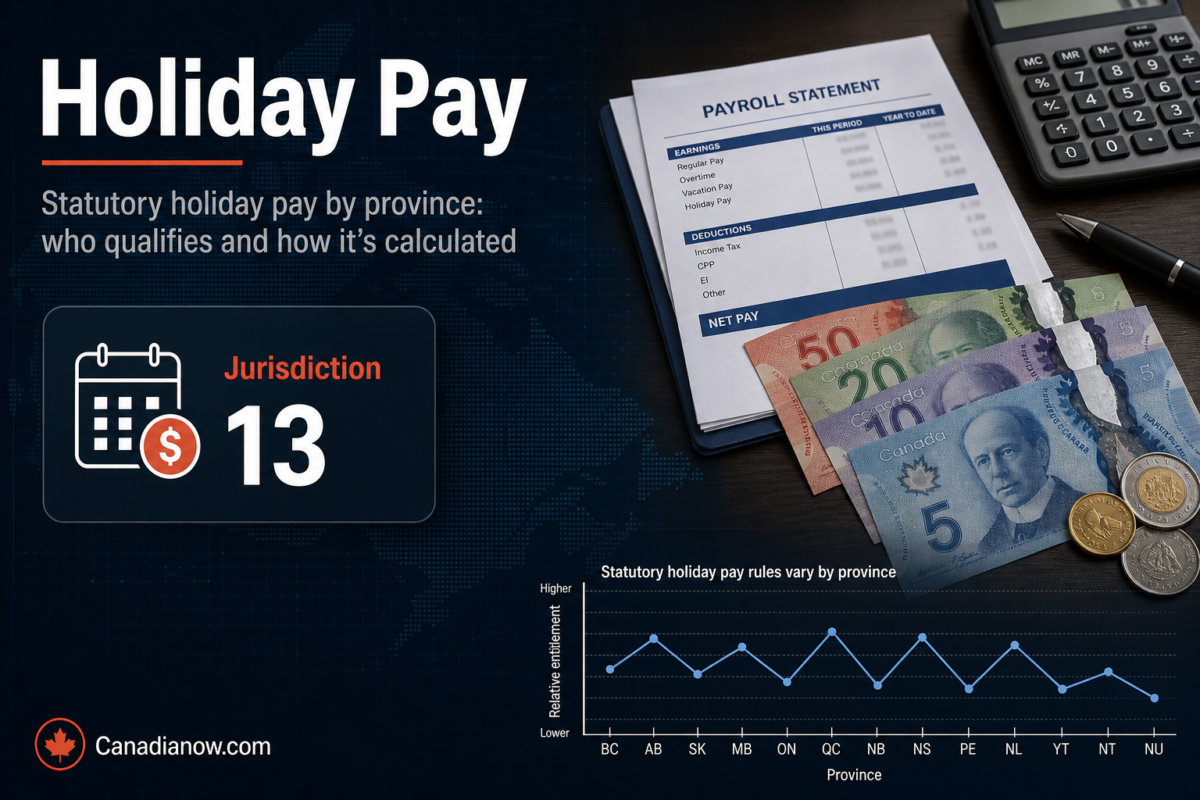
Whether you get paid for a statutory holiday, and how much, depends on your province, how long you have worked there, and whether you showed up for your scheduled shifts around it. There is no national rule — only thirteen jurisdictions with overlapping but different ones.
Here is what actually determines the answer.
The Two Questions That Decide Everything
Every jurisdiction asks the same two things in some form:
- Do you qualify? Most provinces require you to have worked a minimum period before the holiday, and to have worked your last scheduled shift before it and your first scheduled shift after it
- What is the amount? Typically a proportion of your wages over a defined earlier period — commonly 5% of wages in the four weeks before the holiday, or an average of daily earnings
The “last shift before, first shift after” rule is the one that catches people. Calling in sick on the day before a long weekend can, in some jurisdictions, cost you the holiday pay entirely unless the absence is covered by a protected leave.
Where the Rules Diverge Most
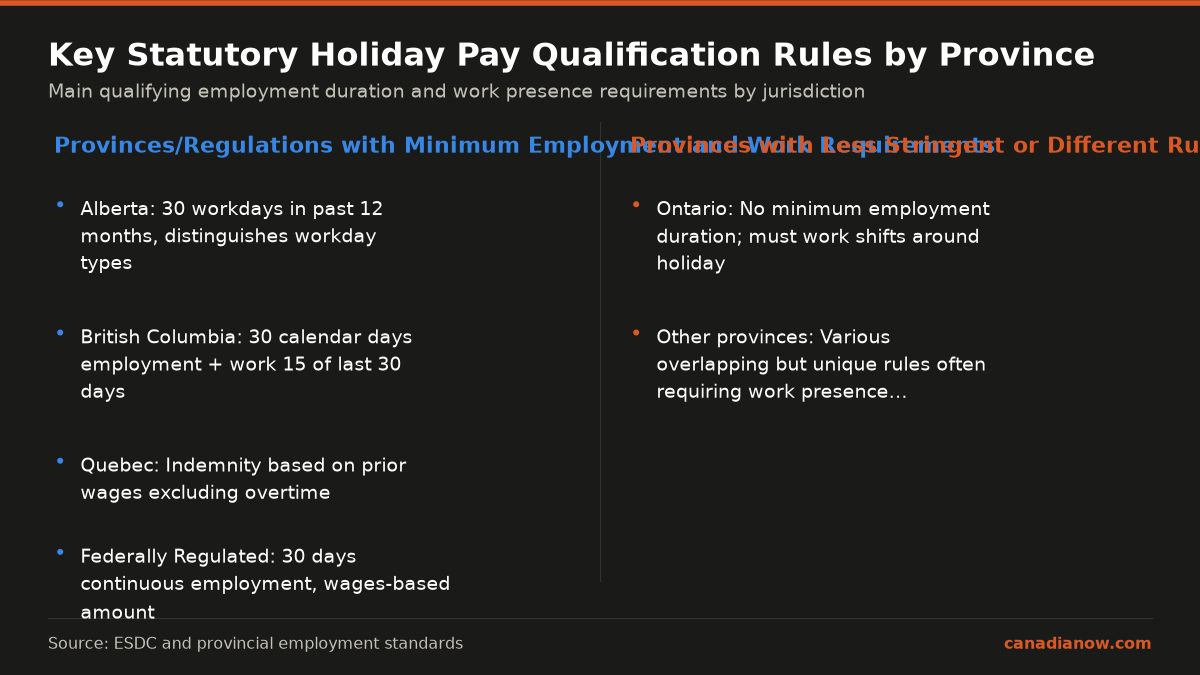
- Ontario — no minimum length of employment required. You can qualify in your first week, provided you work the shifts around the holiday
- Alberta — historically required 30 workdays in the preceding 12 months, and distinguishes between regular and irregular workdays
- British Columbia — requires 30 calendar days of employment before the holiday and work on at least 15 of the preceding 30 days
- Quebec — calculates an indemnity based on wages in a defined preceding period, excluding overtime
- Federally regulated employees — 30 days of continuous employment, with the amount based on wages in the four weeks before the holiday
Because these differ, the same employee doing the same job for the same national employer can be entitled to different amounts depending on which province they work in.
If You Work On the Holiday
Two standard structures exist, and which one applies depends on your jurisdiction and often on your employment agreement:
- Premium pay — typically one and a half times your regular rate for hours worked, plus your holiday pay
- Substitute day — regular pay for hours worked, plus another day off with pay later
Retail, hospitality and healthcare workers are the most likely to encounter this, and also the most likely to be paid incorrectly, because the calculation involves two separate entitlements that some payroll systems handle poorly.
Part-Time and Casual Workers
Part-time employees are generally entitled to statutory holiday pay, calculated proportionally to their earnings — not excluded. The common assumption that holiday pay is a full-time benefit is wrong in most jurisdictions.
Casual and on-call workers are more variable, and the qualifying-shift rules are where entitlement is most often lost.
If You Think You Were Underpaid
Start with your pay statement: holiday pay should appear as a separate line, not folded into regular hours. If it is missing or looks wrong, raise it with payroll before escalating — the majority of cases are calculation errors rather than deliberate underpayment.
If that does not resolve it, each province has an employment standards branch that accepts complaints, and federally regulated employees go to the Labour Program instead.