Canada does not have a single national minimum wage that applies everywhere. Each province and territory sets its own — and they change frequently. Here is the complete, current breakdown for 2026.
Federal Minimum Wage
The federal minimum wage applies to workers in federally regulated industries — banks, airlines, telecommunications, interprovincial transport, and postal services. As of April 1, 2026, the federal minimum wage is $18.15 per hour.
This is indexed to inflation and adjusts annually each April 1.
Provincial and Territorial Minimum Wages in 2026
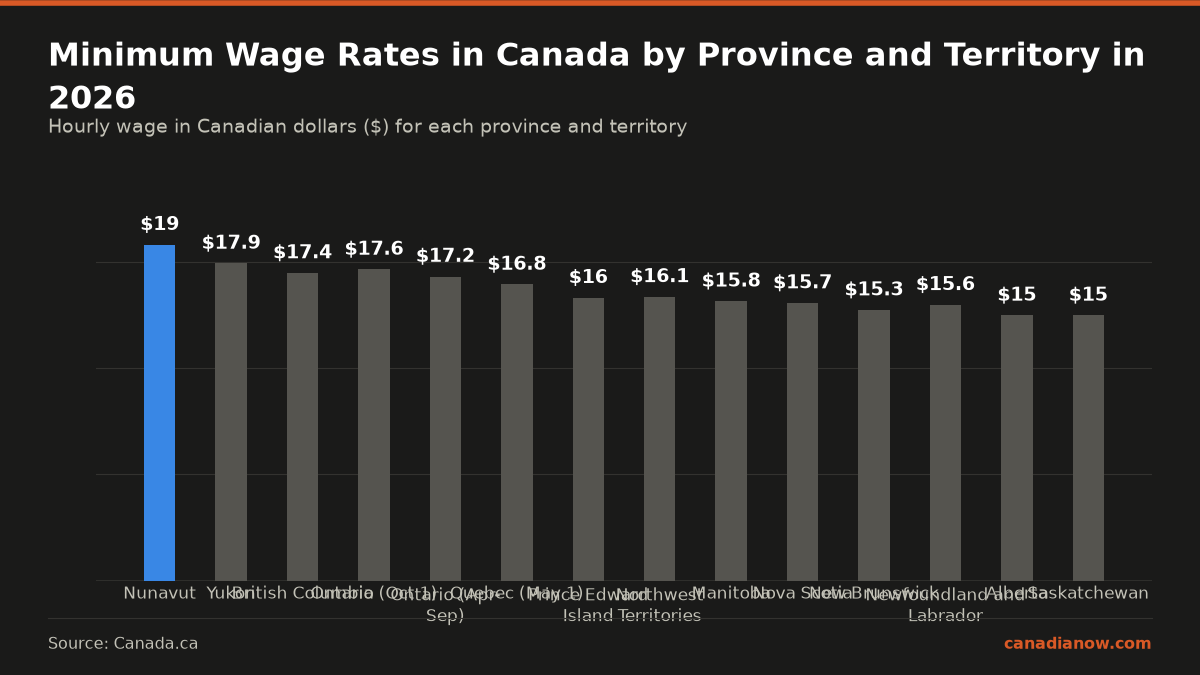
- Ontario: $17.20/hour (increases to $17.60 on October 1, 2026)
- British Columbia: $17.40/hour
- Alberta: $15.00/hour (among the lowest, but no provincial income tax)
- Quebec: $16.10/hour (increasing to $16.75 on May 1, 2026)
- Nova Scotia: $15.70/hour
- Manitoba: $15.80/hour
- Saskatchewan: $15.00/hour
- New Brunswick: $15.30/hour
- Prince Edward Island: $16.00/hour
- Newfoundland and Labrador: $15.60/hour
- Northwest Territories: $16.05/hour
- Nunavut: $19.00/hour (highest in Canada)
- Yukon: $17.94/hour
Special Minimum Wage Rates
Some provinces have different minimum wage rates for specific worker categories:
- Liquor servers (Ontario): The separate lower rate for servers was eliminated — all workers now receive the general minimum wage
- Students under 18 (Ontario): $16.20/hour for students working 28 hours or fewer per week during school
- Home workers: Some provinces pay a premium (typically 110% of minimum wage) for workers doing piecework at home
Can You Actually Live on Minimum Wage in Canada?
Bluntly: in most major cities, no — not comfortably. At $17.20/hour for 40 hours per week in Ontario, a full-time minimum wage worker earns approximately $35,776 per year before taxes. After taxes and basic living costs in Toronto, there is very little left.
Organizations like the Ontario Living Wage Network calculate a “living wage” — the minimum needed for a basic decent standard of living — at $25.05/hour in Toronto and $20.40/hour in most other Ontario regions. These are significantly above the legal minimum.
Minimum Wage and Your Immigration Status
Minimum wage laws in Canada apply equally to all workers regardless of immigration status — citizens, permanent residents, work permit holders, and international students all have the same legal minimum wage protections. If an employer pays you less than minimum wage, it is illegal regardless of what your permit says.
Frequently Asked Questions
Q: Does the federal minimum wage override provincial minimums?
A: The federal minimum wage applies only to federally regulated workplaces. For all other jobs, the provincial minimum applies — whichever is higher between the federal and provincial rate.
Q: How often does minimum wage increase in Canada?
A: Most provinces review and adjust minimum wages annually. Ontario increases its minimum wage on October 1 each year. The federal minimum adjusts on April 1 each year tied to the Consumer Price Index.
Q: Is minimum wage the same for part-time workers?
A: Yes. Minimum wage applies per hour regardless of full-time or part-time status.
Bottom Line
Minimum wages in Canada range from $15.00 (Alberta and Saskatchewan) to $19.00 (Nunavut) per hour in 2026. Most provinces are in the $15.60–$17.40 range. If you are working at or near minimum wage, focus on building Canadian work experience quickly — the difference between minimum wage and even a $22–$25/hour role is transformative for your financial stability.
For the authoritative source on this topic, see Canada.ca.
Related Reading
- Why Are Canadian Flags at Half-Mast Today?
- Average Salary in Toronto in 2026: What to Realistically Expect
- New Flight Delays Hit Canada And US On Easter Monday 2026
Want to know exactly where you stand? Our personalized report covers your CRS score, the PNP and Express Entry categories you actually qualify for, and a realistic next-step plan.