Quick Answer
The average salary in Canada is approximately CAD $70,000 per year, based on Statistics Canada’s average weekly earnings of $1,347.14 for July 2026 (up 3.2% from a year earlier). The median full-time salary is closer to $63,000 — this is the more honest benchmark, since the average is pulled up by high earners in finance, technology, and medicine. Salaries vary by province by up to 25% for the same job. Alberta and Ontario sit above the national average; Atlantic provinces below.
Average vs Median: Why the Gap Matters
If you are comparing your salary to “the Canadian average,” you need to understand which average is being quoted.
| Measure | 2026 figure | What it shows |
|---|---|---|
| Average (mean) weekly earnings (StatsCan) | $1,316 / week ($68,400 / year) | Total payroll ÷ number of employees; skewed by top earners |
| Median hourly wage, full-time workers | $30.50 / hour ($63,400 / year) | The middle earner: 50% above, 50% below |
| Average hourly wage (Feb 2026) | $38.49 / hour | Mean of all hourly wages; also skewed by high earners |
For comparing your own pay, the median is more honest. For comparing total economic output, the mean is more useful. Most government data uses both.
Province-by-Province Breakdown
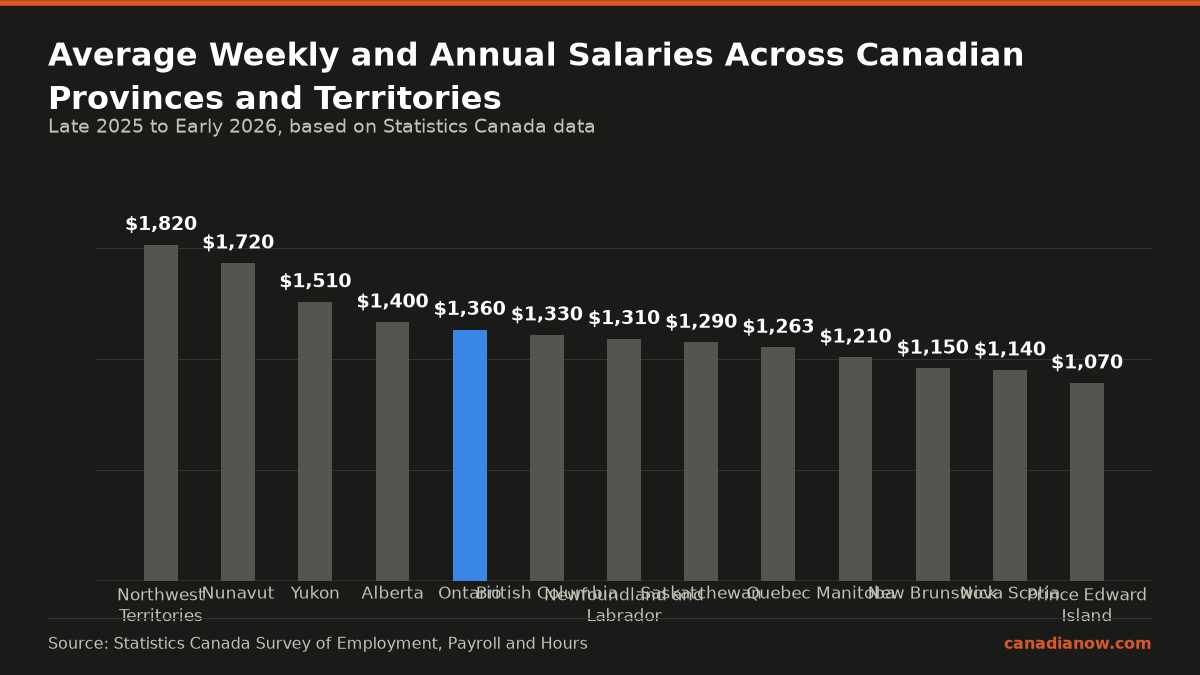
Approximate average weekly earnings, late 2025 / early 2026, with annual equivalents.
| Province / Territory | Weekly avg | Annual equivalent | Notes |
|---|---|---|---|
| Northwest Territories | ~$1,820 | ~$94,600 | Remote-location premium |
| Nunavut | ~$1,720 | ~$89,400 | Remote-location premium |
| Yukon | ~$1,510 | ~$78,500 | Remote-location premium |
| Alberta | ~$1,400 | ~$72,800 | Energy sector premium |
| Ontario | ~$1,360 | ~$70,700 | Finance, tech, professional services |
| British Columbia | ~$1,330 | ~$69,200 | Tech, film, real estate |
| Newfoundland and Labrador | ~$1,310 | ~$68,100 | Resource sector |
| Saskatchewan | ~$1,290 | ~$67,100 | Agriculture, mining, energy |
| Quebec | ~$1,263 | ~$65,700 | Middle of national pack |
| Manitoba | ~$1,210 | ~$62,900 | Diverse economy, lower cost of living |
| New Brunswick | ~$1,150 | ~$59,800 | Below national average |
| Nova Scotia | ~$1,140 | ~$59,300 | Below national average |
| Prince Edward Island | ~$1,070 | ~$55,600 | Lowest of provinces |
Figures rounded from Statistics Canada Survey of Employment, Payroll and Hours, late 2025. The most recent reference month available at publication is December 2025; the average for 2026 is expected to track similar levels.
The Territories Are Misleading
The territories show the highest average earnings in Canada by a wide margin, but those numbers do not represent a broader labour market. They reflect the cost of operating in remote locations, isolation pay, and the heavy concentration of public-sector and resource-sector jobs in Yellowknife, Whitehorse, and Iqaluit. For a newcomer or worker comparing offers, the provincial figures are far more relevant.
This article shows general national and provincial wage data. It is not financial advice for your specific career decision. Talk to your bank’s newcomer specialist or a licensed Canadian financial advisor when planning major financial moves.
What Actually Drives Salary in Canada
- Industry — mining, oil and gas, finance, and technology pay above average. Hospitality, retail, and personal services pay below.
- Location — Toronto, Vancouver, and Calgary pay more, but cost of living often eats the premium. Hamilton, Ottawa, Edmonton, and parts of Atlantic Canada often offer better real purchasing power.
- Education and credentials — regulated professions (medicine, law, engineering, nursing) command a meaningful pay premium because licensing limits supply.
- Experience — peak earning years are typically 45–54.
- Employer size — larger employers usually pay better and offer stronger benefits, RRSP matches, and pensions.
- Union or collective agreement — unionized roles often have higher floors and slower ceilings.
- Field of specialization — within a single industry, niche skills can shift pay 10–15%.
Year-Over-Year Trend
Average weekly earnings in Canada grew approximately 1.94% year over year as of late 2025 — a slowdown from the 4%+ growth seen in 2022 and 2023. Wage growth has cooled alongside a softer labour market: unemployment was 6.7% in February 2026, and payroll employment has declined slightly across retail, manufacturing, and accommodation.
Healthcare and social assistance continue to add jobs faster than any other sector and remain the strongest area for wage growth.
Average Salary by Industry (2026 Estimates)
| Industry | Approx. annual median |
|---|---|
| Mining, oil and gas extraction | $110,000+ |
| Finance and insurance | $85,000 |
| Technology and information services | $82,000 |
| Professional, scientific, technical services | $78,000 |
| Public administration | $76,000 |
| Healthcare and social assistance | $68,000 |
| Manufacturing | $65,000 |
| Educational services | $62,000 |
| Construction | $60,000 |
| Retail trade | $42,000 |
| Accommodation and food services | $36,000 |
What This Means for a Newcomer
If you are negotiating a Canadian salary offer or planning your career, use these benchmarks:
- Compare your offer to the median for your industry and province, not the national average
- Adjust for cost of living — $70,000 in Halifax goes much further than $70,000 in downtown Toronto
- For regulated professions (medicine, nursing, engineering, accounting), credential recognition often determines pay more than experience
- Newcomer-targeted job sites and “no Canadian experience required” filters help benchmark realistic first offers
Where the Numbers Come From
The figures in this article are drawn from:
- Statistics Canada Survey of Employment, Payroll and Hours (SEPH), monthly
- Statistics Canada Labour Force Survey, monthly
- Trading Economics aggregation of StatsCan releases
- Government of Canada Job Bank wage data, by NOC code and province
If you need salary data for a specific NOC code in your province, the Job Bank wage tool is the most authoritative free source.
FAQ
What is a “good” salary in Canada in 2026?
A “good” salary depends on the city, family size, and lifestyle. For a single person in a mid-sized city, $60,000–$75,000 supports a comfortable life. In Toronto or Vancouver, that figure climbs to $80,000–$95,000 for the same comfort level.
What is the minimum wage in Canada in 2026?
The federal minimum wage rose to $18.15 per hour on April 1, 2026. Provincial minimum wages vary, with most provinces between $15 and $17.50. Yukon and Nunavut sit above $17.50.
Do salaries in Canada include benefits and pension?
Quoted salaries are usually base pay only. Total compensation may also include extended health benefits, RRSP matching, vacation pay, and bonuses, which can add 10–25% to the base figure.
To see what a salary actually leaves you after tax, CPP and EI in your province, use our salary calculator.
Sources
- Statistics Canada — Survey of Employment, Payroll and Hours (December 2025 release)
- Statistics Canada — Labour Force Survey (February 2026 release)
- Government of Canada Job Bank — Wage data by NOC code
- Federal minimum wage update, April 1, 2026
Written by Caglar Aybas. Reviewed for accuracy and currency. Last reviewed: May 2026.
For the authoritative source on this topic, see the CRA.
General information only gets you so far. For a report built around your specific profile — province options, CRS score, and timeline — check out our personalized reports.
To see what a salary actually leaves you after tax, CPP and EI in your province, use our salary calculator.