Quick Answer
A police clearance certificate (PCC) is required for permanent residence applications and some work permits in Canada. You need one from every country where you lived 6 months or longer in a row since age 18. Each country has its own process, cost, and processing time — some take days, some take 6+ months. Start gathering PCCs before IRCC asks, because the request deadline is usually only 30–60 days.
Who Needs a PCC and When
| Application | PCC required? |
|---|---|
| Express Entry PR (after ITA) | Yes — for every qualifying country |
| PNP permanent residence | Yes |
| Spousal sponsorship | Yes — for the sponsored person |
| Citizenship application | Only if you spent 183+ days in another country in the past 4 years |
| Work permit | Usually no, but an officer can request one |
| Study permit | Usually no, but possible for some countries |
The rule for PR: every country (including your home country) where you spent 6 consecutive months or more since turning 18. Tourist trips under 6 months do not count. Military service usually does.
This guide explains the general PCC requirement. It is not legal advice. If you have any criminal history — even a minor offence, even one that was dismissed or pardoned in another country — consult a Canadian immigration lawyer before submitting your application. A conviction abroad can make you inadmissible, and how you disclose it matters enormously.
Canadian PCC: How to Get One
If you have lived in Canada 6+ months, you may also need a Canadian police certificate for some applications:
- Standard option: a criminal record check from the RCMP, done via fingerprints at an accredited fingerprinting company (about $25–$90 total depending on the provider)
- For Express Entry: IRCC normally does NOT require an RCMP certificate for time spent in Canada — they run their own background checks. Read your document checklist carefully before paying for one
Getting PCCs from Common Countries
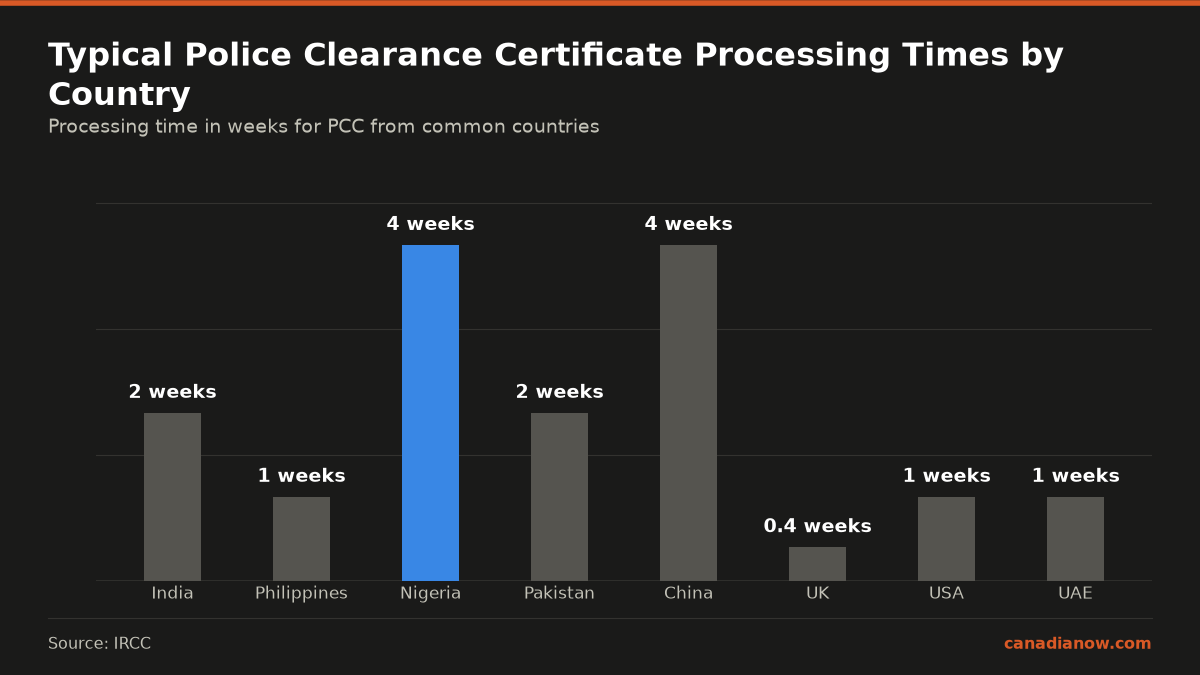
| Country | Where to apply | Typical timeline |
|---|---|---|
| India | Passport Seva Kendra or BLS/VFS abroad | 2–6 weeks |
| Philippines | NBI Clearance (online + biometrics) | 1–4 weeks |
| Nigeria | Nigeria Police Force CID, Alagbon | 4–12 weeks |
| Pakistan | Local police khidmat centers / district police | 2–8 weeks |
| China | Notarized No Criminal Record Certificate via notary office | 4–10 weeks |
| UK | ACRO Criminal Records Office (online) | 2–15 working days |
| USA | FBI Identity History Summary (fingerprints) | 1–8 weeks |
| UAE | Dubai Police / MOI app (former residents need a registered fingerprint) | 1–3 weeks |
IRCC maintains a country-by-country instruction page — always follow the exact method listed there, because IRCC rejects certificates obtained through non-approved channels for some countries.
Timing Strategy: Start Before the ITA
The single most common PCC mistake in Express Entry: waiting until you receive your Invitation to Apply. After an ITA you have only 60 days to submit your complete e-APR — and a Nigerian, Chinese, or Indian PCC can easily take longer than that.
- Make a list of every country where you lived 6+ consecutive months since age 18
- Check the IRCC instruction page for each country’s approved method
- Start the slowest applications as soon as you enter the Express Entry pool
- Validity note: most PCCs must be issued after you last lived in that country; for your current country of residence, it must usually be no older than 6 months at submission
What If a Country Won’t Issue One?
Some countries refuse to issue PCCs to non-residents, have collapsed administrative systems, or are at war. IRCC accepts a letter of explanation documenting your genuine attempts: emails, application receipts, embassy correspondence. Submit the proof of effort in place of the certificate, and explain clearly. Officers have discretion to waive the requirement when obtaining a certificate is genuinely impossible.
Common PCC Mistakes That Delay Applications
- Ordering the wrong document type (e.g. a “character certificate” when IRCC requires the police-issued version)
- Submitting a certificate issued before you left the country (it must usually cover your full residence period)
- Missing a country entirely — exchange semesters, work postings, and military service count
- Letting your current-country PCC expire (the 6-month freshness rule) while waiting for other documents
- Not getting certified translations for non-English/French certificates
FAQ
Does a PCC expire?
The certificate itself usually has no expiry, but IRCC applies freshness rules: for the country you currently live in, it should be issued within 6 months of submission. For countries you left, it must be issued after your last departure.
I visited a country many times, totalling more than 6 months. Do I need a PCC?
The rule is 6 or more months in a row. Multiple shorter trips that add up to 6 months do not trigger the requirement — but an officer can still request one in individual cases.
What if my PCC shows an old minor offence?
Disclose it. Hiding it is misrepresentation — a 5-year ban. Whether the offence makes you inadmissible depends on its Canadian equivalent. This is exactly the situation where paying for an hour with an immigration lawyer is worth it.
Canadianow is an independent publisher, not a law firm. Last reviewed: June 2026.
Sources
- IRCC — How to get a police certificate (country-by-country instructions)
- RCMP — Certified criminal record checks
Written by Caglar Aybas. Last reviewed: June 2026.
For official, up-to-date details, see IRCC.
General information only gets you so far. For a report built around your specific profile — province options, CRS score, and timeline — check out our personalized reports.