If you arrived in Canada this year, you have probably heard about the “GST cheque” — the quarterly payment that shows up in most people’s bank accounts. In July 2026 it got a new name: the Canada Groceries and Essentials Benefit (CGEB). For newcomers, the name change matters less than one fact that has not changed: you will not get it automatically in your first year unless you apply.
Quick Answer
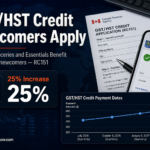
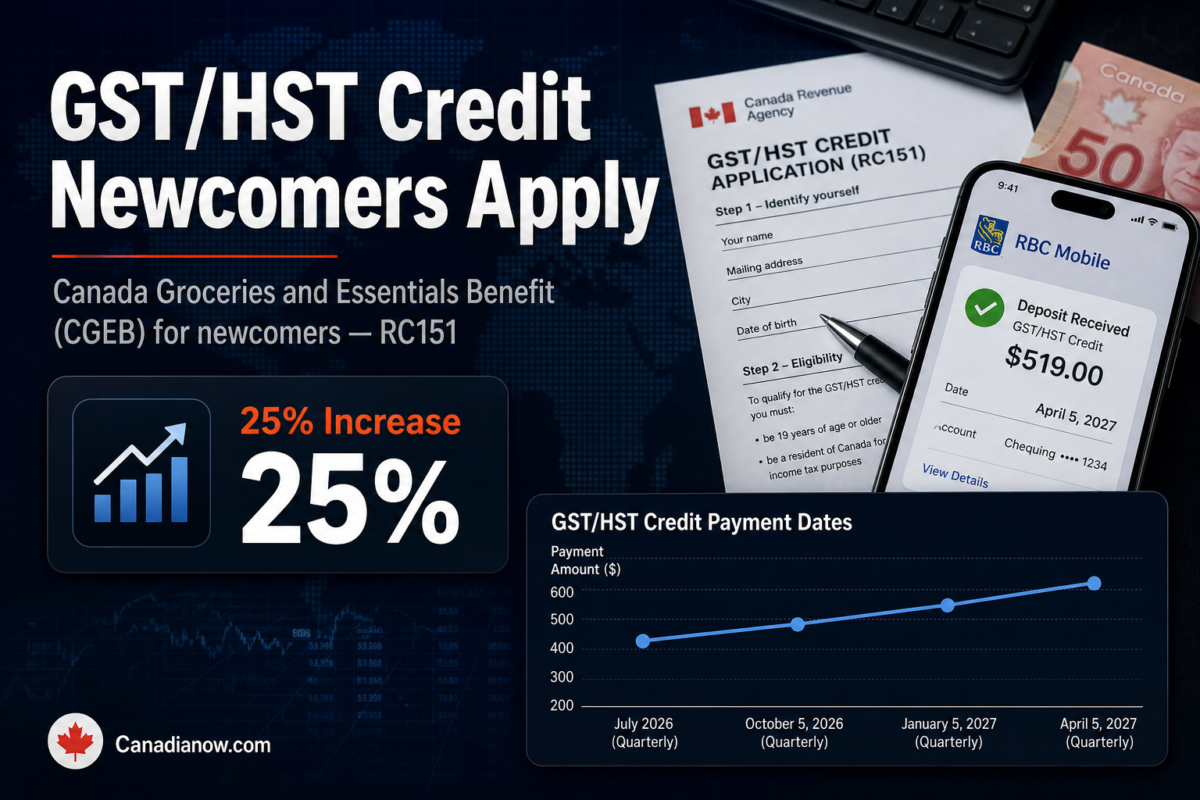
The CGEB is the former GST/HST credit, renamed in July 2026 with a 25% higher amount. Most people receive it automatically by filing a tax return. Newcomers apply for their first year using Form RC151 (or Form RC66 if they are also applying for the Canada Child Benefit). The form asks for your world income before you arrived, because payments are calculated from income in years when you were not yet here. Work permit and study permit holders who are Canadian residents for tax purposes can qualify — there is no 18-month waiting rule like the one for the Canada Child Benefit.
This guide explains general rules. It is not tax advice. Always confirm your situation on the CRA pages linked below, or with a free tax clinic (CVITP) if your income or residency is complicated.
What Actually Changed in July 2026
- The name. CRA letters, My Account and payment descriptions now say “Canada Groceries and Essentials Benefit.” Your bank may still show a GST reference for a while.
- The amount. The CRA applied a 25% increase from July 2026, which it says will remain for five years. For July 2026 to June 2027 the base maximums are $679 for a single person, $890 for a couple and $234 per child under 19.
- Not the rules. Eligibility, the quarterly schedule and the newcomer application process are the same as for the old GST/HST credit.
Payment dates are on our CGEB payment dates page — the next ones are October 5, 2026, then January 5 and April 5, 2027.
Who Qualifies
Official rule: the CRA says you are eligible if you are a resident of Canada for income tax purposes at the end of the month before, and at the beginning of the month in which, a payment is made — and you are at least 19 in the month before the payment (or have a spouse, common-law partner or child).
What it means for newcomers: your immigration status is not the test — tax residency is. People who move to Canada to live and work usually become tax residents on the day they arrive, because that is when they establish residential ties (a home, a job, a spouse or dependants here).
| Your status | Can you get the CGEB? |
|---|---|
| Permanent resident | Yes, if you meet the income test |
| Work permit holder living in Canada | Yes, if you are a tax resident — no waiting period |
| International student living in Canada | Usually yes; students are typically tax residents once they establish ties here |
| Visitor or short-term stay without ties | Generally no — non-residents are not eligible |
Unsure whether you are a tax resident? The CRA can decide for you with Form NR74. Our first tax filing guide explains the residency test.
How to Apply in Your First Year
- Get your SIN first if you can. The form can be filed without one, with an explanation and ID, but a SIN avoids delays (how to get a SIN).
- Choose the right form.
- No children: use the RC151 online form.
- Children under 19: apply with Form RC66 (Canada Child Benefits Application) — it registers you for the CGEB too — and include RC66SCH. If you do not yet qualify for the CCB, use the PDF RC151 to register your children for the CGEB.
- Report your world income. This is the part that confuses everyone — see the next section.
- File a tax return every year after that. From your first return onward, the CRA calculates the benefit automatically. No return means no payment.
Why the CRA Asks for Your Income From Before You Moved
Every CGEB payment year runs from July to June and is calculated from a previous year’s income. If you arrived in February 2026, for example:
- payments for early 2026 are based on your 2024 income, and
- payments from July 2026 to June 2027 are based on your 2025 income —
both years when you lived abroad. That is why the form asks for your income from all sources worldwide for those years, and for the part of your arrival year before your residency date. Report it converted to Canadian dollars. A salary that looks large in another currency may still leave you under the phase-out once converted, so do not skip the form because you assume you earned too much.
Practical step: if you had no income abroad (for example, you were a student), say so — enter zero rather than leaving the section blank.
Common Newcomer Mistakes
- Waiting for the first tax return instead of applying with RC151 — this delays everything until after you file.
- A spouse who does not file. For couples, both returns are needed from the second year on.
- Not updating your status or address with the CRA after you move or become a PR (why benefit payments stop).
- Assuming a work permit disqualifies you. The 18-month rule applies to the Canada Child Benefit, not the CGEB.
FAQ
Is the CGEB the same as the GST/HST credit?
Yes. It is the same program under a new name since July 2026, with a 25% increase to the amount.
Do I need to apply again every year?
No. You apply once in your first year. After that, filing your tax return each year is enough.
Can I get it on a work permit?
Yes, if you are a resident of Canada for tax purposes and meet the income test. There is no minimum time in Canada.
How much will I get?
For July 2026 to June 2027, up to $679 if single or $890 for a couple, plus $234 per child under 19, reduced as family income rises.