“Middle class” is one of those terms everyone uses but nobody defines precisely. In Canada in 2026, the definition is more complicated than a single number — and it matters differently depending on where you live.
How Statistics Canada Defines Middle Class
Statistics Canada typically defines middle-income Canadians as households earning between 75% and 200% of the median household income. With the median household income in Canada sitting at approximately $85,000–$92,000 in 2026, that puts the middle-income range at roughly $64,000–$184,000 for a household.
For individual earners, middle class is generally considered to be between $45,000 and $110,000 per year.
What Middle Class Actually Feels Like — By City
The problem with national definitions is that $80,000 feels very different in different places:
- Toronto / Vancouver: $80,000 household income is lower-middle at best. Renting a one-bedroom consumes 35–45% of take-home pay. Saving for a down payment is extremely slow.
- Calgary / Ottawa: $80,000 is solidly middle class — comfortable renting, reasonable savings rate, occasional travel.
- Montreal: $75,000 feels middle class, thanks to lower rents and subsidized childcare.
- Smaller cities (Halifax, Winnipeg, Saskatoon): $60,000–$70,000 provides a genuinely comfortable middle-class lifestyle.
Middle Class by Household Type
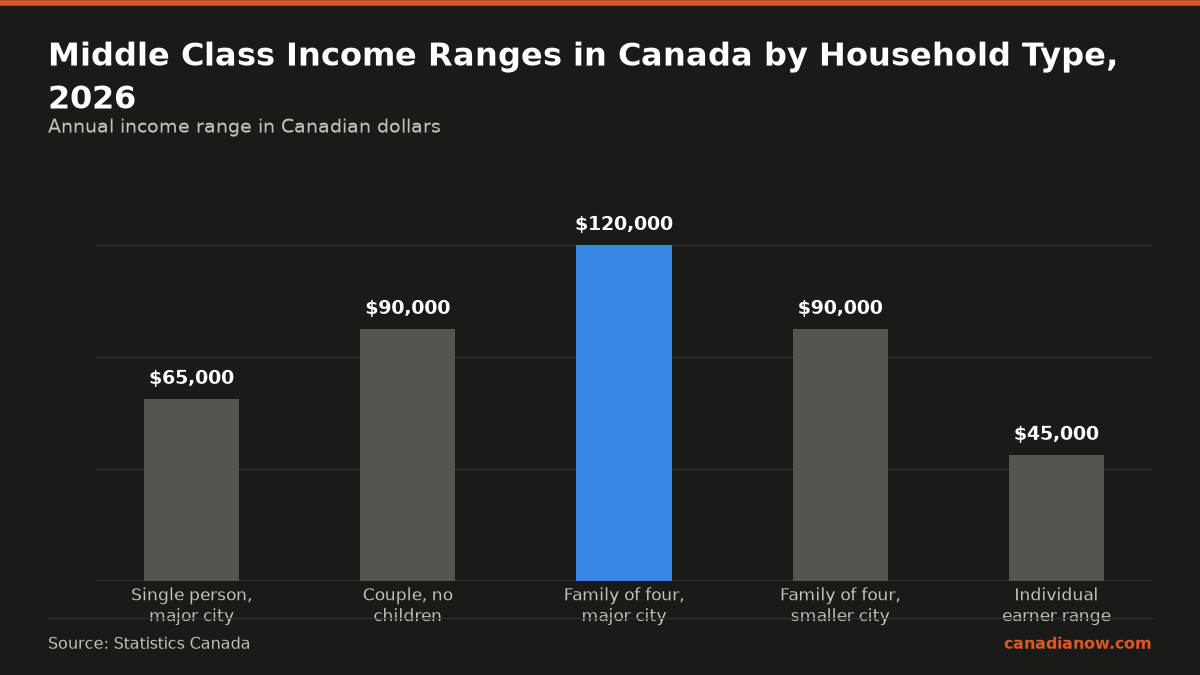
A more useful framework than a single number:
- Single person, major city: $65,000–$90,000 to live a stable, non-stressed middle-class life
- Couple, no children: Combined $90,000–$130,000
- Family of four, major city: Combined $120,000–$160,000 to live comfortably without financial anxiety
- Family of four, smaller city: Combined $90,000–$120,000
The Shrinking Middle Class in Canada
Housing costs have compressed the middle class significantly in Canada’s major cities. A household earning $100,000 — which was solidly middle class a decade ago — now faces mortgage payments or rents that were unimaginable in 2015. Many dual-income households earning $120,000–$140,000 combined report feeling financially stretched in Toronto and Vancouver.
Benefits That Support the Middle Class
Canadian tax and benefit programs supplement middle-class incomes meaningfully:
- Canada Child Benefit: Up to $7,786 per year for a child under 6 (income-tested)
- Canada Groceries and Essentials Benefit (formerly the GST/HST credit): Quarterly payments for lower and middle-income earners
- RRSP deductions: Reduce taxable income, effectively giving middle-class earners a meaningful tax refund
- TFSA: Tax-free savings growth — available to all Canadian residents
Frequently Asked Questions
Q: Is $70,000 middle class in Canada?
A: Nationally, yes — it sits within the middle-income range. But in Toronto or Vancouver, $70,000 for a single person is more accurately lower-middle class given housing costs.
Q: What income do you need to own a home in Canada?
A: In Toronto or Vancouver, typically $130,000+ as a household to qualify for and comfortably service a mortgage on an average property. In smaller cities, $80,000–$100,000 household income can support homeownership.
Q: Is Canada’s middle class doing better or worse than 10 years ago?
A: Wages have risen, but housing costs in major cities have risen faster. The effective purchasing power and financial security of middle-income earners in Toronto and Vancouver has declined in real terms since 2015.
Bottom Line
Middle class in Canada in 2026 means roughly $65,000–$110,000 for an individual, or $90,000–$160,000 for a household — but the number is almost meaningless without knowing your city. Focus on the ratio of your income to local housing costs: if rent or mortgage takes more than 35% of your take-home pay, you are financially stretched regardless of what the national statistics say about your income bracket.
You can find the current official information on Canada.ca.
Related Reading
- New Flight Delays Hit Canada And US On Easter Monday 2026
- 2026 Rent Increase Rules in Canada: Ontario 2.1%, B.C. 2.3%, Manitoba 1.8% (Plus What Changes in Quebec, Nova Scotia, PEI, and Newfoundland)
- What Is the Average Salary in Canada in 2026? (By City and Job)
Not sure how this affects your own eligibility? Get a personalized report on your CRS score and which Express Entry or PNP category actually fits your situation.