If you’ve started researching Express Entry or applied for a job in Canada, you’ve probably run into a five-digit code and a confusing letter combination — “TEER 1,” “TEER 3” — attached to your occupation. TEER stands for Training, Education, Experience and Responsibilities, and it’s the backbone of how Canada classifies every job in the country under the National Occupational Classification (NOC) 2021 system. Getting your TEER category right isn’t a technicality: it determines whether you’re even eligible to apply for Express Entry, how many Comprehensive Ranking System (CRS) points you can claim, and whether a job offer counts toward permanent residence at all.
What Is a TEER Code? (And Why NOC 2021 Replaced the Old System)
Until late 2022, Canada classified occupations using “Skill Type” (0, A, B, C, D) and “Skill Level” under NOC 2016. That system was retired in favour of NOC 2021 Version 1.0, which introduced TEER as a single, more precise measure of the training, education, experience, and level of responsibility an occupation typically requires. Statistics Canada and Employment and Social Development Canada (ESDC) jointly maintain the NOC, and it’s the classification IRCC uses across every economic immigration program.
Every occupation in Canada has a 5-digit NOC code. The structure is:
- 1st digit: the broad occupational category (0–9) — the general field of work, such as business and finance, health, or trades
- 2nd digit: the TEER category (0–5) — the level of training, education, experience, and responsibility the job requires
- 3rd–5th digits: the specific unit group — the exact occupation
So a code like 21234 tells you two things at a glance: the “2” means it’s in the natural and applied sciences category, and the second “1” means it’s a TEER 1 occupation that typically requires a university degree.
The 6 TEER Categories Explained: TEER 0 to TEER 5
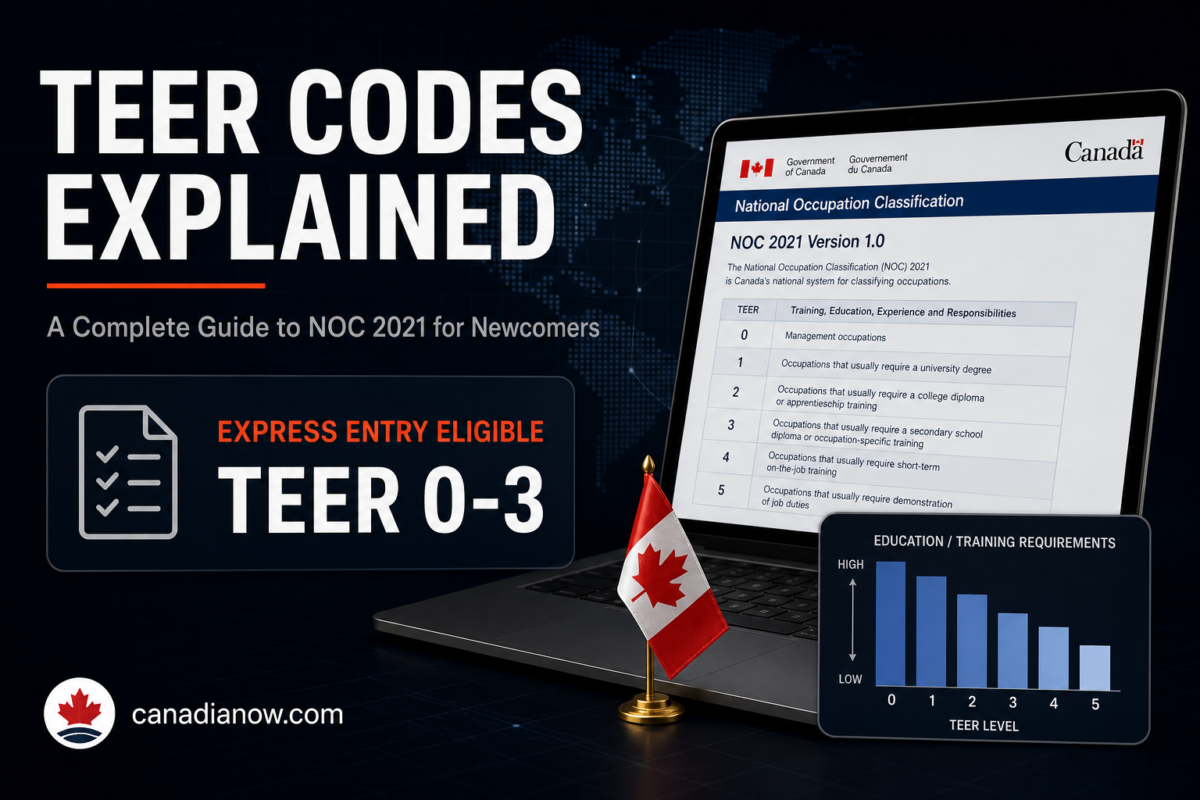
There are six TEER categories, numbered 0 through 5. As the number gets higher, the typical education and training requirement gets lower.
| TEER Category | Typical Requirement | Example Occupations |
|---|---|---|
| TEER 0 | Management occupations | Financial managers, restaurant managers, construction managers |
| TEER 1 | Usually requires a university degree (bachelor’s, master’s, or doctorate) | Software engineers, registered nurses, accountants, university professors |
| TEER 2 | Usually requires a college diploma, apprenticeship training of 2+ years, or supervisory responsibilities | Licensed practical nurses, computer network technicians, chefs, paralegals |
| TEER 3 | Usually requires a college diploma, apprenticeship training of less than 2 years, or over 6 months of on-the-job training | Food service supervisors, dental assistants, electrical apprentices |
| TEER 4 | Usually requires a high school diploma and/or several weeks of on-the-job training | Retail salespersons, home support workers, transport truck drivers |
| TEER 5 | Usually needs only short-term work demonstration; no formal education required | Fruit pickers, dishwashers, cleaning staff |
One exception worth flagging: management occupations always fall under TEER 0, regardless of whether the manager personally holds a university degree — the TEER 0 designation reflects the managerial responsibility itself, not a fixed education path. Entry into management is often through experience in a related TEER 1 or TEER 2 occupation rather than a specific credential.
Why TEER Matters for Express Entry (FSW, CEC, FST)
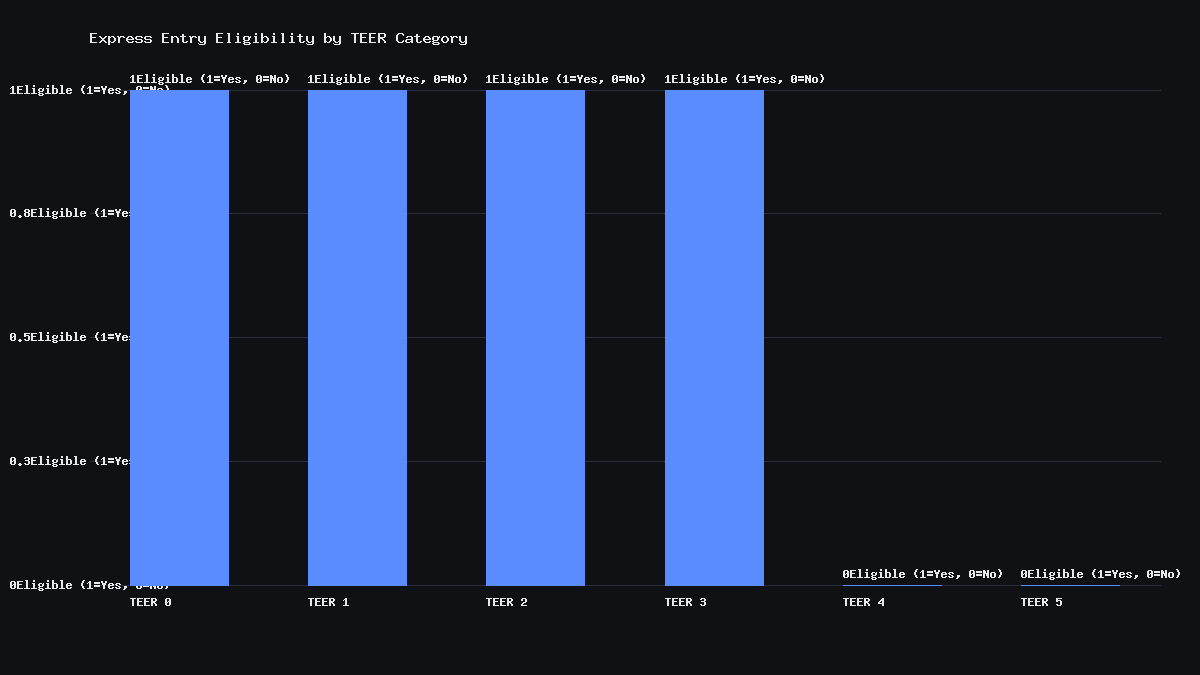
TEER category is the eligibility gatekeeper for Canada’s three current Express Entry programs — the Federal Skilled Worker Program (FSWP), the Canadian Experience Class (CEC), and the Federal Skilled Trades Program (FSTP):
- Federal Skilled Worker Program: requires at least one year of continuous, full-time (or equivalent part-time) skilled work experience in the past 10 years in a TEER 0, 1, 2, or 3 occupation.
- Canadian Experience Class: requires at least one year of Canadian work experience, also in a TEER 0, 1, 2, or 3 occupation.
- Federal Skilled Trades Program: targets specific TEER 2 and TEER 3 trade occupations that meet its separate certification and work-experience requirements.
TEER 4 and TEER 5 occupations are not eligible for Express Entry at all — no combination of experience in those categories will qualify you for FSW, CEC, or FST. This trips up a lot of newcomers whose Canadian work history is genuinely valuable but coded at TEER 4 or 5. If your work experience sits at that level, provincial and regional pathways are usually the better route: some Provincial Nominee Program streams, the Atlantic Immigration Program, and the Rural Community Immigration Pilot are specifically designed to accept TEER 4 and TEER 5 experience that Express Entry won’t.
TEER also feeds directly into your CRS score: your NOC’s TEER category affects how your work experience and skill transferability points are calculated, and category-based selection draws are frequently built around specific NOC codes and their TEER levels. Getting the wrong TEER code on your profile can misstate your eligibility entirely, not just cost you a few points.
It’s also worth noting that Express Entry itself may look different in the near future — IRCC has proposed merging FSW, CEC, and FST into a single Federal High-Skilled Class, detailed in our Express Entry merge guide. That proposal changes program structure and CRS weighting, not the underlying TEER system — TEER 0–3 eligibility is expected to remain the dividing line regardless of how the programs themselves are reorganized.
How to Find Your Own TEER Code
Follow these steps to identify the correct NOC code — and therefore TEER category — for your own job:
- Use the official NOC search tool. ESDC’s NOC 2021 search portal (accessible via canada.ca) lets you search by job title or keyword and returns the matching unit group and its 5-digit code.
- Match duties, not job titles. Job titles vary enormously between countries and even between employers in Canada. IRCC and provincial officers assess your NOC based on the actual duties in your reference letters and contracts, not the title on your business card. Read the “main duties” list for your candidate NOC and confirm your real day-to-day tasks substantially match.
- Check the “employment requirements” section. Each unit group entry lists the typical education, certification, or licensing requirements — this is what confirms the TEER category applies to your specific role.
- Cross-reference against IRCC’s eligible occupation lists. If you’re applying through Express Entry, confirm your NOC and TEER combination actually appears on the current list of eligible occupations for the program or category draw you’re targeting.
- When in doubt, get a second opinion. Because reference letters and duty descriptions are scrutinized closely, it’s worth having a Regulated Canadian Immigration Consultant (RCIC) or immigration lawyer review your intended NOC before you submit — a mismatched or overstated NOC is one of the more common reasons applications run into trouble.
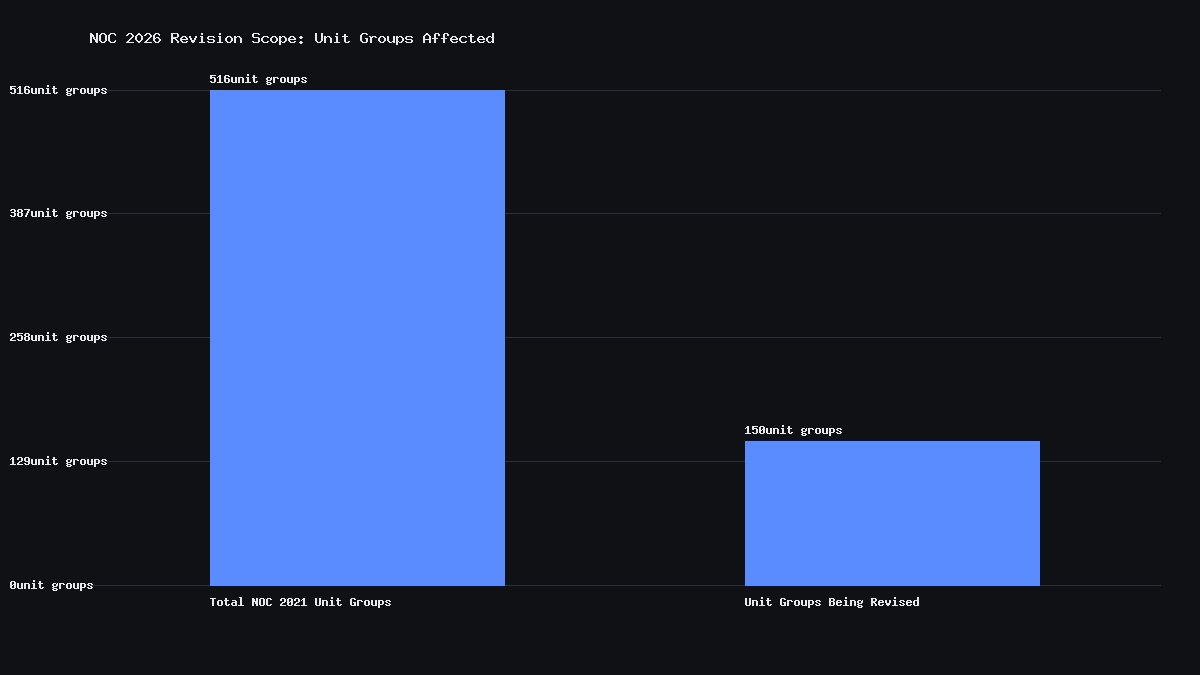
One more thing to watch for: Statistics Canada is rolling out NOC 2026, a major revision affecting roughly a third of all unit groups, expected in December 2026. Some occupations could shift TEER category or be restructured entirely — see our NOC 2026 changes guide for what’s being revised and how to check if your code is affected.
FAQ
What does TEER stand for?
Training, Education, Experience and Responsibilities — the four factors Canada’s NOC 2021 system uses to categorize every occupation into one of six levels, numbered 0 through 5.
Which TEER levels qualify for Express Entry?
TEER 0, 1, 2, and 3 occupations are eligible for the Federal Skilled Worker Program and Canadian Experience Class. TEER 4 and 5 occupations do not qualify for Express Entry, though some Provincial Nominee Program streams and regional pilots do accept them.
Is TEER 0 higher or lower than TEER 1?
TEER 0 is reserved exclusively for management occupations, regardless of the manager’s formal education. TEER 1 covers non-management professional occupations that typically require a university degree. Neither is strictly “higher” — they represent different types of roles rather than a single ranked scale.
Can my NOC code change if my job duties change?
Yes. Your TEER category and NOC code are based on the actual duties you perform, so a promotion, a change in responsibilities, or moving to a different employer can shift which NOC code — and TEER level — applies to your experience.
Canadianow is an independent publisher, not a law firm. Last reviewed: July 2026.
Sources
- Employment and Social Development Canada — NOC 2021 Version 1.0 Search Portal
- Statistics Canada — Introduction to NOC 2021 Version 1.0
- IRCC — Find Your National Occupational Classification (NOC)
- IRCC — Federal Skilled Worker Program Eligibility
Written by Caglar Aybas. Last reviewed: July 2026.
You can find the current official information on the official NOC portal.
Not sure which TEER category your job falls under, or whether it’s eligible for Express Entry? Get a personalized report on your NOC match, CRS score, and which pathway actually fits your situation.