Quick Answer
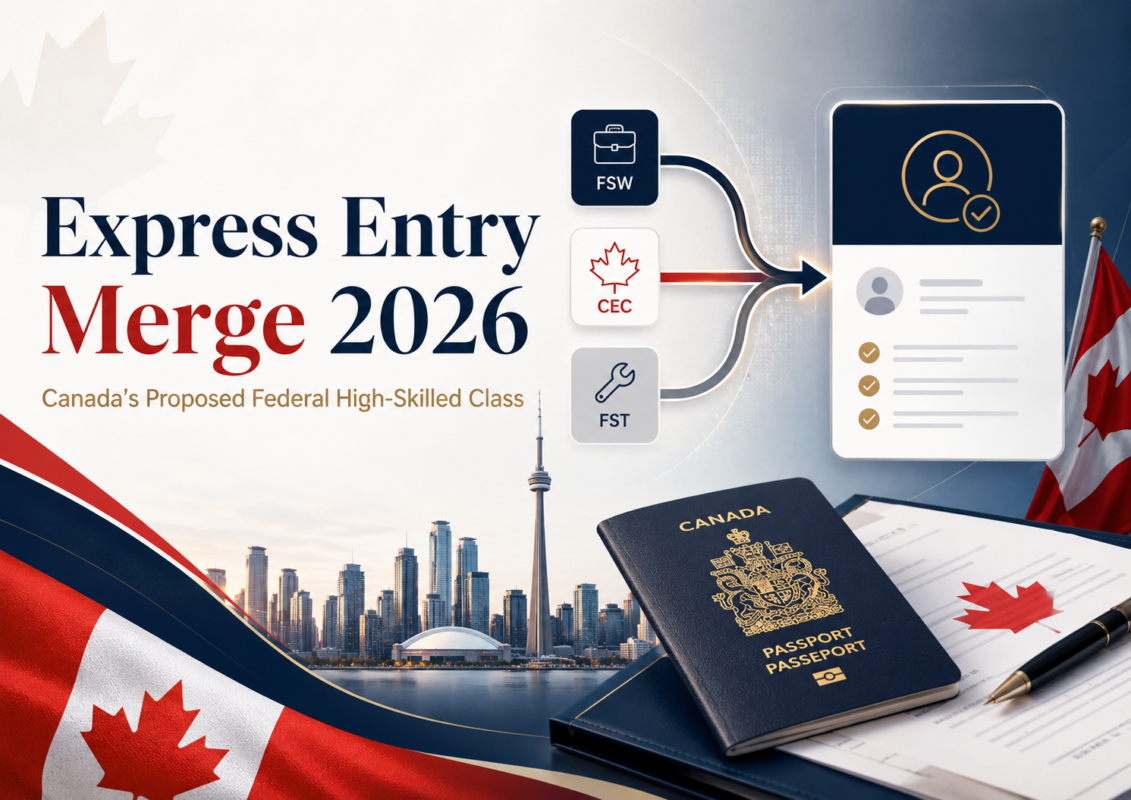
Canada is proposing to merge its three Express Entry programs — Federal Skilled Worker (FSW), Canadian Experience Class (CEC), and Federal Skilled Trades (FST) — into a single Federal High-Skilled Class. This is the biggest change to Express Entry since it launched in 2015. As of June 2026 it is still a proposal under consultation, not law. The current rules continue until regulations pass through the Canada Gazette. But the direction of travel is clear, and it changes who should apply now versus wait.
What Is Actually Changing
IRCC set out the plan in its Forward Regulatory Plan 2026–2028 and ran a public consultation that closed on May 24, 2026. Three structural changes are on the table:
- Three programs become one. FSW, CEC, and FST would be repealed and replaced by a unified Federal High-Skilled Class with one set of eligibility rules.
- CRS rebalancing. The Comprehensive Ranking System would shift points toward higher earnings, demonstrated labour-market demand, and high-wage job offers, and away from some existing factors.
- Possible removal of certain bonus points. Proposals discussed reducing or removing points for factors like French proficiency bonuses and the sibling-in-Canada bonus — though nothing is confirmed.
This article summarizes a proposal, not current law. It is not legal advice. The rules described here are not in force. Until regulations are formally enacted, Express Entry runs under the existing FSW, CEC, and FST framework. If you are in the pool or planning to apply, this is exactly the moment to get personalized advice from a licensed RCIC or immigration lawyer — the strategic decisions here are individual.
Why IRCC Says It Is Doing This
The three programs were designed before Express Entry existed in 2015, and were originally meant to be processed first-come, first-served. Under the current system they function only as minimum eligibility thresholds — actual selection happens through the CRS score and category-based draws. IRCC argues the program distinctions have become administrative friction that no longer affects who actually gets invited.
Who Benefits Under the Proposed Model
| Profile | Likely impact |
|---|---|
| High earners and those with high-wage job offers | Positive — CRS would reward earnings more |
| Skilled workers abroad with strong credentials | Possibly positive — a lower language threshold (CLB 6 vs 7) was discussed |
| Candidates relying heavily on Canadian experience (CEC) | Possibly negative — raw Canadian work time may be devalued |
| French-speaking candidates relying on the French bonus | Uncertain — bonus could be reduced |
| Candidates using the sibling-in-Canada bonus | Negative — this bonus was flagged for removal |
What You Should Do Right Now
- If you are already eligible under current rules, act on the current system. The existing framework still applies. Strong CEC profiles in particular may want to submit while raw Canadian experience still carries full weight.
- Build CRS resilience that survives any model. Higher language scores and a strong NOC match help under both the current and proposed systems. A jump from CLB 8 to CLB 9 across all four abilities can add 20–30 points.
- Do not panic-apply with a weak profile. Nothing changes overnight; regulations must pass through the Gazette process first.
- Watch the Canada Gazette, not headlines. Only a published regulation makes this real.
What Happens to People Already in the Pool
IRCC has been clear that current draws continue under current rules until new regulations are enacted. The agency issued tens of thousands of invitations across draws in early 2026 under the existing structure. A profile in the pool today is assessed under today’s rules. If new regulations pass while your profile is active, transitional provisions would normally apply — but those provisions have not been published, which is precisely why the situation is worth monitoring.
Timeline: How Fast Could This Happen?
- April 2026: Proposal published in the Forward Regulatory Plan
- May 24, 2026: Public consultation closed
- Next: IRCC reviews feedback, drafts regulations
- Required step: Publication in the Canada Gazette (Part I for comment, then Part II to take effect)
- No confirmed implementation date as of June 2026
Because this is a regulatory amendment rather than legislation, it could move relatively quickly once drafted — but the Gazette process still takes months.
FAQ
Should I wait for the new system before applying?
For most candidates, no. The current system is open and predictable. Waiting for an undefined future system with unknown rules is riskier than applying under rules you can see today.
Will my CRS score change automatically?
Not until regulations are enacted. If and when the new CRS weighting takes effect, IRCC would recalculate scores under the new grid — potentially up or down depending on your profile.
Does this affect Provincial Nominee Programs?
PNPs operate separately. A provincial nomination still adds 600 CRS points and remains the single largest score boost available under both the current and proposed models.
Canadianow is an independent publisher, not a law firm. This article summarizes proposals as of June 2026; verify current rules on canada.ca. Last reviewed: June 2026.
Sources
- IRCC — Forward Regulatory Plan 2026–2028
- IRCC — Express Entry consultation (closed May 24, 2026)
- Canada Gazette — regulatory amendment process
Written by Caglar Aybas. Last reviewed: June 2026.
You can find the current official information on IRCC.
Every case is different. If you want a clear, personalized breakdown of your options — CRS score, eligible programs, and next steps — we can put one together for you.