Your first Notice of Assessment (NOA) arrives a few weeks after you file your first Canadian tax return, and a lot of newcomers glance at the bottom line, see they don’t owe anything, and file the letter away without reading it. That’s a mistake, because the NOA isn’t just a receipt — it’s a document you’ll be asked to produce again and again over the next few years, often with very little notice, for things that have nothing to do with taxes on the surface.
What the NOA Actually Confirms
The Canada Revenue Agency issues a Notice of Assessment after processing your return, and it states what the CRA has officially recorded as your income, deductions, and tax owed or refunded for that year — which may not match exactly what you filed, since the CRA sometimes adjusts figures based on information they receive independently from employers, banks, or other sources. If your NOA shows a different result than what you filed, read the explanation section closely; it will usually say why, and you have the right to dispute it if you think the CRA made an error, though most differences turn out to be minor corrections rather than mistakes worth fighting.
Where You’ll Actually Need to Show It
| Situation | Why the NOA Matters |
|---|---|
| Mortgage or major loan application | Lenders use it to verify your reported income independently of pay stubs |
| Family sponsorship applications | IRCC requires NOAs as proof of income meeting the low income cut-off (LICO) threshold |
| Provincial nominee and some Express Entry streams | Certain PNP and job-offer streams request NOAs as income verification |
| RRSP contribution room | Your NOA states your exact available RRSP room for the following year |
| Student loan and grant applications | Some provincial programs use household NOA-verified income for assessment |
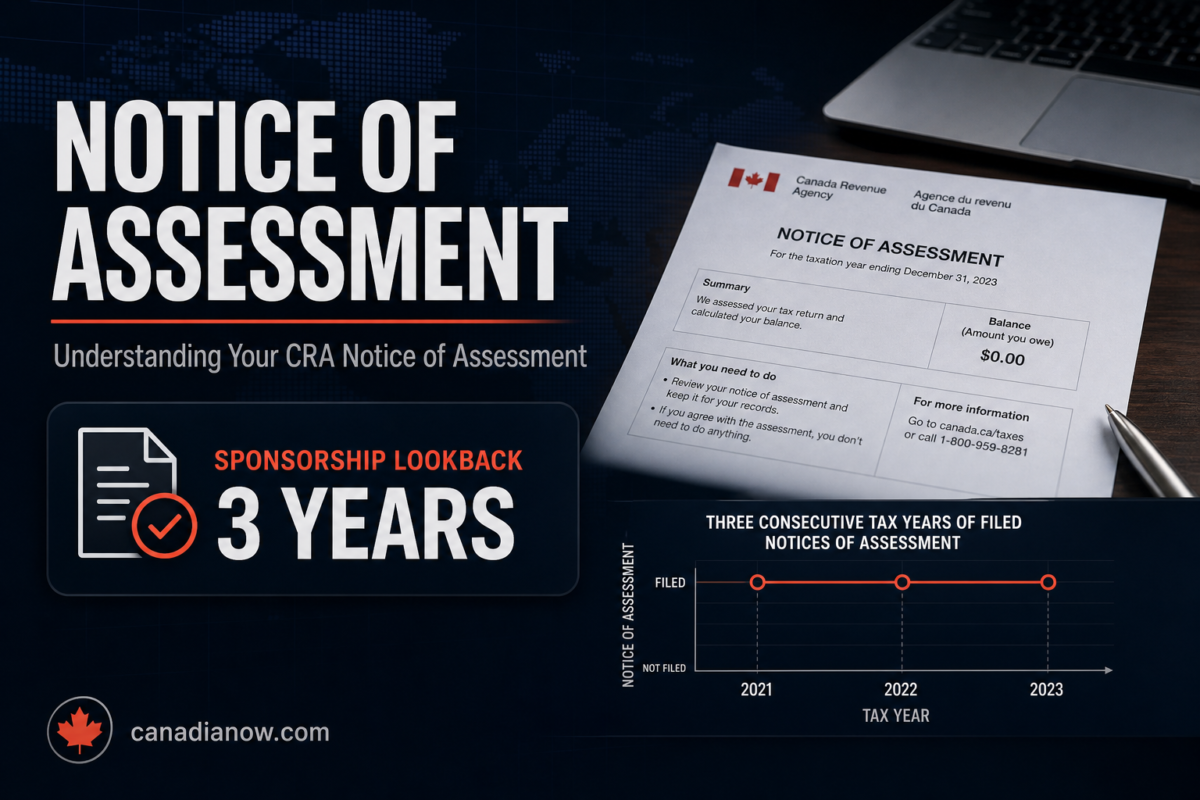
The family sponsorship use case is the one that trips up newcomers most often, because it’s not about your income in the year you apply — many sponsorship streams look at your NOAs from the past three tax years, which means a newcomer who only recently started filing in Canada may not have enough NOA history yet to qualify as a sponsor, regardless of current income. If sponsorship is part of your longer-term plan, that’s a reason to make sure you’re filing every year without gaps from the moment you become required to, even in years your income is low.
How to Get a Copy If You’ve Lost It
You don’t need to keep a physical copy forever — the CRA My Account portal keeps your NOA history available indefinitely, and you can view or download any past year’s notice directly from there once your account is set up and verified. If you haven’t registered for CRA My Account yet, do it as soon as you’ve filed your first return; it’s also how you’ll track refunds, benefit payments, and RRSP room going forward, so there’s no reason to wait until you specifically need an NOA to set it up.
The Line Newcomers Often Misread: “Balance Owing” vs Refund
The NOA states, near the top, either an amount owing or a refund amount, and it’s easy to misread which one applies, especially in the first year when the format is unfamiliar. If you owe money and don’t pay it by the deadline stated on the notice, interest starts accruing from the original filing due date, not from the date on the NOA — so a bill that shows up weeks after filing can already include several weeks of interest if you filed close to the deadline. Read this line carefully, and if anything is ambiguous, log into CRA My Account rather than guessing from the paper letter.
What “Notice of Reassessment” Means, and Why It’s Different
Occasionally the CRA reviews a return after the fact and issues a Notice of Reassessment, which supersedes your original NOA and can either increase or decrease what you owe. This is a normal part of the system — a portion of returns are selected for closer review, or reassessed automatically when new information comes in from a third party like an employer’s corrected slip — and it isn’t inherently a sign of a problem. Compare it carefully against your original filing and NOA, and if the change is substantial or unclear, it’s worth a call to the CRA or a tax professional before simply paying whatever the new balance says.