What Job Bank Actually Is
Job Bank is the Government of Canada’s official employment platform, run by Employment and Social Development Canada, and it exists for two overlapping purposes: connecting job seekers with employers, and generating the labour market data that feeds directly into how IRCC and provinces decide which occupations are in demand. That second function is why it’s worth using even if you find your actual job somewhere else — the data trail matters.The Immigration-Specific Reason to Have a Profile
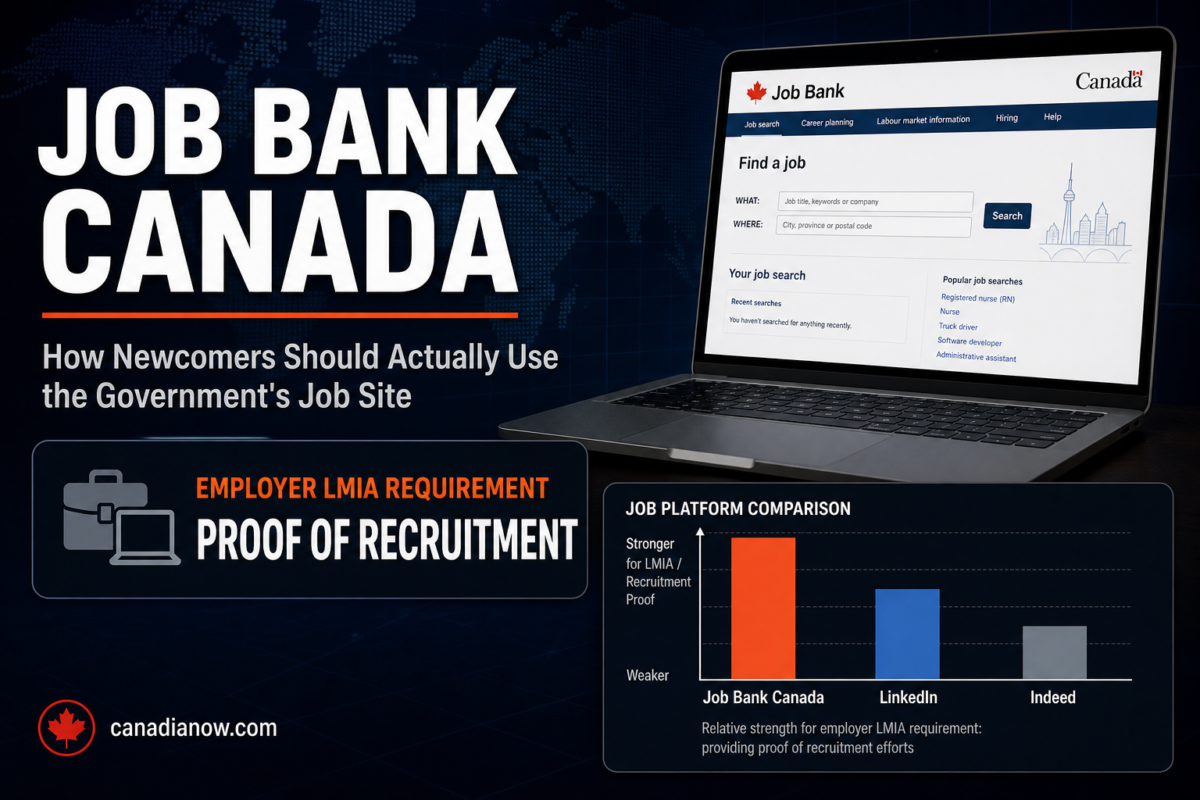
Creating a Job Bank account and building a profile makes you visible to employers searching for candidates, but it also connects to the Job Match feature, which some employers use specifically when they’re trying to fill a role that could support an LMIA application. Employers pursuing certain LMIA streams are required to demonstrate genuine recruitment effort in the Canadian labour market before hiring a foreign worker, and posting through Job Bank with documented advertising is one of the standard ways they satisfy that requirement. A complete, well-built profile puts you in front of exactly the employers who are already navigating that process, rather than ones who haven’t considered sponsoring a work permit at all.Building a Profile That Actually Gets Matched
The matching algorithm weighs your listed skills, NOC code, location flexibility, and language proficiency against employer postings, so a thin profile with just a resume attached performs worse than one where you’ve filled in the structured fields completely. It’s worth spending real time on this rather than treating it as a formality — list every relevant certification, be specific about the NOC code that matches your experience rather than a vague nearby one, and set your location radius wide enough to surface postings in nearby cities if you’re open to relocating.The Wage Report Tool Most People Never Find
Buried inside Job Bank is a wage report tool that shows median, low, and high wages by occupation and region, pulled from real labour market data rather than crowd-sourced estimates. This is genuinely useful before a salary negotiation or before deciding whether a job offer is reasonable for your role and city — it’s one of the more reliable free sources for this in Canada, and most newcomers never discover it because it’s not the first thing the homepage surfaces.Using Job Bank Alongside, Not Instead of, Other Platforms
The realistic approach is running Job Bank in parallel with LinkedIn, Indeed, and industry-specific boards, not relying on it exclusively. Job Bank tends to be stronger for roles in the trades, healthcare support, transportation, and other occupations the government actively tracks for labour shortages, and comparatively thinner for tech, marketing, and corporate roles where private platforms dominate. Knowing which category your target role falls into helps you weight your time appropriately instead of splitting effort evenly across platforms that don’t serve your occupation equally well.A Practical Warning About Fake Postings
Job Bank vets employers before they can post, which makes it meaningfully safer than open platforms where anyone can list a job, but it’s not immune to scams entirely — some fraudulent LMIA-related job offers, where someone charges a newcomer money for a “guaranteed” job offer meant to support an immigration application, use a real-looking Job Bank posting as cover for the scam happening off-platform. A legitimate employer never charges you for a job offer, and any recruiter asking for payment tied to an LMIA or work permit sponsorship should be treated as an immediate red flag regardless of what platform introduced you.Frequently Asked Questions
Is Job Bank only useful for LMIA-related jobs?
No. Most listings have nothing to do with LMIA or immigration at all u2014 it’s a general job platform. The LMIA connection is one specific advantage worth knowing about, not the platform’s main purpose.
Do I need to be in Canada to create a Job Bank profile?
No, you can create a profile from outside Canada. Many candidates start building their profile and researching in-demand occupations well before they land.
Is the wage report data reliable for salary negotiation?
It’s drawn from real labour market data rather than self-reported estimates, which makes it a more credible starting point than crowd-sourced salary sites, though it’s still worth cross-checking against a couple of other sources for a specific role.