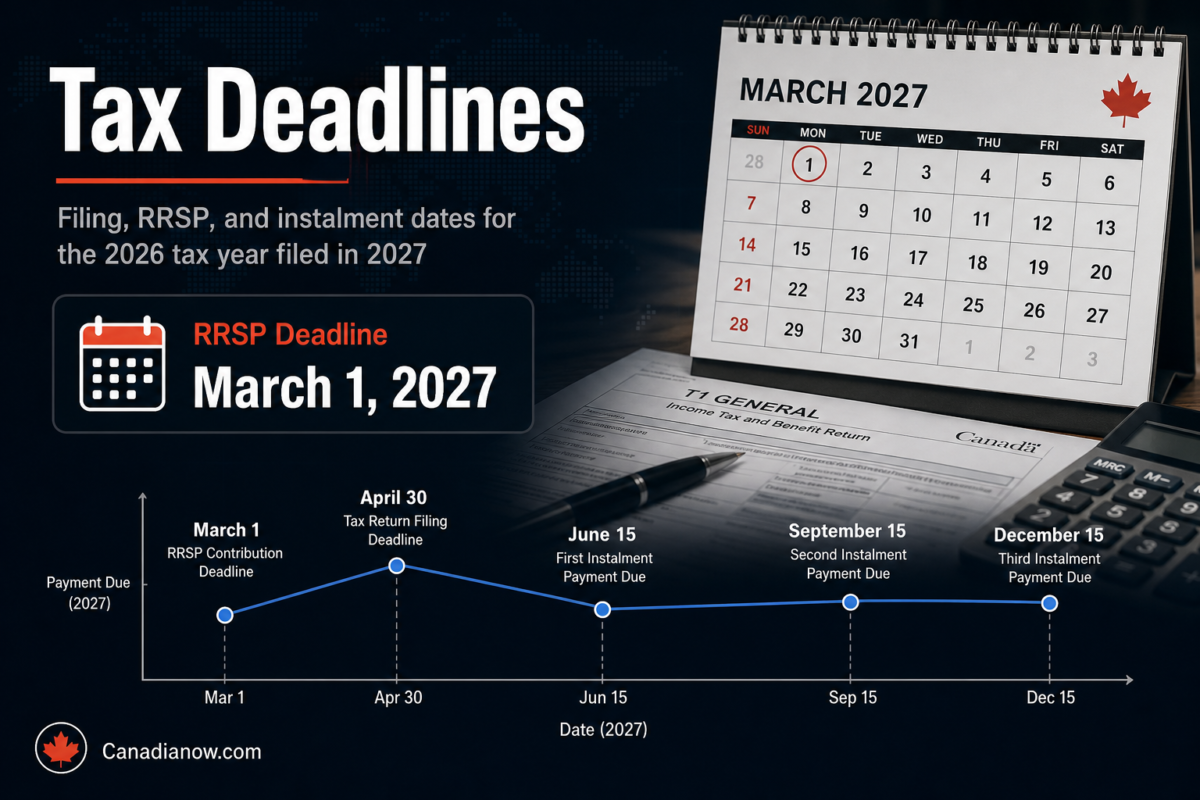
Canadian tax deadlines are not one date. There is a filing deadline, a payment deadline that can differ from it, a contribution deadline that falls two months earlier, and instalment dates spread through the year. Missing the wrong one costs interest; missing the right one costs benefits.
Here is every date that matters for the 2026 tax year, filed in 2027.
The Dates
- Monday, March 1, 2027 — RRSP contribution deadline for the 2026 tax year
- Friday, April 30, 2027 — filing deadline for most individuals, and the payment deadline for everyone
- Tuesday, June 15, 2027 — filing deadline if you or your spouse were self-employed
- March 15, June 15, September 15, December 15, 2027 — quarterly instalment dates
The Trap: Self-Employed Filing vs Payment
This one costs people money every year. If you are self-employed, you get until June 15 to file — but any balance owing is still due April 30.
Interest begins accruing on May 1 on anything unpaid, even though your return is not late. The extra six weeks are for paperwork, not for payment. If you expect to owe, estimate and pay by April 30, then file properly in June.
Why the RRSP Deadline Is in March
Contributions made in the first 60 days of a calendar year can be applied to either the previous tax year or the current one. For the 2026 tax year that window closes March 1, 2027.
This is the last lever available to reduce your 2026 taxable income after the year has already ended — which is why the deadline generates so much financial-industry noise in late February. It is also worth knowing that you can contribute and choose to deduct in a later year, if your income will be higher then.
Newcomers: File Even With No Income
The single most consequential misunderstanding among new arrivals is that filing is optional when you earned nothing in Canada.
Filing is what triggers benefit eligibility. The Canada Child Benefit, the GST/HST credit (now the Canada Groceries and Essentials Benefit), the Ontario Trillium Benefit and provincial credits are all calculated from your filed return. No return means no assessment, which means no payments — regardless of how low your income was.
If you arrived partway through 2026, you file for 2026 and report your Canadian income from your date of entry, along with world income for the part-year residency calculation.
Who Has to Pay Instalments
Instalments apply if your net tax owing exceeded a threshold in the current year and in either of the two previous years. In practice this catches the self-employed, people with significant investment income, and retirees whose pension income has insufficient tax withheld.
The CRA sends instalment reminders in February and August. Those reminders are not bills — they are calculated estimates, and you can pay based on your own projection instead if your income has dropped.
What Happens If You File Late
The late-filing penalty is a percentage of the balance owing plus an additional amount for each full month the return is late. If nothing is owing, there is no penalty — but benefit payments still stop until the return is assessed, which is usually the more expensive outcome for lower-income households.