Updated July 2026. In March 2026 the Prime Minister’s Office announced that Ted Gallivan would become Deputy Minister of Immigration, Refugees and Citizenship, replacing Dr. Harpreet S. Kochhar, who moved to lead the Canadian Food Inspection Agency. Now that Gallivan has settled into the role, here’s what the appointment means — and doesn’t mean — for people with applications in the system.
Who Ted Gallivan Is
Gallivan is a career federal executive with an enforcement-heavy résumé rather than an immigration-program background:
- Interim Deputy National Security and Intelligence Advisor to the Prime Minister (from February 2025)
- Executive Vice-President of the Canada Border Services Agency (CBSA) — the agency responsible for border enforcement, detention, and removals
- Senior leadership roles at the Canada Revenue Agency, including compliance programs
That profile matters. Deputy ministers are the top non-political officials in a department: they don’t set policy direction (ministers and cabinet do), but they decide how the machine runs — processing priorities, integrity screening, how aggressively rules are operationalized.
Why the Government Made This Move
The appointment fits a visible pattern through 2025–26: Ottawa has been tightening the temporary-resident system — study permit caps and compliance checks, LMIA scrutiny, and the proposed asylum-system overhaul. Placing a CBSA and national-security veteran atop IRCC signals that program integrity and enforcement coordination are the operational priority, not expansion.
What It Means for Applicants
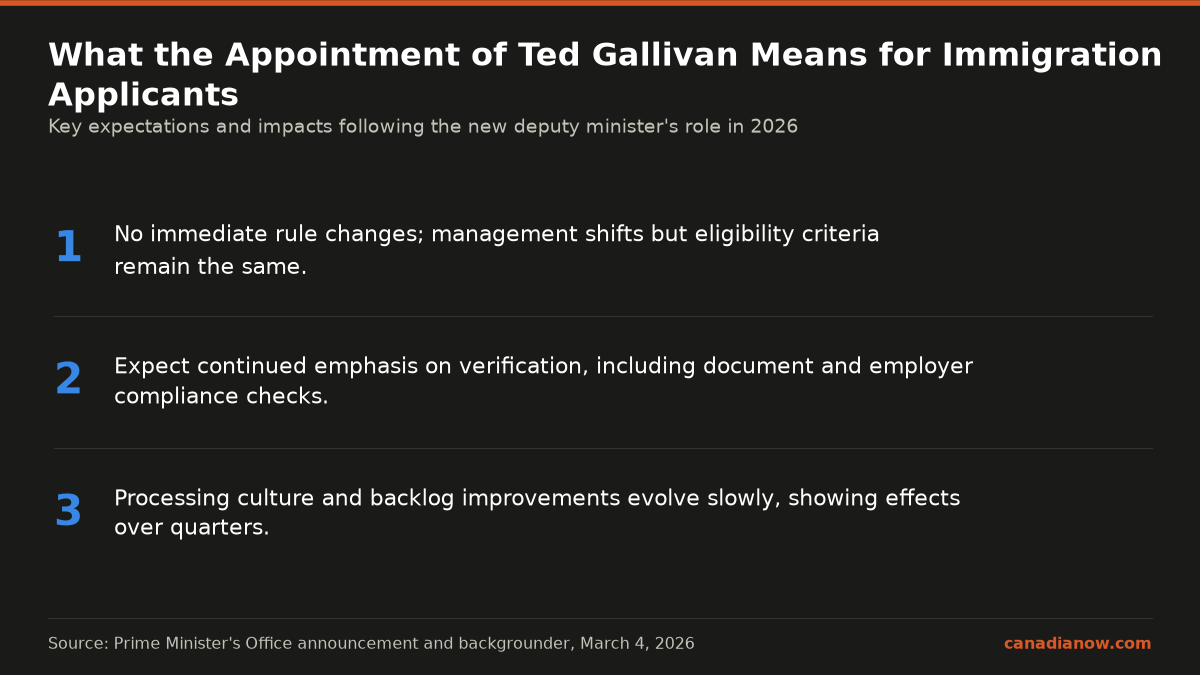
- No immediate rule changes. A deputy minister swap changes management, not law. Your eligibility criteria didn’t move.
- Expect continued emphasis on verification. The trend of document verification, employer compliance checks, and study-permit compliance reviews (like the June 2026 update we covered here) is consistent with this leadership direction.
- Processing culture evolves slowly. Deputy ministers influence backlogs through resourcing decisions; any effect shows up over quarters, not weeks.
The Bigger Picture
Kochhar’s tenure (January 2024 to early 2026) covered the levels-plan reductions and the caps era. Gallivan inherits a department mid-transition: shrinking temporary-resident targets, new asylum legislation in progress, and public pressure over housing-linked immigration debates. Watch three things through the rest of 2026: how the asylum reform regulations are implemented, whether study/work permit compliance actions accelerate, and whether processing standards hold as volumes shift.
Related Coverage
- Canada’s proposed asylum reform: what’s actually in it
- IRCC’s study permit compliance update
- Express Entry Canada: the complete guide
Source: Prime Minister’s Office announcement and backgrounder, March 4, 2026.
You can find the current official information on IRCC.
General information only gets you so far. For a report built around your specific profile — province options, CRS score, and timeline — check out our personalized reports.