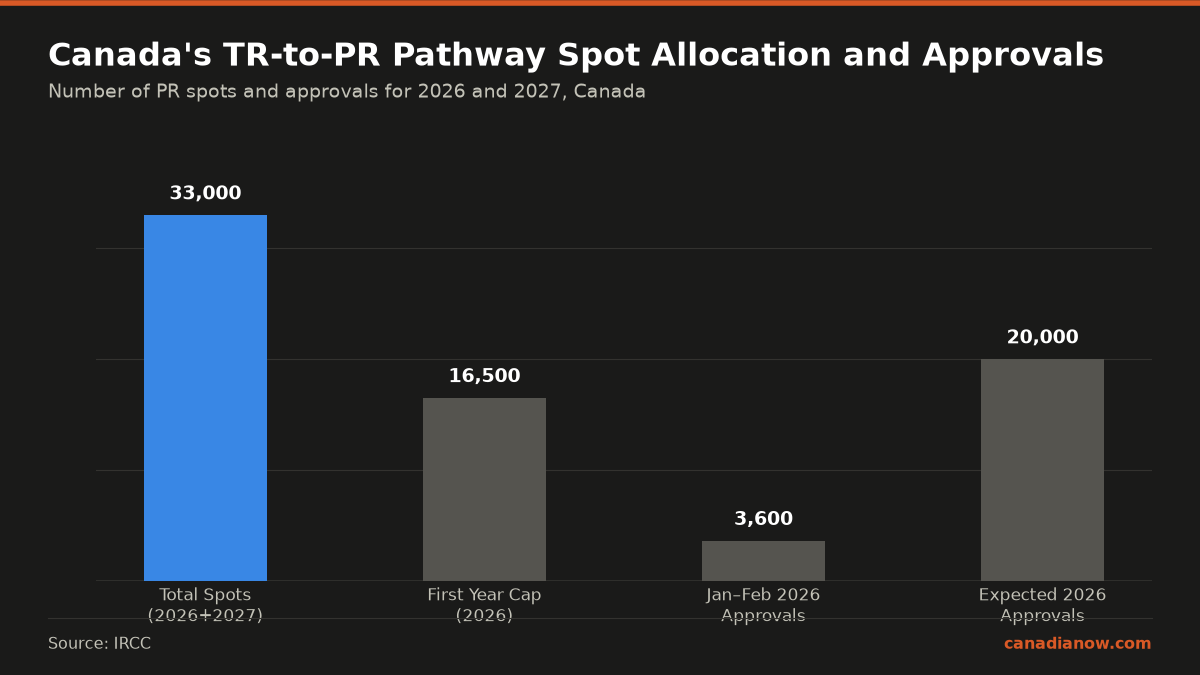
Updated July 2026. Canada’s one-time TR-to-PR pathway — officially the In-Canada Workers Initiative — is real, running, and different from what most rumours claimed. It will transition up to 33,000 temporary workers to permanent residence across 2026 and 2027. Here’s the current state of the program, who it actually covers, and what (if anything) you should do.
What the Program Is
The In-Canada Workers Initiative is a limited, one-time measure — not a new permanent immigration stream. It has two parts:
- Fast-tracking existing applications: IRCC is prioritizing PR applications already in its inventory from workers who applied through programs like the Provincial Nominee Program and have been living in a smaller community for at least two years. No action needed — eligible files are pulled automatically.
- A new application window: a portal opened in May 2026 with a hard cap of 16,500 spots for the first year, first-come first-served for complete applications.
Progress so far: IRCC granted PR to about 3,600 workers in January–February 2026 alone and says it’s on track for at least 20,000 approvals in 2026, with the remainder in 2027.
The Detail Everyone Misses: Big Cities Are Excluded
Toronto, Montreal, Vancouver — and all 41 Census Metropolitan Areas — are excluded. This program is explicitly for workers settled in smaller communities and rural regions. If you live and work in a major metro, this pathway is not for you, and no agent or consultant can get you into it.
Who Should Pay Attention
- Workers in smaller communities with a PR application already filed: you may be fast-tracked without lifting a finger — watch your IRCC account for movement
- Workers with 2+ years in a non-CMA community considering the application window: completeness is everything in a first-come first-served cap; have language tests, reference letters, and police certificates ready before the portal is your bottleneck
- Everyone else: your paths remain the standard ones — Express Entry, PNPs, and family sponsorship
Beware the Scam Layer
Every capped, headline-grabbing program spawns fraud. Remember: there is no fee anyone can pay to “reserve a spot,” IRCC never contacts applicants through WhatsApp, and job offers sold for cash to qualify for this pathway are the same LMIA-style scams we’ve documented before — they end in refusals and bans, not PR.
The Bigger Picture
This initiative exists because Ottawa cut temporary-resident targets while hundreds of thousands of workers were already here and integrated. Expect the government to judge its results (retention in smaller communities, processing speed) before deciding whether anything like it becomes permanent. Official details are published on IRCC’s site — treat any “guaranteed spots” messaging elsewhere as marketing.
Related Guides
- TR to PR options in Canada: everything currently open
- Canadian Experience Class (CEC) guide
- Atlantic Immigration Program
Program details as reported by IRCC and immigration media through May 2026; caps and criteria can change — verify on IRCC’s official pages before applying.
Not sure how this affects your own eligibility? Get a personalized report on your CRS score and which Express Entry or PNP category actually fits your situation.