Updated July 2026. December 2025 brought a cluster of federal and municipal changes touching travel, workplace rights, drug enforcement, and Toronto homeowners. Here’s what actually took effect.
Canada Strong Pass Renewed
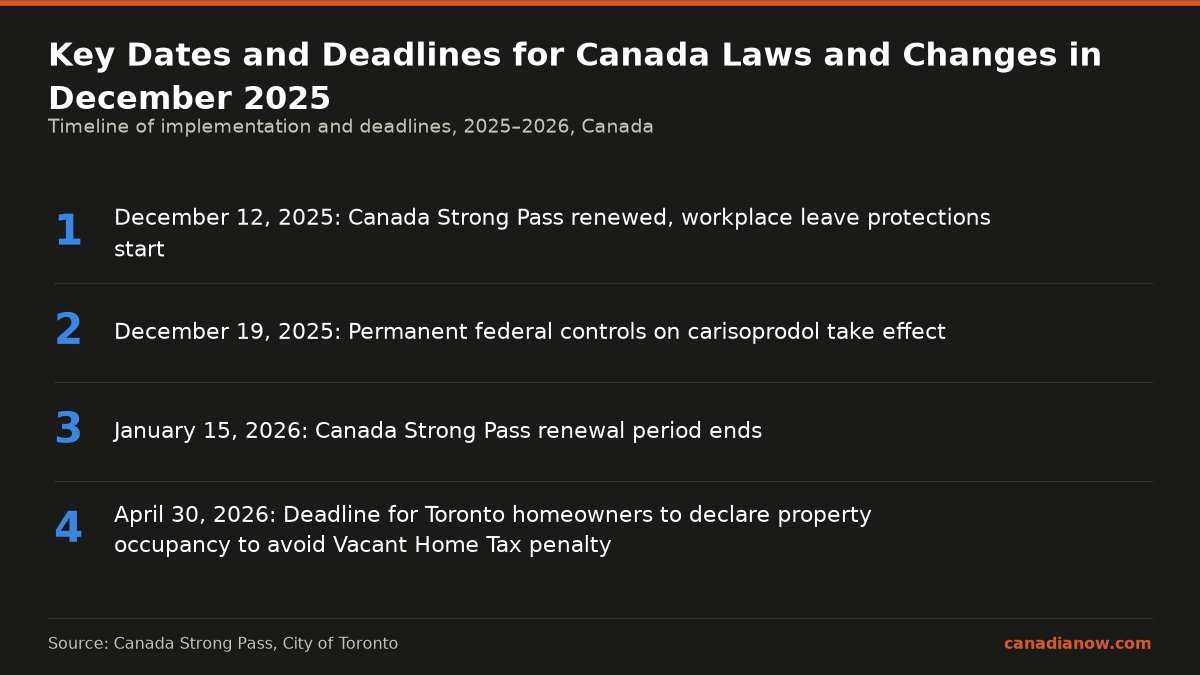
The Canada Strong Pass — the federal program offering affordable domestic travel — was renewed from December 12, 2025 to January 15, 2026, with a further relaunch planned for summer 2026. There’s no physical pass or registration required: Canadians simply visit a participating site or travel partner to access free admission to Parks Canada sites, camping discounts, museum admissions, and VIA Rail travel offers.
New Workplace Leave Protections
Starting December 12, 2025, amendments to the Canada Labour Code strengthened leave rights for federally regulated employees. Changes included extended leave protections following pregnancy loss, expanded bereavement leave of up to 8 weeks for the death of an employee’s child (including a spouse’s or common-law partner’s child), and modernized rules around job security and benefits continuation during extended leave.
Permanent Controls on Carisoprodol
Effective December 19, 2025, Canada implemented permanent federal controls on the sedative carisoprodol. Health and enforcement agencies found that earlier temporary controls hadn’t fully deterred organized crime groups from importing the substance — which is often mixed with opioids or counterfeit pills — so permanent scheduling now allows border agents and police to pursue stronger investigations and penalties.
Toronto’s Vacant Home Tax Declaration
Toronto’s 2025 Vacant Home Tax declaration portal opened, requiring all residential property owners to declare their property’s occupancy status for the January 1 to December 31, 2025 period, with a deadline of April 30, 2026, to avoid penalties. Toronto doesn’t rely solely on self-reported declarations — the city cross-checks claims using utility-usage data, mail delivery patterns, 311 complaint records, building permits, and data-sharing agreements with provincial and federal agencies. The tax targets vacant residential properties as part of the city’s broader housing supply strategy.
Sources: Canada Strong Pass, official program page; City of Toronto, Vacant Home Tax.