Quick Answer
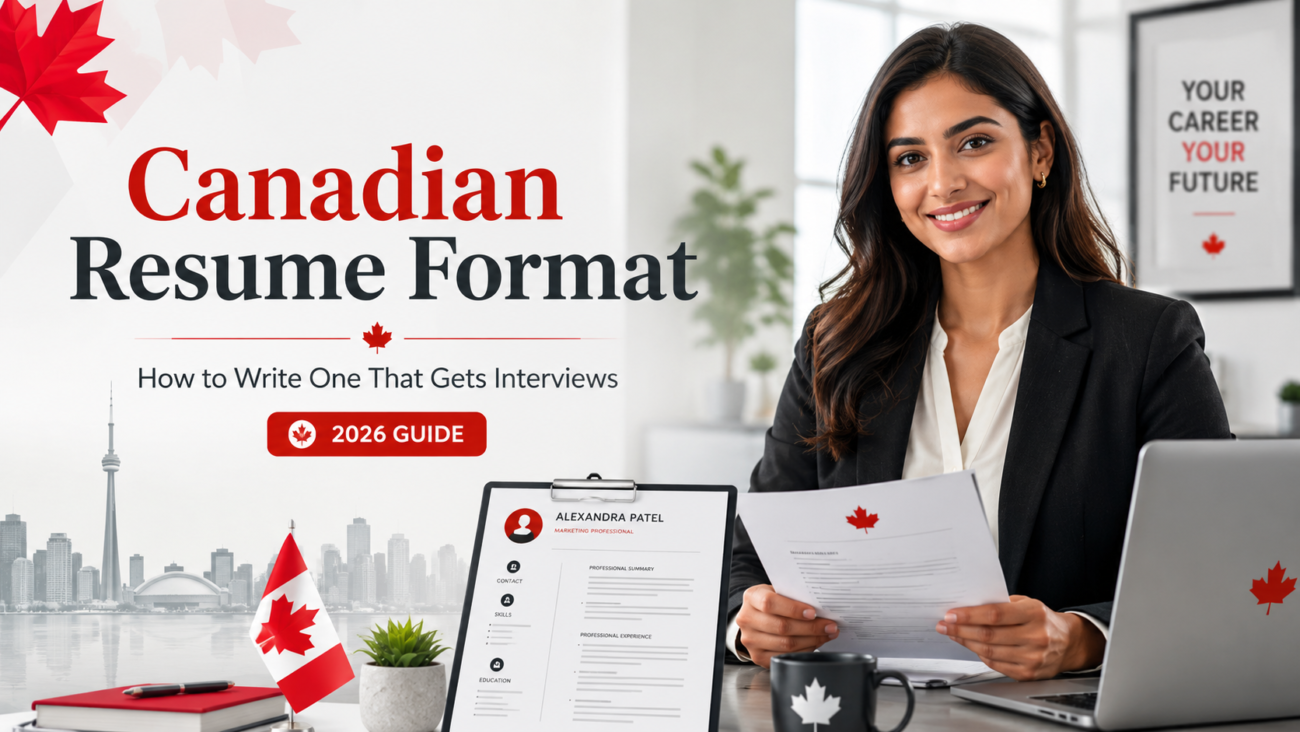
A Canadian resume is typically 2 pages maximum, reverse chronological, no photo, no personal information (age, marital status, religion, nationality), and focused on measurable results. Canadians expect clean formatting, ATS-compatible structure, and a brief professional summary at the top. Hiring managers in Canada read dozens of resumes daily — first impressions are decided in under 10 seconds.
How Canadian Resumes Differ From Other Countries
| Element | Canada standard | Common in other countries (do NOT do this in Canada) |
|---|---|---|
| Photo | Never include | Common in Turkey, Germany, China, India |
| Age / date of birth | Never include | Standard in many countries |
| Marital status | Never include | Common in South Asia, Middle East, Europe |
| Nationality / visa status | Never include on resume | Common in many countries |
| Gender / pronouns | Optional only if you choose | — |
| Length | 1–2 pages max | 3–5 page CVs are normal in UK, academia |
| “References available upon request” | Outdated — remove it | Standard phrase in many countries |
| Objectives statement | Replaced by professional summary | Common in US/UK resumes of the 1990s–2000s |
The Standard Canadian Resume Structure
Use this order:
- Header: Full name, city/province (no street address), phone, professional email, LinkedIn URL (optional), GitHub or portfolio (if relevant)
- Professional Summary: 3–4 lines describing who you are professionally, your top skills, and what you bring. Tailor it to each job posting.
- Work Experience: Reverse chronological. For each role: Company name, your job title, city/province, start–end month/year. Then 3–5 bullet points of accomplishments, not just duties.
- Education: Degree, institution, city, year graduated. If you have a foreign degree, add your ECA reference number or specify the Canadian equivalent.
- Skills: Technical skills, software, languages. Keep it factual — only list skills you can demonstrate in an interview.
- Certifications and Professional Development: Only include relevant ones with dates.
The Most Important Rule: Results, Not Duties
Most newcomer resumes describe job duties. Canadian hiring managers want to see results. The formula is:
[Action verb] + [what you did] + [measured result]
| Duty-focused (weak) | Results-focused (strong) |
|---|---|
| Responsible for managing social media accounts | Grew Instagram following from 5,000 to 22,000 in 18 months through content strategy |
| Worked with sales team to increase revenue | Exceeded sales targets by 23% in Q3 2024, highest in 5-person team |
| Was in charge of customer service | Maintained 97% customer satisfaction score across 200+ monthly interactions |
| Helped implement new software system | Led ERP migration for 40-person department; completed 3 weeks ahead of schedule |
ATS Optimization: What It Means for Newcomers
Most Canadian employers with more than 50 employees use Applicant Tracking Software (ATS) to filter resumes before a human reads them. ATS scans for keywords matching the job posting.
To pass ATS:
- Use the exact job title from the posting in your summary if it matches your experience
- Mirror specific language from the job description (e.g. if posting says “cross-functional collaboration”, use that phrase)
- Avoid tables, text boxes, columns, graphics, and headers/footers — ATS often cannot read these
- Save as .docx or PDF (check job posting for preferred format)
- Use standard section headings (Work Experience, Education, Skills) — creative headings confuse ATS
Foreign Credentials on a Canadian Resume
Do not hide foreign education or experience. Canadians value international backgrounds. What matters is clarity:
- Write degree names in English, add the original language in brackets if notable
- Include the country: “University of Istanbul, Turkey” not just “University of Istanbul”
- If you have an ECA, you can note: “Recognized as equivalent to Canadian Bachelor’s degree (WES ECA)”
- For regulated professions (engineering, nursing, accounting), list your registration status: “Currently pursuing P.Eng. designation, Ontario”
Cover Letters
Canadian employers expect a cover letter for most professional positions. Unlike some countries where cover letters are generic, Canadian cover letters should be specific:
- Name the company and the exact role in paragraph 1
- Explain in 2–3 sentences why you are the right person for this role
- Reference 1–2 specific things about the company that interest you (from their website)
- Maximum one page; most are 250–400 words
FAQ
Should I include my Canadian work permit or PR status on my resume?
No. Do not include immigration status on a Canadian resume. You may be asked about your right to work in a separate section of the application, but it does not belong on your resume. Including it can lead to discrimination, which is illegal but difficult to prove.
Do Canadian employers check education from other countries?
Most do not independently verify foreign credentials unless the role is regulated. For non-regulated roles, your resume and interview performance carry more weight. Having an ECA from WES or IQAS removes any ambiguity.
Is a Canadian resume different from an American one?
Mostly no — the formats are nearly identical. The main difference: US resumes often include a GPA and some use one page more aggressively. Canadian resumes are slightly more flexible on length (2 pages is standard) and de-emphasize the one-page rule seen in some US advice.
Sources
Written by Caglar Aybas. Last reviewed: June 2026.
For official, up-to-date details, see Job Bank.
If you'd rather have this mapped out for your exact situation instead of piecing it together yourself, our personalized report covers eligibility, CRS score, and next steps.