Quick Answer
Whether you can exchange your foreign driver’s licence in Canada without taking tests depends on two things: which province you live in and which country issued your licence. Licences from countries with reciprocal agreements (US, UK, Australia, Germany, France, South Korea, Japan and others) usually swap directly. Everyone else gets partial credit for experience but must pass knowledge and road tests. You generally have 60–90 days after becoming a resident to stop driving on your foreign licence.
The Two Questions That Decide Everything
- Does your licence country have an exchange agreement with your province? Each province maintains its own list — they are similar but not identical.
- How many years of driving experience can you prove? Two or more years usually lets you skip graduated licensing stages even when tests are required.
Exchange Agreements by Province (Major Countries)
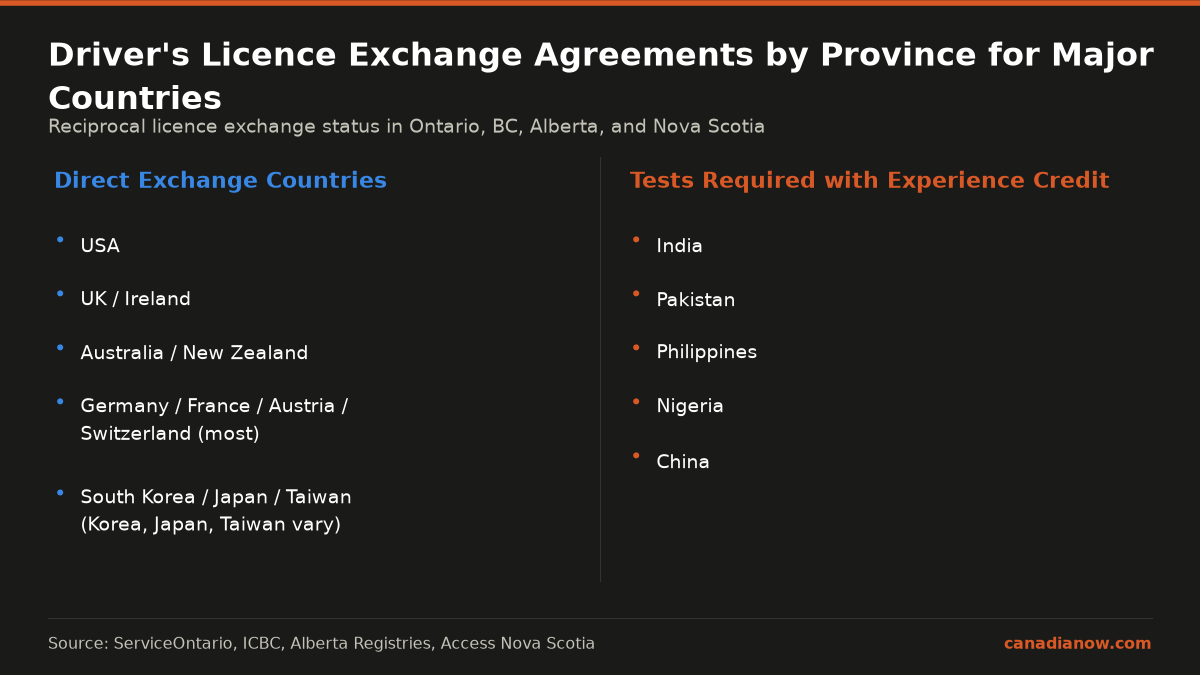
| Licence from | Ontario | BC | Alberta | Nova Scotia |
|---|---|---|---|---|
| USA | Direct exchange | Direct exchange | Direct exchange | Direct exchange |
| UK / Ireland | Direct exchange | Direct exchange | Direct exchange | Direct exchange |
| Australia / NZ | Direct exchange | Direct exchange | Direct exchange | Direct exchange |
| Germany / France / Austria / Switzerland | Direct exchange | Direct exchange | Direct exchange | Most: direct |
| South Korea / Japan / Taiwan | Direct exchange | Direct exchange (Korea, Japan) | Direct (Korea, Japan) | Korea, Japan: direct |
| India / Pakistan / Philippines / Nigeria / China / Brazil | Tests required, experience credit given | Tests required | Tests required | Tests required |
Lists change — Ontario added and adjusted countries several times in recent years. Verify on your province’s licensing site (DriveTest/ServiceOntario, ICBC, Alberta Registries, Access Nova Scotia) before booking anything.
Driving without a valid licence after your grace period ends is a provincial offence and can void your car insurance entirely — meaning an at-fault accident leaves you personally liable for all damages. The grace period (60 days in Ontario, 90 in BC and Alberta) starts when you become a resident, not when you feel settled. Treat this as a first-month task.
Direct Exchange: How It Works
- Go to the provincial licensing office (ServiceOntario/DriveTest, ICBC, registry agent in Alberta)
- Bring: foreign licence, passport, immigration document (work/study permit, PR card, COPR), proof of provincial residence
- If your licence is not in English or French: a certified translation, or in some provinces a letter from the issuing authority
- Driving experience proof: if your licence does not show the original issue date, get a driving record / licence verification letter from your home authority — this is the document people most often miss
- Pass a vision test, pay the fee ($90–$160 depending on province), surrender your foreign licence in most provinces
- Temporary licence issued same day; the card arrives by mail
Non-Agreement Countries: The Experience Credit Path
Using Ontario as the example (other provinces are similar in logic):
| Provable foreign experience | What you skip | What you must do |
|---|---|---|
| 2+ years | Skip G1 waiting period and G2 stage | Pass knowledge test, then book the full G road test directly |
| 1–2 years | Skip part of the graduated wait | Knowledge test + G2 road test, then G later |
| Under 1 year / no proof | Nothing | Full graduated licensing from G1 |
The “proof” is the foreign driving record or authentication letter. Without it, your 10 years of experience count as zero. Order this document before you leave your home country if at all possible — obtaining it remotely is much harder.
What About an International Driving Permit (IDP)?
An IDP is only a translation of your existing licence. It does not extend your grace period, does not replace the exchange process, and does not function as a licence by itself. Useful for the first weeks if your licence is in another language; irrelevant after that.
Insurance: The Hidden Half of This Topic
Your licence history affects your insurance premium more than almost anything else. Two tips that save real money:
- Get a claims/experience letter from your foreign insurer. Some Canadian insurers grant partial driving-history credit for documented foreign insurance history, cutting the “new driver” premium penalty significantly.
- Don’t let your licence class lapse. A gap between your foreign licence ending and Canadian licence starting reads as “unlicensed period” to insurers.
FAQ
Can I drive in Canada on my foreign licence as a visitor?
Yes, visitors can drive on a valid foreign licence (with IDP if not in English/French) for the duration of their visit. The exchange clock applies to residents — workers, students, PRs.
Do I have to surrender my original licence?
In most direct-exchange provinces, yes — the foreign licence is taken. Some countries’ licences are returned to the issuing authority. If keeping your home licence matters to you, check whether your home country allows reissuing.
My licence expired just before I moved. Can I still exchange it?
Usually no — most provinces require a valid (unexpired) licence for exchange. Renew it from abroad before moving if you can.
Canadianow is an independent publisher. Verify current exchange lists with your provincial licensing authority. Last reviewed: June 2026.
Sources
- ServiceOntario / DriveTest — Exchange an out-of-country licence
- ICBC — Moving to BC: licence exchange
- Alberta — Exchange a non-Alberta licence
- Access Nova Scotia — Driver licensing for new residents
Written by Caglar Aybas. Last reviewed: June 2026.
For the authoritative source on this topic, see IRCC.
If you'd rather have this mapped out for your exact situation instead of piecing it together yourself, our personalized report covers eligibility, CRS score, and next steps.