Quick Answer
Canada’s federal government has published proposed regulations to overhaul how asylum claims are received, processed, and decided. As of June 2026 these are proposals implementing a broader asylum reform framework — not yet final law. The changes aim to speed up decisions and manage volume, but they also raise real concerns for claimants about timelines, eligibility, and access to the system. If you or someone you know is considering or making an asylum claim, understanding what’s proposed — and what’s still just proposed — matters enormously.
What’s Happening
The government published proposed regulations to implement an asylum reform framework that would fundamentally redesign the claims process. The stated goals are faster processing and better system management amid high volumes. Because these are proposed regulations, they must go through the formal process (including the Canada Gazette) before taking effect — the current system continues to apply until then.
Asylum and refugee claims are high-stakes and deeply individual. This article is general information about proposed policy, not legal advice. A poorly handled claim can have life-altering consequences, and the rules are changing. Anyone considering or pursuing an asylum claim should work with a licensed immigration lawyer or an accredited refugee-claim representative — not an unlicensed agent. Free and low-cost legal aid exists for refugee claimants in many provinces.
Why Reform Is Being Proposed
Canada has faced record claim volumes and a growing backlog. Recent years have also seen tightening across the immigration system — including measures affecting asylum claims and removals. The proposed regulations are the government’s attempt to build a faster, more structured asylum process. Whether faster also means fairer is the central debate among advocates and legal experts.
What Claimants Should Keep in Mind
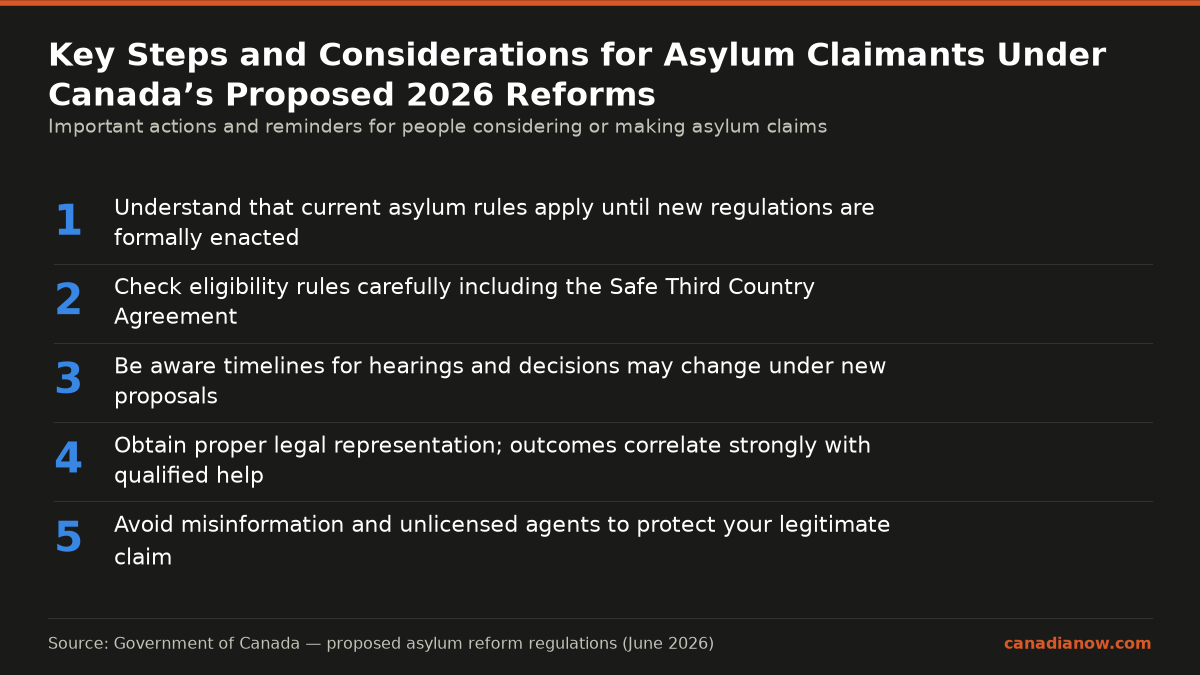
- The current system still applies until new regulations are formally enacted
- Eligibility rules can be technical — things like the Safe Third Country Agreement affect who can claim and where
- Timelines may change under the proposals — both for hearings and decisions
- Representation matters — outcomes are strongly tied to having proper legal help
- Misinformation is dangerous — relying on rumours or unlicensed agents can destroy a legitimate claim
Asylum Is Not an Immigration Shortcut
An important, honest point: an asylum claim is for people with a genuine fear of persecution — it is not a workaround for a closed PR pathway or a capped sponsorship stream. Some people facing blocked options are told to “just claim asylum.” This is risky and often harmful: a denied claim can damage every future immigration application and may lead to a removal order. If your real situation is an economic or family-reunification one, asylum is usually the wrong and most dangerous route.
Where to Get Real Help
- Licensed immigration lawyers and accredited refugee representatives (verify through the law society or CICC)
- Provincial legal aid — many provinces provide refugee legal aid for eligible claimants
- Settlement agencies and refugee-serving NGOs — for orientation and referrals
- The Immigration and Refugee Board — the independent tribunal that decides claims
Avoid anyone who guarantees an outcome, charges for “guaranteed” asylum approval, or tells you to fabricate a story — that is fraud and it will sink your claim.
What to Watch Next
- Whether the proposed regulations are finalized and when they take effect
- Changes to hearing and decision timelines
- Any changes to eligibility or intake rules
- Transitional provisions for claims already in the system
FAQ
Are the new asylum rules in effect now?
No. As of June 2026 they are proposed regulations. The current system applies until they are formally enacted through the Gazette process.
Can I claim asylum because my sponsorship or PR pathway closed?
You should not claim asylum unless you have a genuine fear of persecution. Using asylum as an immigration shortcut is risky and can harm all future applications. Get proper advice on your actual options.
Do I need a lawyer for an asylum claim?
Strongly recommended. Outcomes correlate heavily with proper representation, and legal aid is available for eligible claimants in many provinces.
Canadianow is an independent publisher, not a law firm. This summarizes proposed policy as of June 2026; verify current rules on canada.ca and seek legal advice. Last reviewed: June 2026.
Sources
- Government of Canada — proposed asylum reform regulations (June 2026)
- Immigration and Refugee Board of Canada
- Canada Gazette — regulatory process
Written by Caglar Aybas. Last reviewed: June 2026.
For official, up-to-date details, see IRCC.
Want to know exactly where you stand? Our personalized report covers your CRS score, the PNP and Express Entry categories you actually qualify for, and a realistic next-step plan.