What the FHSA Actually Is
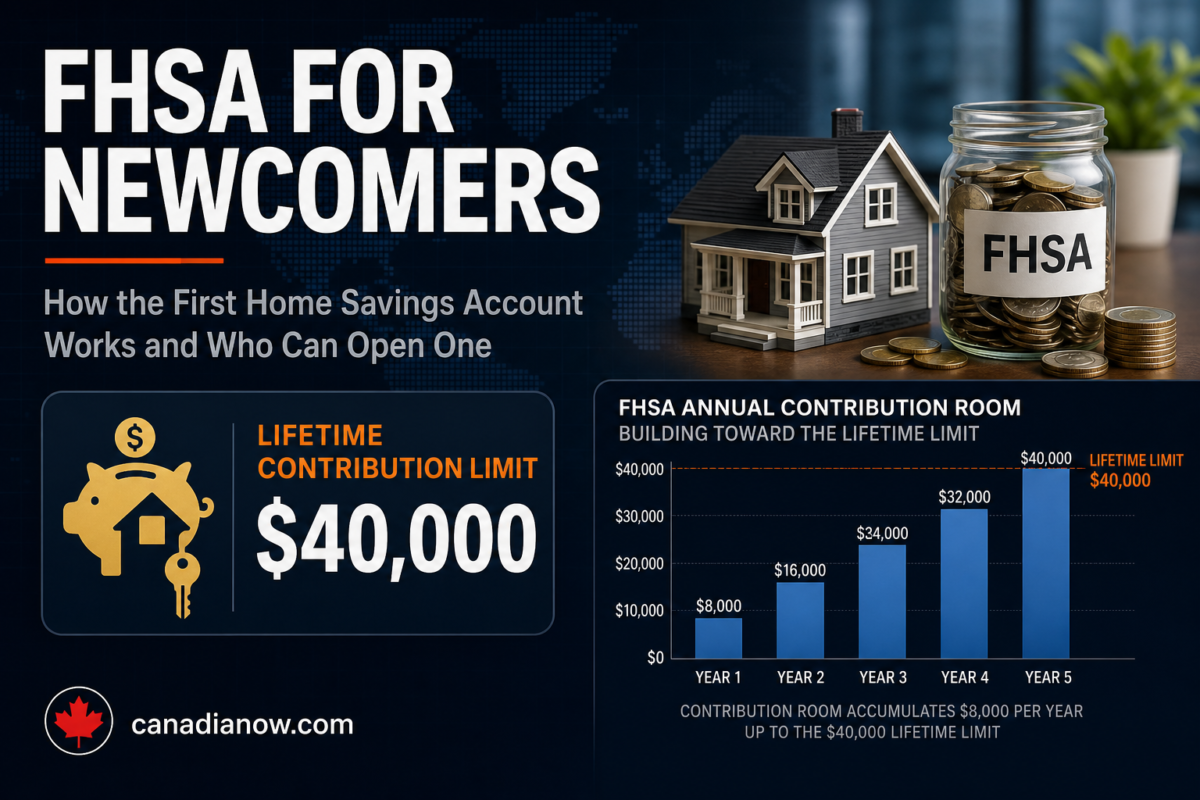
The First Home Savings Account, introduced in 2023, is a registered account built specifically for saving toward a first home purchase, and it combines the best feature of each of the other two registered accounts rather than forcing a choice between them. Contributions are tax-deductible the way RRSP contributions are, reducing your taxable income in the year you contribute. Withdrawals for a qualifying first home purchase are completely tax-free, the way TFSA withdrawals always are. No other registered account in Canada does both at once. The annual contribution limit is $8,000, with a lifetime limit of $40,000, and unused contribution room carries forward — though only up to $8,000 of unused room can carry into a single future year, so you can’t stockpile several years of unused room and dump it all in at once the way TFSA room works.Can Newcomers Actually Open One?
Yes, with a specific condition that trips people up. You need to be a Canadian resident for tax purposes and at least 18 (19 in some provinces), and — this is the part that matters most for newcomers — you need to qualify as a first-time home buyer, defined as not having owned and lived in a home that you or your spouse owned as a principal residence at any point in the current calendar year or the four preceding years. Critically, this is about home ownership anywhere, not just in Canada. If you owned a home in your home country more than four years before opening the account, you can still qualify. If you sold a home abroad within the last four years, you generally still can, since the test is about ownership during that window, not history before it. It’s worth double-checking your specific situation against CRA’s exact definition rather than assuming, since the edge cases around jointly-owned property and inherited property get complicated. Being a permanent resident isn’t a strict requirement to open the account — being a tax resident is the actual test, which some work permit holders and even some study permit holders can meet depending on their ties to Canada. But since the real value only unlocks on a qualifying withdrawal for an actual home purchase, it mostly matters for people planning to stay and buy.FHSA vs the RRSP Home Buyers’ Plan
The older mechanism, the Home Buyers’ Plan, lets you withdraw up to $60,000 from an RRSP for a first home, but it’s technically a loan from yourself — you have to repay it over 15 years or it gets added back to your taxable income. The FHSA has no repayment obligation at all; a qualifying withdrawal is simply yours, tax-free, permanently. The two aren’t mutually exclusive either — you can use both an FHSA withdrawal and an HBP withdrawal toward the same home purchase, which for newcomers trying to close a down payment gap as fast as possible is worth knowing, since combining them can meaningfully shorten the savings timeline.What Happens If You Don’t Buy a Home
The account has a maximum participation period of 15 years from when you first open it, or until the end of the year you turn 71, whichever comes first. If you don’t end up making a qualifying withdrawal, you can transfer the funds into an RRSP or RRIF tax-free without affecting your RRSP contribution room, or withdraw the funds directly, though a non-qualifying withdrawal in that case is taxed as income. In practice, most people who open one and later change plans just roll it into their RRSP rather than cashing out.Where to Actually Open One
Every major bank and most online brokerages now offer FHSAs — the account itself is standardized by the government, but what you can hold inside it (cash, GICs, mutual funds, ETFs, stocks) depends on the institution. For newcomers still building Canadian investment history, a simple high-interest savings FHSA through their existing bank is usually the lowest-friction starting point, with the option to move to a self-directed version later once they’re more comfortable navigating Canadian investment platforms.Frequently Asked Questions
Can I have both an FHSA and use the RRSP Home Buyers’ Plan?
Yes. They’re separate mechanisms and can both be applied to the same home purchase, which can meaningfully shorten how long it takes to save a full down payment.
Does opening an FHSA affect my TFSA or RRSP contribution room?
No. The FHSA has its own independent $8,000 annual and $40,000 lifetime limit, separate from TFSA and RRSP room. Contributing to one doesn’t reduce room in the others.
What if I owned a home in my home country ten years ago?
That’s outside the four-year lookback window CRA uses to define a first-time buyer, so it generally doesn’t disqualify you. The test is about ownership during the current year and the four preceding years, not your full home-ownership history.