Quick Answer
To open a bank account in Canada as a newcomer, you need two pieces of government-issued ID (or one primary + one secondary), a Canadian address, and your SIN (optional at most banks, but required to earn interest). You do not need a credit history, a minimum deposit, or a Canadian job offer. Walk in to any major bank branch with your passport and immigration document and they will open an account the same day.
What You Actually Need
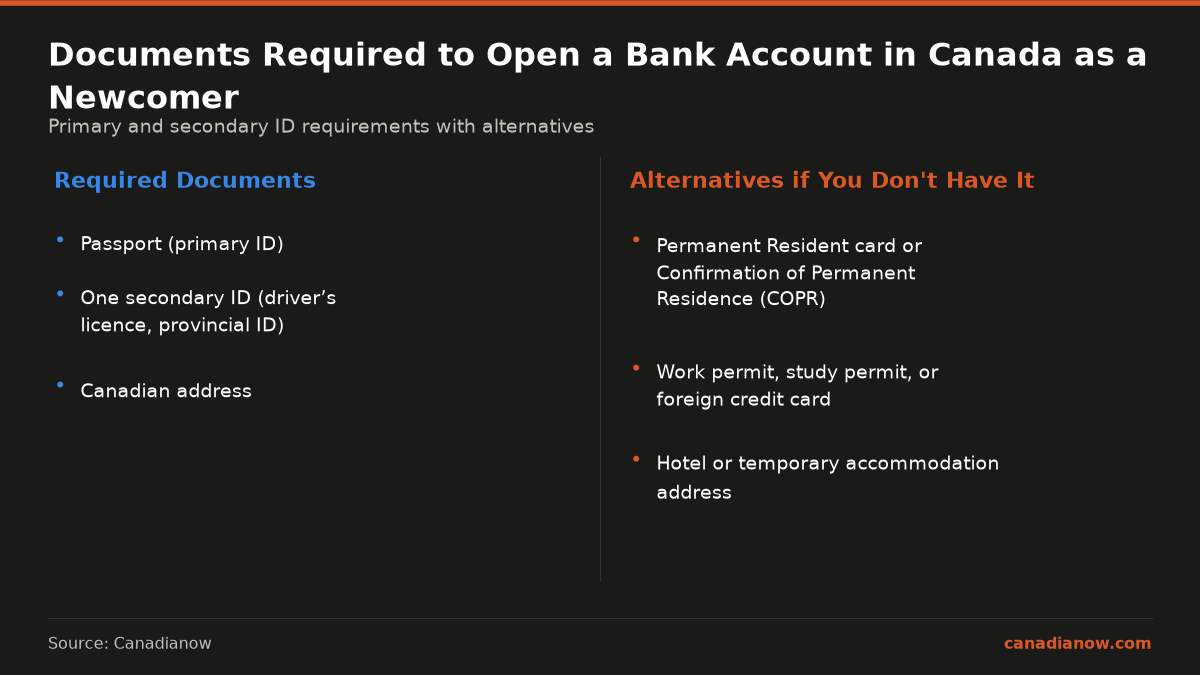
| Item | Required? | Alternatives if you don’t have it |
|---|---|---|
| Passport | Yes (primary ID) | PR card or COPR also work as primary |
| Secondary ID (driver’s licence, provincial ID) | Yes — one secondary | Work permit, study permit, or credit card from another country |
| Canadian address | Yes | Hotel/temporary accommodation address is acceptable |
| SIN (Social Insurance Number) | No, but recommended | Bank can open without it; you must provide it within a few weeks to earn interest |
| Canadian credit history | No | N/A — not required for a basic account |
| Minimum deposit | No at most banks | N/A — you can open with $0 |
Newcomer Banking Packages
All five major Canadian banks (RBC, TD, Scotiabank, BMO, CIBC) offer newcomer packages: free chequing accounts for 1–3 years for recent permanent residents, international students, and in some cases work permit holders. These usually include:
- No monthly fee for 1–3 years
- Free unlimited transactions
- Free first order of cheques
- Optional savings account with no minimum balance
- Free international money transfer credits (varies)
After the newcomer period ends, the account converts to a standard chequing account with fees of $10–$17/month. You can switch banks or plans at that point.
This article provides general information about Canadian banking for newcomers. It is not financial advice for your specific situation. Talk to your bank’s newcomer specialist when opening your account — they can advise on which package fits your situation.
Step-by-Step: How to Open Your Account
- Choose your bank. All major banks work. Consider proximity to branches and ATMs, which countries you will send money to (some banks have lower fees for specific corridors), and which bank your employer uses for direct deposit.
- Book an appointment or walk in. Most major branches serve newcomers same-day. Appointments can be booked online and are faster.
- Bring your ID. Passport + one secondary document. If you have your SIN, bring it. If you don’t have it yet, tell them — they will flag the account for SIN update later.
- Tell them you are a newcomer. Ask specifically about the newcomer banking package. Bank staff may not offer it automatically.
- Choose your account types. At minimum: one chequing account (for everyday spending) and one high-interest savings account (for your emergency fund and any money you are not spending immediately).
- Set up online banking and the mobile app before you leave the branch.
- Set up direct deposit with your employer using your transit number, institution number, and account number (the bank will give you a void cheque or pre-authorized debit form).
Online-Only Banks
Online-only banks (Simplii Financial, Tangerine, EQ Bank, Wealthsimple Cash) generally charge no monthly fees permanently and offer higher interest rates on savings. Most are accessible to newcomers after the first 30–90 days in Canada, once you have a Canadian address and SIN confirmed. They are not ideal as your first account because:
- No in-person help if problems arise
- Some require an existing Canadian bank account to fund the new one
- No access to in-branch services (notarizations, bank drafts, large cash withdrawals)
Use a major bank for month 1, then consider opening an online savings account alongside it for better interest rates.
What to Do in Your First Week
- Set up direct deposit for your employer — takes 1–2 pay cycles to activate
- Enable Interac e-Transfer for paying rent and sending money to others in Canada
- Download and activate the bank’s mobile app
- Set a monthly balance alert so you always know your available funds
- Ask about a secured credit card if you want to start building credit immediately
FAQ
Can I open a bank account before I arrive in Canada?
RBC, Scotiabank, and TD offer “pre-arrival” online account opening from outside Canada. You complete the process online and activate the account when you arrive at a branch. Useful for having an account number ready for direct deposit on day one.
Do I need a specific type of visa to open a bank account?
No specific visa type is required. Visitors, students, workers, and PRs can all open accounts. What matters is valid government ID and a Canadian address.
Is my money safe in a Canadian bank?
Yes. All major banks are members of the Canada Deposit Insurance Corporation (CDIC), which protects eligible deposits up to $100,000 per category per institution.
Sources
- Financial Consumer Agency of Canada — Opening a bank account
- Canada Deposit Insurance Corporation (CDIC) — Deposit protection
- Major Canadian bank newcomer package pages (RBC, TD, Scotiabank, BMO, CIBC)
Written by Caglar Aybas. Last reviewed: June 2026.
For the authoritative source on this topic, see the CRA.
Want to know exactly where you stand? Our personalized report covers your CRS score, the PNP and Express Entry categories you actually qualify for, and a realistic next-step plan.