
Quick Answer
On June 4, 2026, Canada announced a plan to fast-track work permits for AI professionals through the existing Global Talent Stream (GTS), targeting start-to-finish processing in 20 business days. The key thing most coverage misses: you cannot apply for this yourself. It is employer-driven. Without a qualifying Canadian job offer and an employer willing to file an LMIA, there is no application to submit. AI roles were already GTS-eligible — the announcement signals priority and intent, not an entirely new door.
How the 20-Day Fast-Track Actually Works
The 20 business days are two sequential 10-day phases:
- Phase 1 — ESDC processes the LMIA (10 business days). Your employer applies for a Labour Market Impact Assessment under the GTS.
- Phase 2 — IRCC processes your work permit (10 business days). After the positive LMIA, you submit your own work permit application.
The clock starts only when your employer submits a complete LMIA — not when you start gathering documents. Compare this to the typical two-to-six-month processing for a standard TFWP work permit.
This guide explains a developing policy. It is not legal advice. As of June 2026 the government has confirmed the direction but not all qualifying details or a firm launch date for the dedicated AI sub-stream. The GTS itself is operational now. For an employer-driven, fast-moving process like this, both you and your employer benefit from professional guidance — consider a licensed immigration lawyer or RCIC familiar with the GTS.
The Two GTS Categories
| Category | Who it is for | Referral needed? |
|---|---|---|
| Category A | Unique and specialized talent, referred by a designated referral partner | Yes |
| Category B | Occupations on the published Global Talent Occupations List (includes many tech/AI roles) | No |
Most AI, machine learning, and data science roles sit in TEER 0 or TEER 1 of the NOC and fall under Category B, which does not require a referral.
Who Qualifies
- You work in a qualifying tech/AI occupation — data scientist, software engineer, machine learning engineer, AI programmer, and similar
- You have a genuine job offer from an eligible Canadian employer
- The employer pays the prevailing wage for the role
- The role is TEER 0 or 1 of the NOC
- The employer is willing and able to file the GTS LMIA and pay the $1,000 LMIA processing fee per position
What It Costs — and Who Pays
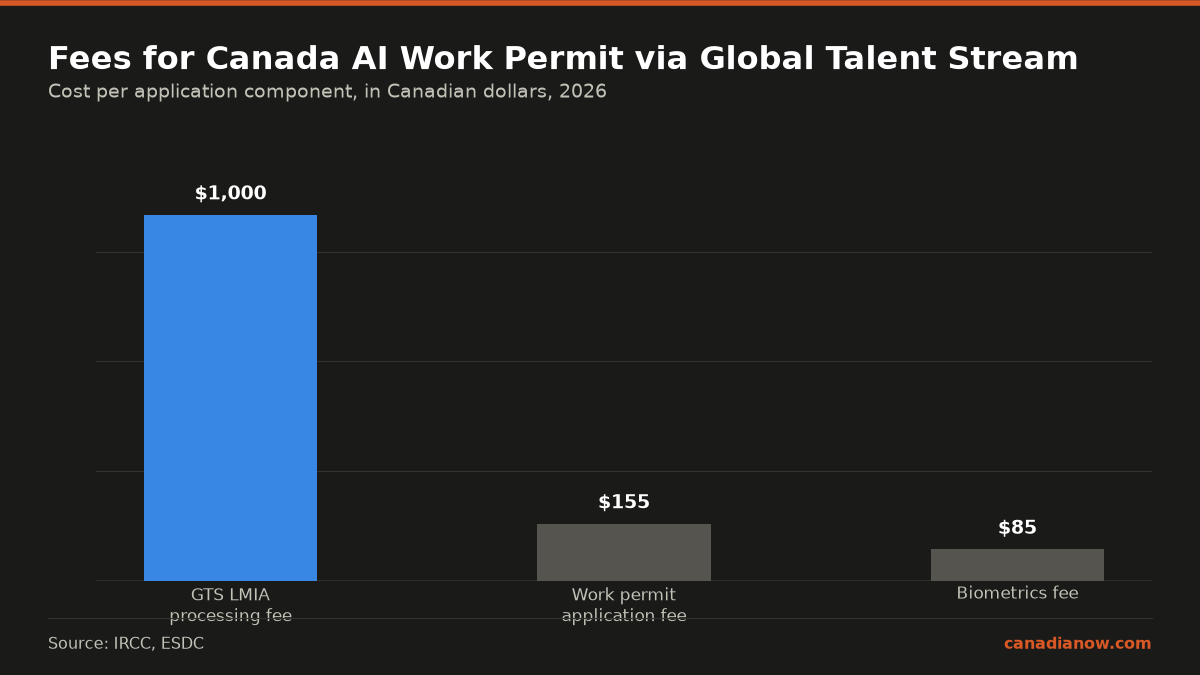
| Cost | Amount | Who pays |
|---|---|---|
| GTS LMIA processing fee | $1,000 per position | Employer (not refundable) |
| Work permit application fee | $155 | You |
| Biometrics | $85 | You |
The employer also commits to a Labour Market Benefits Plan — promises to create jobs, transfer skills, or invest in the Canadian workforce as a condition of using the stream.
The Honest Caveats Most Sites Skip
- You cannot self-apply. No employer, no application. If a website offers to “get you the AI fast-track” without a job offer, that is a red flag.
- The NOC is outdated. Canada’s NOC classification has not been updated since 2021 and does not capture the full range of modern AI roles. Your exact title may need to map carefully to an existing NOC.
- No general TR-to-PR program exists yet. A broad temporary-to-permanent pathway has been discussed for 2026, but as of June 2026 there is no open general program you can apply to.
- Quebec runs its own stream. Quebec has a separate provincial pilot for AI, IT, and visual effects workers with different rules.
How to Position Yourself Now
- Target Canadian employers who are GTS-designated or willing to become so — usually scale-ups and tech firms, not small businesses
- Make sure your role and duties clearly map to a TEER 0/1 tech NOC
- Have your credentials, reference letters, and portfolio ready so you can move the moment an employer files the LMIA
- Ask prospective employers directly whether they use the Global Talent Stream — it is a strong signal of a fast, serious hiring process
From Work Permit to PR
The government has said the AI worker stream will be accompanied by measures supporting transition to permanent residence, but the specifics are not published. In the meantime, AI professionals on a GTS work permit build Canadian work experience that strengthens an Express Entry profile and may qualify for category-based STEM draws.
FAQ
Can I apply for the AI work permit without a job offer?
No. The Global Talent Stream is entirely employer-driven. The LMIA is filed by the employer. A job offer is the foundation of any application.
Is the 20-day processing guaranteed?
It is a target, not a guarantee, and it counts only business days after a complete LMIA is submitted. Document gaps on the employer side restart the effective clock.
Does this help me if I am already in Canada on another permit?
Potentially, if you secure a qualifying offer and the employer files the GTS LMIA. The pathway is about the job and the employer, not your current location.
Canadianow is an independent publisher, not a law firm. Developing policy as of June 2026; verify on canada.ca. Last reviewed: June 2026.
Sources
- Government of Canada — AI for All national strategy (June 4, 2026)
- ESDC — Global Talent Stream requirements and occupations list
- IRCC — Global Talent Stream work permit processing
Written by Caglar Aybas. Last reviewed: June 2026.
For the authoritative source on this topic, see Job Bank.
Want to know exactly where you stand? Our personalized report covers your CRS score, the PNP and Express Entry categories you actually qualify for, and a realistic next-step plan.