Your family came to Canada on one permit: you work (or study), and your spouse holds an open work permit because of you. Now your permit is expiring and you have applied to extend it. Your spouse’s permit ends on the same day as yours. Can they keep working? Do they apply now or wait for your new permit? This is the family version of the status clock, and the order of applications matters.
Quick Answer
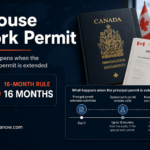
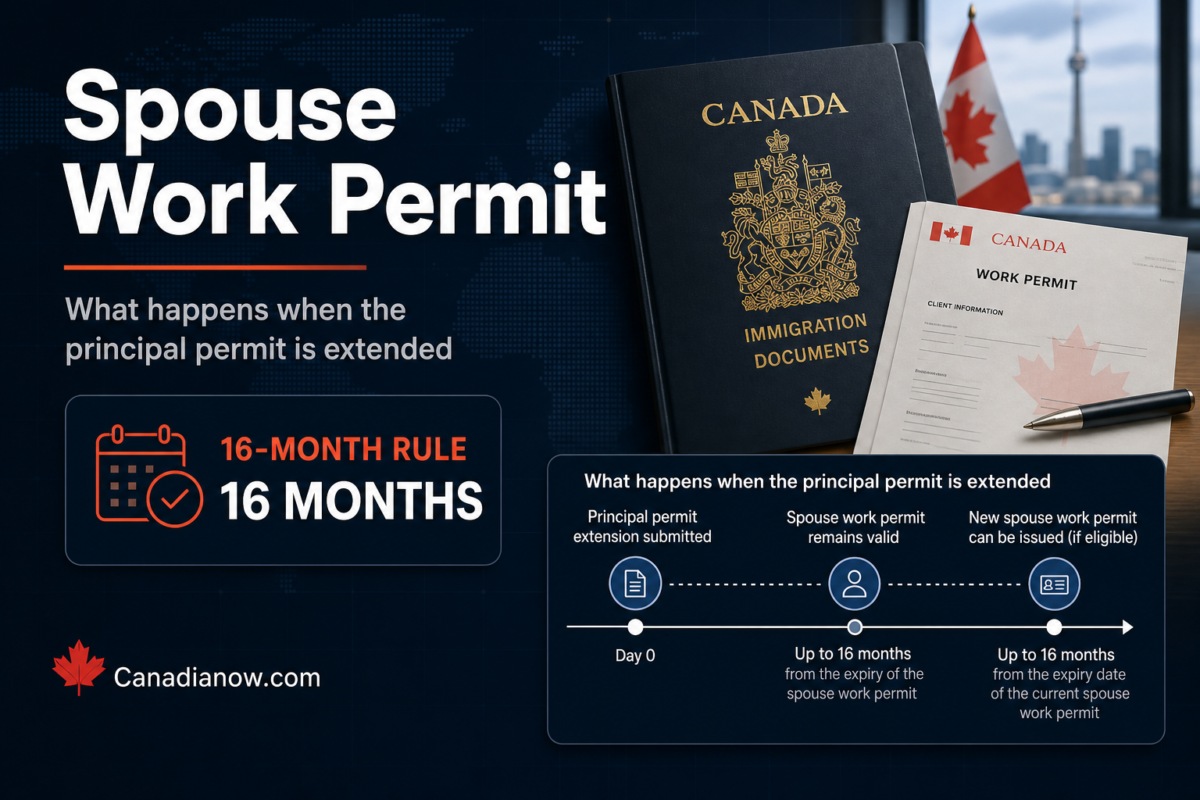
A spouse’s open work permit is valid only as long as the principal’s permit. When the principal applies to extend, the spouse should also apply for a new open work permit before their own permit expires — that gives the spouse maintained status and lets them keep working under the same conditions while IRCC decides. The spouse’s new permit can’t run past the principal’s new permit, and the family must still meet the current eligibility rules, which were narrowed in 2025 (for workers: generally a TEER 0 or 1 job or a listed TEER 2 or 3 job, with at least 16 months left on the principal’s authorization when the spouse applies).
This guide explains general rules. It is not legal advice. Family permits depend on the principal’s job or study program and on rules that changed in 2025 and 2026. A licensed RCIC can check your family’s eligibility before either permit expires.
Why the Spouse’s Permit Ends With Yours
Official rule: IRCC says a spousal open work permit “is valid for the same amount of time that your spouse or common-law partner’s work permit or study permit is valid.”
What it means: the spouse’s permit is a mirror of the principal’s. Every time the principal’s permit is extended, the spouse needs a new permit of their own — it does not extend automatically.
Who Qualifies Now (2026 Rules)
Spouses of workers
IRCC’s current criteria for the principal worker include:
- working in a TEER 0 or 1 occupation, or in one of the select TEER 2 or 3 occupations IRCC lists (for example, many healthcare, trades and technical roles);
- having work authorization valid for at least 16 months after IRCC receives the spouse’s application; and
- living, or planning to live, in Canada while working.
Two exceptions noted by IRCC: certain foreign-trained healthcare professionals in Quebec, and, since March 23, 2026, workers on projects covered by a significant investment project (SIP) agreement in British Columbia, whose spouses qualify at any TEER level without the 16-month rule.
Not eligible: if the principal holds a spousal open work permit themselves, or has applied for a PGWP and has not yet received a positive decision. Dependent children lost eligibility for these open work permits on January 21, 2025.
Spouses of students
Since 2024–2025 only spouses of students in certain programs (such as master’s programs of a minimum length, doctoral programs and select professional programs) qualify. Check IRCC’s page for the principal’s program.
The Right Order When the Principal Is Extending
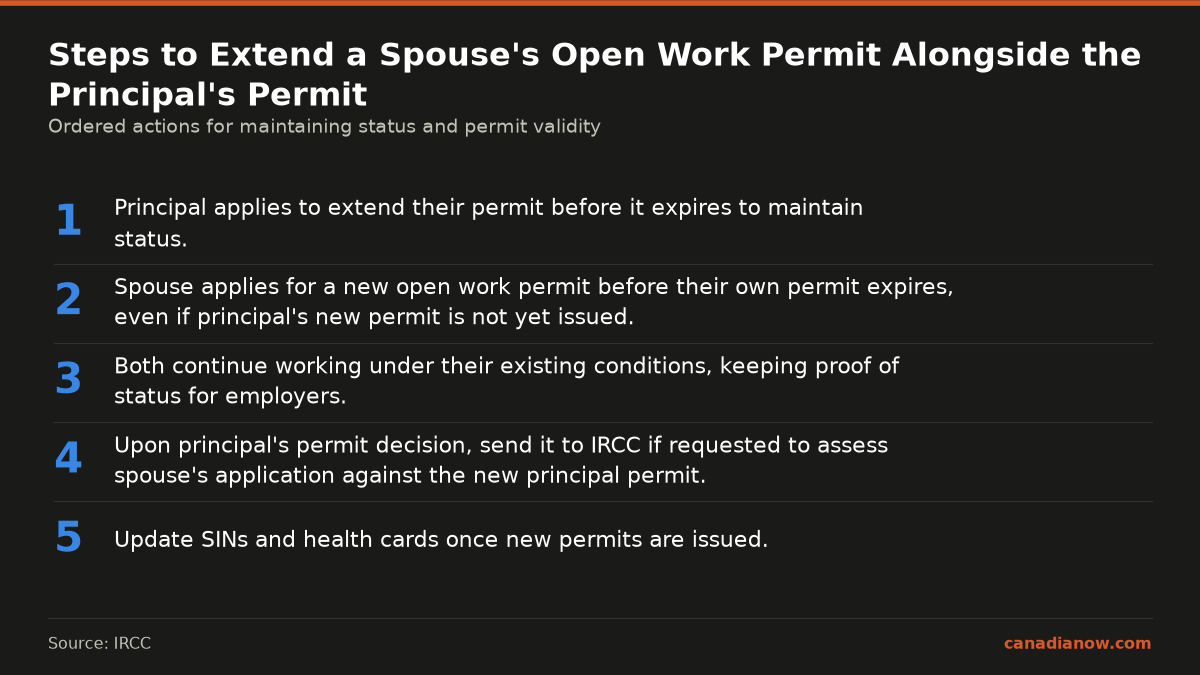
- Principal applies to extend before their permit expires (maintained status for the principal).
- Spouse applies for a new open work permit before the spouse’s own permit expires — even though the principal’s new permit has not been issued yet. This gives the spouse maintained status too.
- Both keep working under their existing conditions. Each should keep their own proof for their employer (proof pack).
- Principal’s decision arrives. Send it to IRCC for the spouse’s file if IRCC asks; the spouse’s application is assessed against the principal’s new permit.
- Update SINs and health cards for both once new permits are issued.
The 16-Month Trap
Interpretation: because the principal’s authorization must be valid for 16 months after the spouse applies, a family where the principal’s new permit is short (for example, a one-year LMIA permit) may find the spouse no longer qualifies, even if they qualified before. Check the length of the principal’s expected permit before assuming the spouse’s renewal is a formality.
Practical step: if the spouse may not qualify again, look at other routes for them early — their own LMIA-based permit, a study permit, or, if the family has applied for PR, a bridging open work permit for the principal and family options in that program (options while waiting for PR).
If the Principal’s Status Changes
| Principal’s situation | Effect on the spouse |
|---|---|
| Extension approved | Spouse can be approved up to the principal’s new expiry date, if eligible under current rules |
| Principal loses their job | The spouse’s existing permit stays valid until its expiry date, but renewal becomes harder |
| Principal switches to a PGWP application | A principal waiting on a first PGWP cannot support a new spousal permit until approved |
| Principal’s extension refused | Principal loses status; the spouse’s pending application is likely to fail too — get advice immediately |
| Family becomes permanent residents | No work permits needed any more (after eCOPR) |
FAQ
Can my spouse keep working after their permit expires while we wait?
Yes, if the spouse applied for a new permit before their own permit expired and stays in Canada — that is maintained status.
Should my spouse wait for my new permit before applying?
No. Waiting risks the spouse’s permit expiring first. The spouse should apply before their own expiry date.
Does my spouse need to meet the new 2025 rules if they already had a permit?
A new permit is assessed under the rules in force when the spouse applies, so yes.