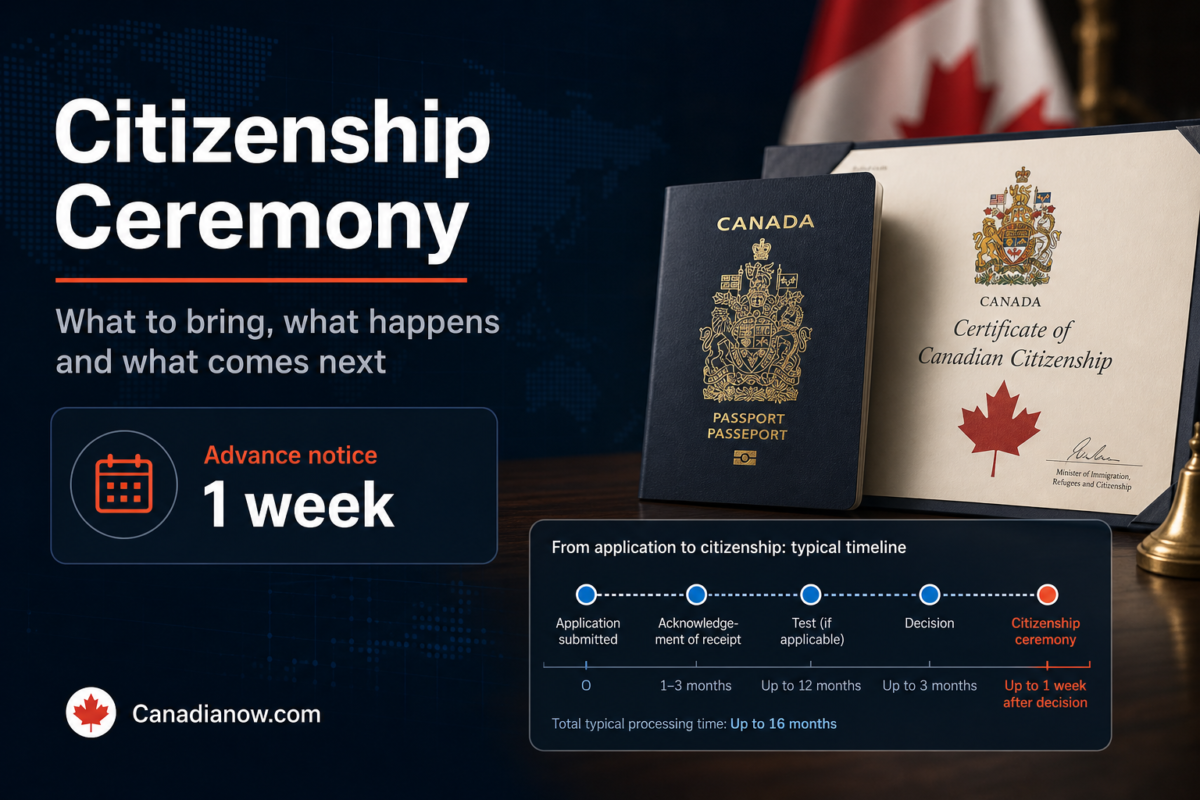
Passing the citizenship test feels like the finish line, but you are not a Canadian citizen yet. Citizenship becomes official only when you take the Oath of Citizenship at a ceremony. Until that moment you are still a permanent resident, and your PR card is cancelled during the ceremony itself, so a few practical details matter: what to bring, what to do if you can’t attend, and why you shouldn’t book international travel for the week after.
Quick Answer
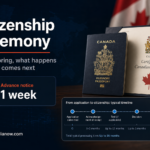
After your application is approved and you have passed the test (if you are 18 to 54), IRCC invites you to a virtual or in-person citizenship ceremony, usually by email and at least one week in advance. Everyone 14 or older takes the oath. Bring your invitation, your PR card (even if expired) or Confirmation of Permanent Residence, and two pieces of ID, at least one with your photo and signature; for a virtual ceremony, also scissors to cut up your PR card. You become a citizen the moment you take the oath. Afterwards you get an electronic or paper citizenship certificate. You need it to apply for your first Canadian passport, because the certificate itself is not a travel document.
Before the Ceremony: Your Invitation
- How it arrives: IRCC sends the invitation at least one week before the ceremony date, by email if you gave one. If IRCC can’t reach you, it may phone (the call can show as “Unknown caller”) or send it by mail. Check your spam folder.
- What it contains: the date, time and either the location or the video conference link, your virtual seat number, and a permission release and consent form.
- Format: most ceremonies are virtual. You can ask once to switch between virtual and in-person, and you will get a new date.
- Keep meeting the requirements: you must still be a permanent resident when you take the oath. If anything has changed since you applied, such as long trips outside Canada or criminal charges, tell IRCC before the ceremony.
Not sure where you are in the process? See how long citizenship takes after PR and the citizenship test guide.
What to Bring
| Who | Bring |
|---|---|
| Everyone | Your ceremony invitation, plus your PR card (even if expired) or your Confirmation of Permanent Residence (IMM 5292 or IMM 5688). If you became a PR before June 28, 2002, bring your Record of Landing (IMM 1000) if you still have it. |
| Adults | Two pieces of ID, at least one with both your photo and your signature. If one of them is your PR card, the other must be issued by the federal, provincial or territorial government. |
| Minors | Two pieces of ID (photo and signature not required), and the minor’s PR card even if the child doesn’t attend. |
| Parent or guardian of a minor | One piece of ID. |
| Virtual ceremony | Your virtual seat number, scissors (you cut up your PR card at the start), the signed consent form if applicable, and a laptop, desktop, tablet or phone with a working camera, microphone and reliable internet (Chrome, Edge or Firefox). |
| In-person ceremony | The signed permission release and consent form from your invitation. |
Foreign ID must be government-issued; if it isn’t in English or French, bring a translation with the translator’s affidavit. You may also bring a holy book to swear the oath on, and a phone or camera for photos.
What Happens at the Ceremony
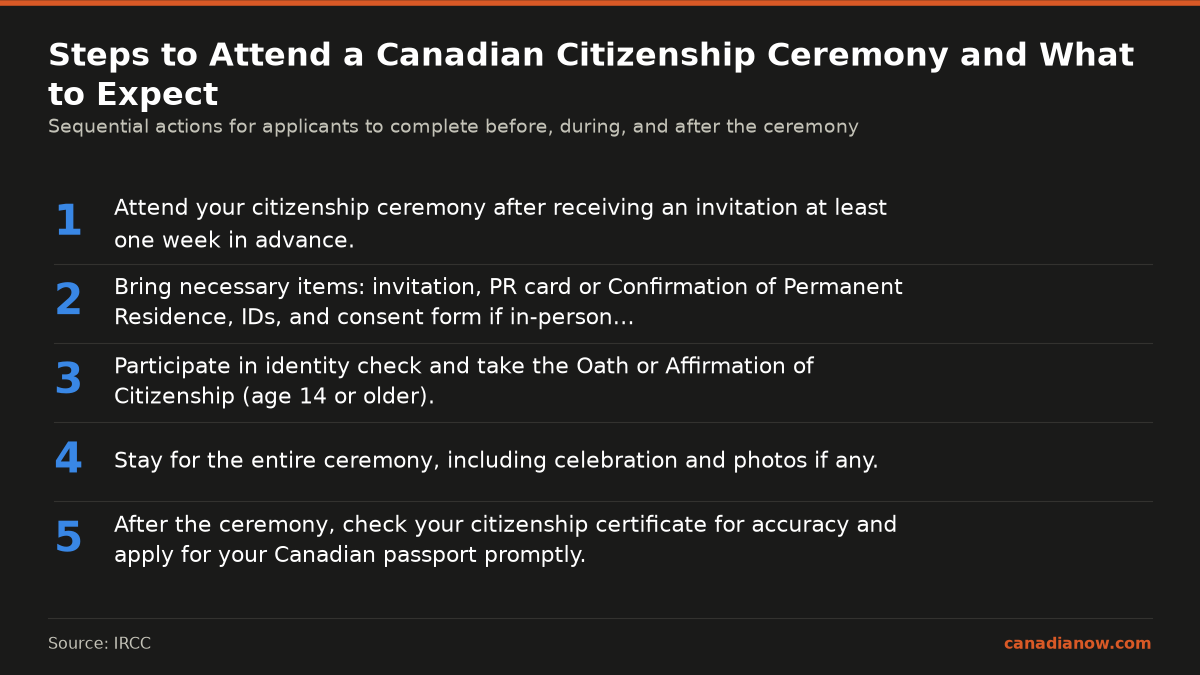
- Check-in: officials confirm your identity and documents. At a virtual ceremony, you join with your seat number and cut your PR card on camera.
- Welcome and remarks: a citizenship judge or official presides, often with a short talk about the rights and responsibilities of citizenship.
- The oath: everyone aged 14 or older says the Oath (or Affirmation) of Citizenship aloud, in English or French. You can swear or solemnly affirm, whichever you prefer.
- Signing: you sign the Oath or Affirmation of Citizenship form. This, with the oath, is the moment you become a citizen.
- National anthem and celebration: the ceremony ends with “O Canada”. At most ceremonies there is time for photos.
You must stay in the room or on screen for the whole ceremony, dress appropriately and behave respectfully. Ceremonies are not a place to promote personal or political views or a business.
The Oath of Citizenship
I swear (or affirm) that I will be faithful and bear true allegiance to His Majesty King Charles the Third, King of Canada, His Heirs and Successors, and that I will faithfully observe the laws of Canada, including the Constitution, which recognizes and affirms the Aboriginal and treaty rights of First Nations, Inuit and Métis peoples, and fulfil my duties as a Canadian citizen.
The reference to the rights of First Nations, Inuit and Métis peoples was added in 2021. There is also a French version.
If You Can’t Attend
- Rescheduling: reply to the office that sent the invitation, or use IRCC’s web form, within 30 days after the ceremony date. A first request is granted, but the next invitation is your final one.
- Missing a ceremony: if you miss the first one, it is rescheduled automatically with a final invitation. If you miss the second without explanation, IRCC starts closing your application as abandoned. Adults get the right of citizenship fee refunded, but you would have to apply again from the start.
- Outside Canada when the invitation arrives: reply with the subject line “Outside Canada – Oath of Citizenship”, including your full name, application number, the date you left, your planned return date and your reasons.
Practical suggestion: avoid long trips abroad while you wait for your ceremony. If you must travel, see travelling while your citizenship application is pending.
After the Ceremony: Your First Steps as a Citizen
- Check your citizenship certificate. You receive an electronic or paper certificate. Make sure your name and date of birth are correct, keep it somewhere safe, and don’t laminate it.
- Apply for a Canadian passport as soon as you have the certificate. Your PR card is cancelled at the ceremony, and the certificate is not a travel document, so you can’t re-enter Canada from abroad until you have a Canadian passport. Don’t book international travel for the days right after your ceremony.
- Register to vote with Elections Canada, and check your provincial voters list.
- Check your other citizenship. Canada allows dual citizenship, but your country of origin may not — see dual citizenship with Canada.
- Update your records where your status matters, such as your employer (if you had work restrictions), Service Canada for your SIN record, and your bank.
FAQ
When do I officially become a Canadian citizen?
On the day you take the oath and sign the oath form at your ceremony — not when your application is approved or when you pass the test.
Do children have to attend the citizenship ceremony?
Children 14 and older must take the oath. Younger children included in the application don’t take the oath, but their PR card and ID are still required.
Is a virtual citizenship ceremony as valid as an in-person one?
Yes. Both formats grant citizenship in the same way, and you can ask once to switch formats.
Can I travel right after my citizenship ceremony?
Not internationally until you have a Canadian passport, because your PR card is cancelled at the ceremony and the citizenship certificate can’t be used to enter Canada.
Can I bring family or friends?
Guests are welcome at most ceremonies, in person or watching on screen. Check your invitation for any limits.