You changed jobs in June, and your new employer started deducting CPP and EI from zero — even though your old employer had already taken most of the year’s maximum. Or you work two jobs and both deduct premiums. Either way, you may have paid more than the law requires. The good news: the overpayment comes back automatically when you file. The less obvious news: with two jobs, CPP can also come out below the yearly amount.
Quick Answer
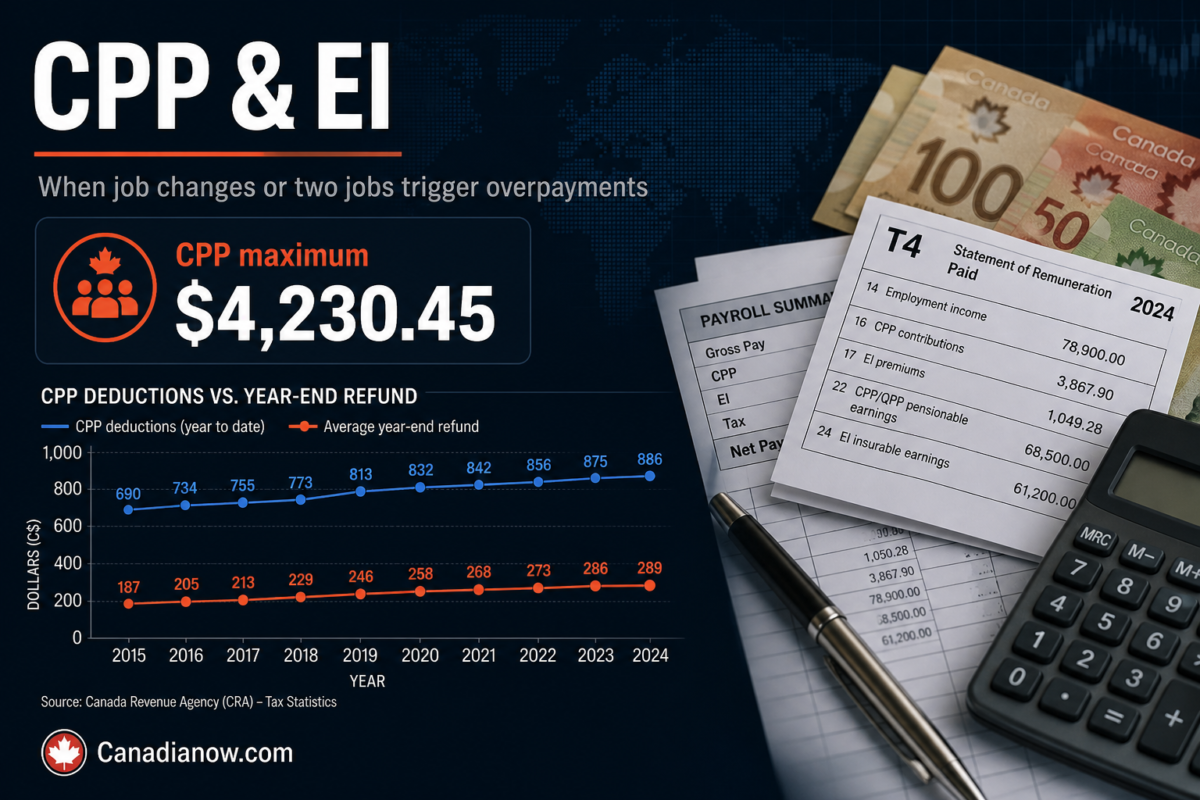
Each employer deducts CPP and EI as if it were your only employer, up to each program’s yearly maximum. If you changed jobs or had two jobs and your combined deductions are more than the 2026 maximums — $4,230.45 base CPP plus $416 CPP2, and $1,123.07 EI (outside Quebec) — the excess is refunded on your tax return: CPP on line 44800, EI on line 45000. With two jobs at the same time, the opposite can happen for CPP: each employer applies the $3,500 exemption, so you may contribute less than the maximum for your income. You are not required to top that up, but you can choose to with Form CPT20.
This guide explains general rules. It is not tax advice. Tax software and the CRA calculate these amounts from your T4 slips.
When You Overpay
| Situation | What happens |
|---|---|
| Changed employers mid-year with good income | The new employer starts deductions again from zero, so combined CPP and EI can exceed the maximum |
| Two jobs at the same time with combined pay above the maximums | Both deduct; combined EI or CPP can exceed the maximum |
| Very low EI insurable earnings (under $2,000 for the year) | EI premiums are refunded |
Worked Example (2026)
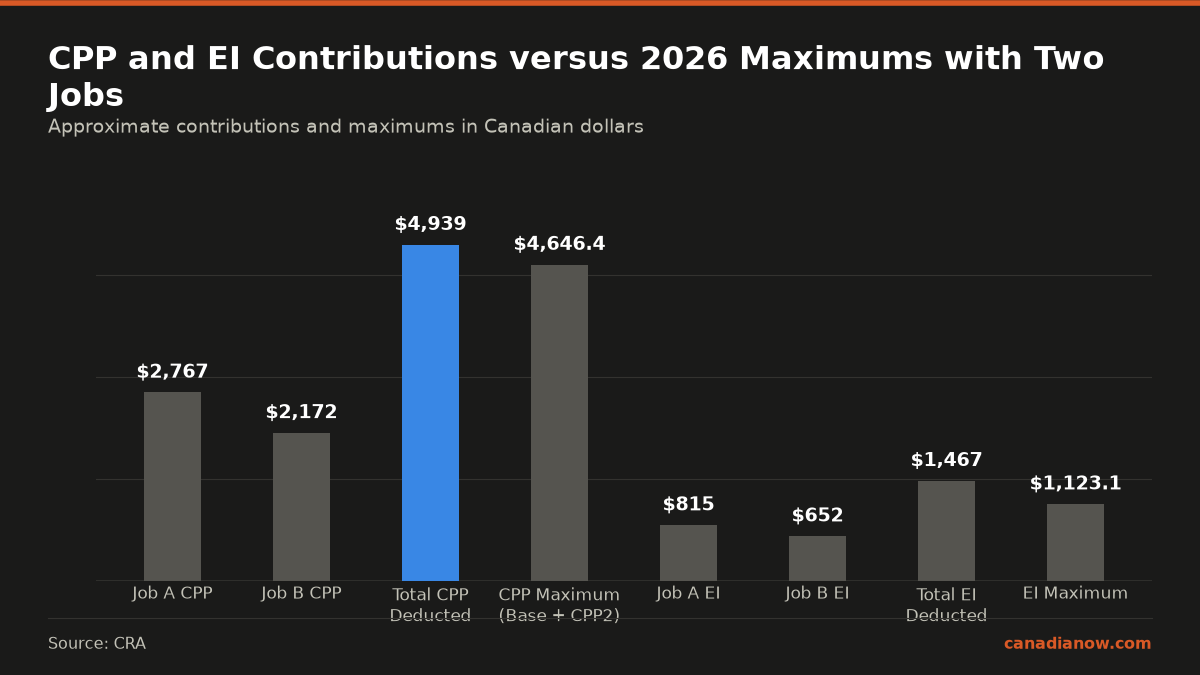
You earn $50,000 at Job A from January to June, then $40,000 at Job B from July to December.
- Job A deducts CPP on $50,000 and Job B on $40,000, each after its own $3,500 exemption: about $2,767 + $2,172 = about $4,939.
- The yearly amount for $90,000 of income is $4,230.45 (base) + $416 (CPP2) = $4,646.45.
- You overpaid about $292 of CPP, refunded when you file.
- EI: Job A deducts about $815 and Job B about $652 — $1,467 in total against a maximum of $1,123.07, so about $344 comes back.
(Figures are approximate; employers prorate the exemption across pay periods.) Try your own numbers in the two-jobs tax checker.
How to Get It Back
- Collect all your T4 slips — the CRA uses boxes 16, 16A and 18 (CPP and EI deducted).
- File your return. Tax software fills in Schedule 8 (CPP) and the EI overpayment line.
- The refund is added to your tax refund or reduces what you owe.
You do not need to ask your employers for anything, and employers cannot refund it themselves once the year is over.
When CPP Comes Out Low
With two jobs at the same time, both employers apply the $3,500 basic exemption, so less CPP may be deducted than your total income calls for. The CRA does not bill you for that difference. You can choose to make additional contributions with Form CPT20, which increases your future pension — an option worth considering if you plan to retire in Canada (how CPP works).
FAQ
Why did my new employer take CPP again?
Employers do not know what a previous employer deducted, so each one starts from zero. The overlap is fixed on your return.
Can I stop the second employer deducting CPP?
Generally no. Deductions are required; any excess is refunded when you file.
Does overpaid EI count toward my benefits?
No. EI benefits depend on insurable hours and earnings, not on overpaid premiums.