You arrived in Canada, worked hard on a modest wage, filed your first tax return — and there was no Canada Workers Benefit on your notice of assessment, even though your coworker on a similar income got several hundred dollars. The reason is one phrase in the CRA’s eligibility rules, and it affects almost every newcomer in their arrival year.
Quick Answer
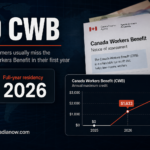
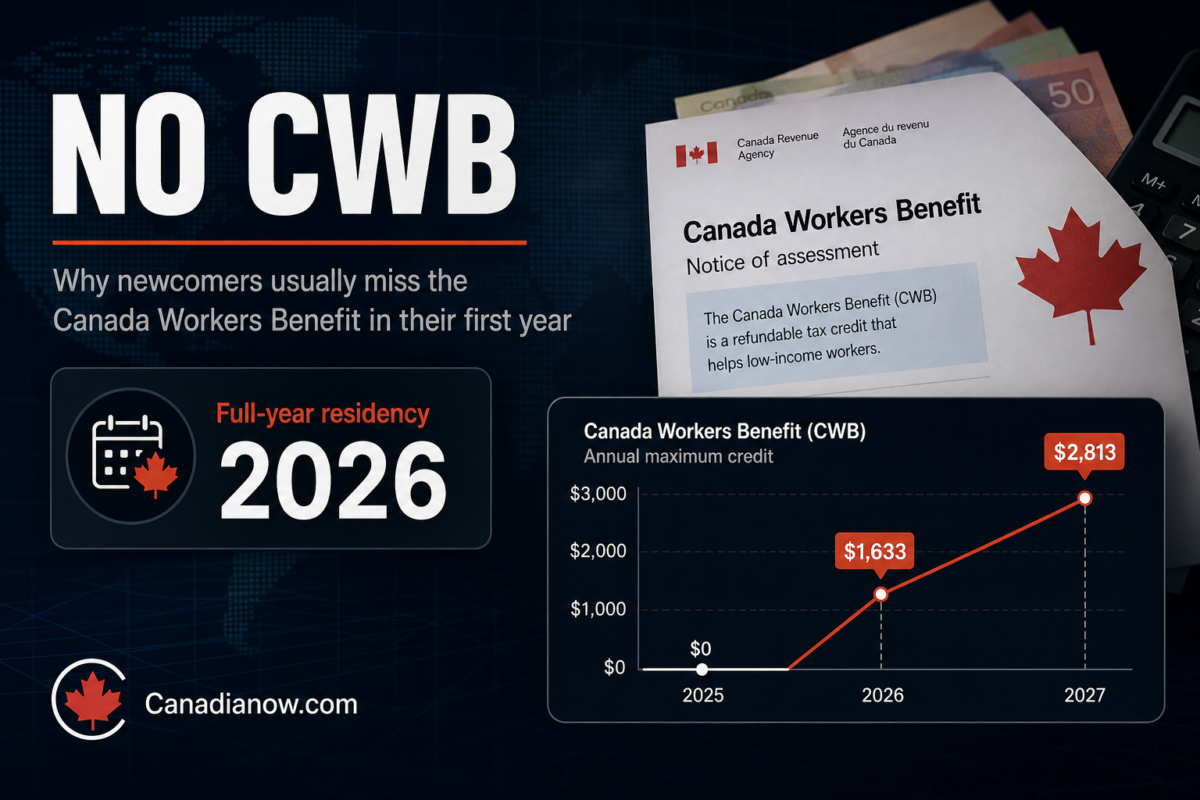
The CRA requires you to be “a resident of Canada throughout the year” to claim the Canada Workers Benefit (CWB). If you arrived partway through the year, you were not a resident for the whole year, so you generally cannot claim the CWB for your arrival year. You can claim it from your first full calendar year as a resident, if your working income and net income fall within the limits. The CWB is available to work permit holders and students who are tax residents too — status is not the barrier, the full-year rule is.
This guide explains general rules. It is not tax advice. Your residency date is a tax question; if it is unclear, the CRA can decide it (Form NR74) or a free tax clinic can help.
The Rule
Official rule: to get the CWB basic amount, the CRA says you must earn working income, have net income below the level set for your province or territory, be a resident of Canada throughout the year, and be 19 or older on December 31 (or live with a spouse, common-law partner or child). If you have a spouse or common-law partner, they must also be a resident of Canada throughout the year to be included.
Not eligible: full-time students for more than 13 weeks in the year (unless you have an eligible dependant), people confined to a prison for 90 days or more, and people exempt from Canadian tax as diplomats.
What It Means by Arrival Date
| You arrived… | CWB for that year? | First year you can claim |
|---|---|---|
| January 1 or earlier | Possibly — resident all year | That year |
| Any later date in the year | Generally no | The next calendar year |
Example: you land on May 20, 2026. Your 2026 return is a part-year return, so no CWB for 2026. If you work in Canada all of 2027 and your income is within the limits, you can claim the CWB on your 2027 return (filed in 2028).
How Much Is It Worth?
For the 2025 tax year, the CRA lists a maximum basic CWB of $1,633 for single individuals and $2,813 for families, reduced as net income rises (it starts to phase out above $26,855 for singles and $30,639 for families outside Quebec, Alberta and Nunavut). A disability supplement of up to $843 is available to people approved for the disability tax credit. Quebec, Alberta and Nunavut use different amounts.
Advance Payments (ACWB)
Once you have been entitled to the CWB on a return, the CRA automatically pays up to half of the next year’s amount in advance, in three payments (ACWB payment dates). In your first eligible year you get the full amount when you file.
What You Can Get in Your Arrival Year
The full-year rule is specific to the CWB. In your arrival year you may still get:
- the Canada Groceries and Essentials Benefit (formerly GST/HST credit), by applying with RC151 (how),
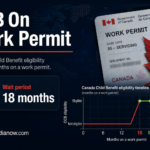
- the Canada Child Benefit, subject to the 18-month rule for temporary residents (how it works),
- provincial credits such as the Ontario Trillium Benefit.
See every program side by side in benefits by immigration status.
FAQ
Can I get the CWB on a work permit?
Yes, if you are a resident of Canada for tax purposes throughout the year and meet the income rules.
I arrived on January 5. Do I qualify for that year?
Generally no, because you were not a resident for the whole year. You can claim from the following year.
Do I have to apply for the CWB?
No separate application — you claim it on your tax return (Schedule 6), and the CRA can calculate it for you.