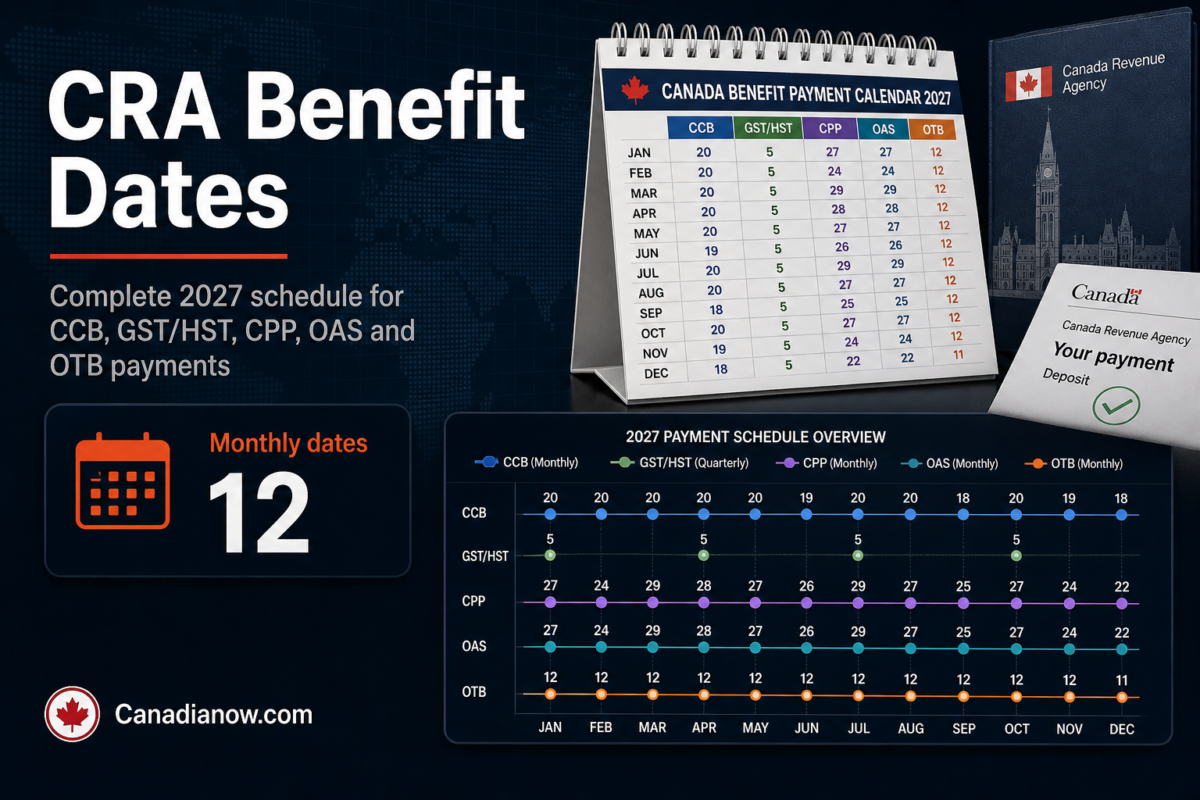
Every federal benefit runs on its own schedule, and none of them line up. The Canada Child Benefit arrives around the 20th, the GST/HST credit comes four times a year, and CPP and OAS land near the end of the month. If you receive more than one, planning around them means tracking three or four separate rhythms.
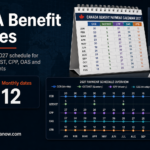
This page collects the 2027 dates for the main federal benefit payments in one place.
Canada Child Benefit (CCB) — Monthly
Paid around the 20th of each month, moved earlier when the 20th falls on a weekend or federal holiday.
- January 20 · February 19 · March 19 · April 20
- May 20 · June 18 · July 20 · August 20
- September 20 · October 20 · November 19 · December 20
GST/HST Credit — Quarterly
Paid four times a year, on or just before the 5th of January, April, July and October.
- January 5 · April 5 · July 5 · October 5
CPP and OAS — Monthly
Both are issued in the last few business days of each month, on the same date.
- January 27 · February 24 · March 29 · April 28
- May 27 · June 28 · July 28 · August 27
- September 27 · October 27 · November 26 · December 29
Ontario Trillium Benefit (OTB) — Monthly
An Ontario program delivered by the CRA, paid on or just before the 10th.
- January 8 · February 10 · March 10 · April 9
- May 10 · June 10 · July 9 · August 10
- September 10 · October 8 · November 10 · December 10
If your annual OTB entitlement is small enough, the CRA pays it as a single lump sum in July instead of monthly instalments — worth knowing before you wait for a payment that is not coming.
How These Dates Are Actually Set
None of these dates are arbitrary, and understanding the rule means you can work out any month yourself rather than looking it up:
- CCB: the 20th, moved to the preceding business day if the 20th is a weekend or federal holiday
- GST/HST credit: the 5th of the quarter month, same weekend-and-holiday rule
- CPP and OAS: counted backward from month end — the third-to-last business day
- OTB: the 10th, same adjustment rule
This is also why the dates shift by a day or two from year to year without anything actually changing.
Direct Deposit vs Cheque
The dates above are when the CRA issues the payment. With direct deposit, the money is generally in your account that same day. If you receive a cheque, add mailing time — the CRA advises waiting five business days past the payment date before reporting a missing payment.
For newcomers, setting up direct deposit through CRA My Account is the single change that removes most payment-timing anxiety.
If a Payment Does Not Arrive
The most common causes, in rough order of frequency: an unfiled tax return (benefit eligibility is recalculated every July from the prior year’s return), an address or banking change that did not reach the CRA, a marital status change that has not been reported, or a child turning 18 and aging out of the CCB.
Benefits are not paid automatically forever — most are recalculated annually based on your filed return, which is why filing on time matters even in a year with no income.