Updated July 2026. Ontario rang in 2026 with a wave of policy changes touching interprovincial labour mobility, provincial tax brackets, and job posting requirements. Here’s what actually took effect on January 1, 2026, and how each change plays out in practice.
Faster Credential Recognition for Regulated Professionals
Under the federal Free Trade and Labour Mobility in Canada Act (effective January 1, 2026), combined with Ontario’s own “As of Right” rules, professionals licensed in regulated occupations elsewhere in Canada — engineers, doctors, architects, electricians, and others — can start working in Ontario within 10 business days of their credentials being confirmed by the relevant regulator. They can practice for up to 6 months while completing full registration with Ontario’s local regulatory body. This is expected to meaningfully ease staffing pressure in sectors like healthcare, where interprovincial credential recognition has historically been slow.
2026 Ontario Tax Brackets and Rates
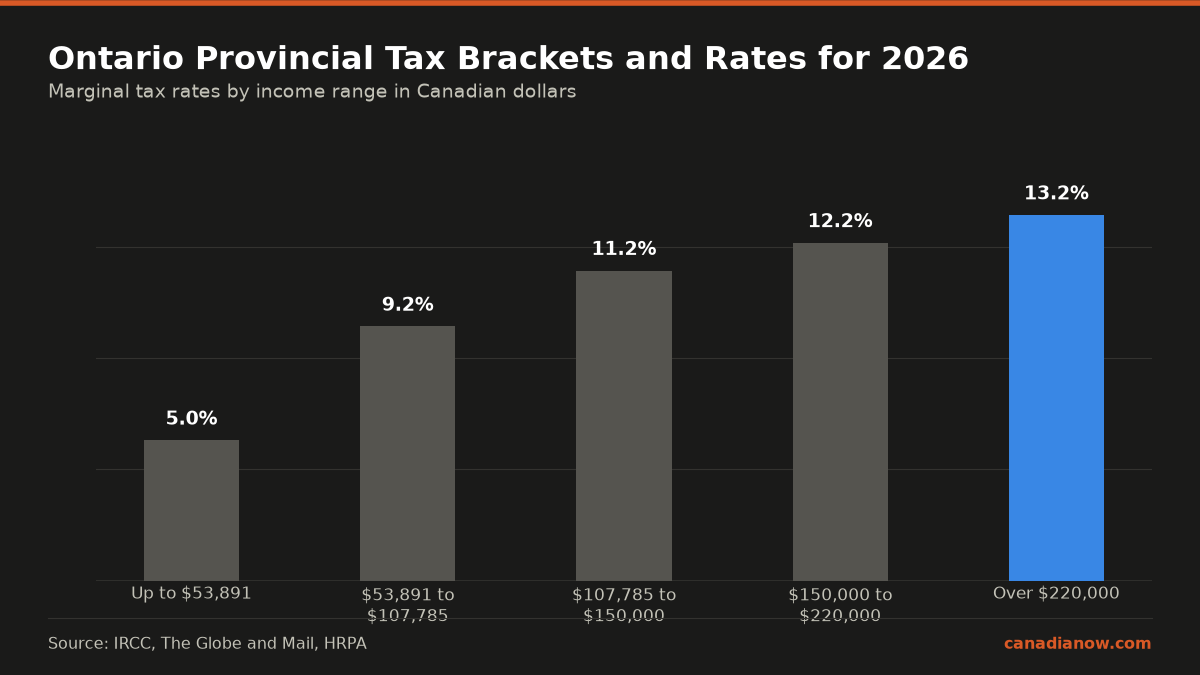
Ontario’s provincial tax brackets were indexed for 2026:
- Up to $53,891: 5.05%
- $53,891 to $107,785: 9.15%
- $107,785 to $150,000: 11.16%
- $150,000 to $220,000: 12.16%
- Over $220,000: 13.16%
Ontario also kept its two-tier surtax system for 2026, which applies on top of basic provincial tax: 20% on basic tax between $5,818 and $7,446, and 56% on basic tax above $7,446. This surtax is what pushes effective marginal rates higher for upper-income earners beyond the bracket rate alone. The non-refundable tax reduction for lower-income households continues unchanged.
New Pay Transparency Requirements
Starting January 1, 2026, amendments to the Employment Standards Act, 2000 require Ontario employers with 25 or more employees to disclose an expected compensation range in every public job posting — and that range can’t span more than $50,000 from low to high. Roles paying over $200,000 per year are exempt. Employers must also disclose whether artificial intelligence is used in candidate selection, and must inform interviewed candidates whether a hiring decision has been made within 45 days of their interview.
Sources: The Globe and Mail; HRPA, Ontario pay transparency + AI disclosure.