Updated July 2026. Bill C-3, which amended the Citizenship Act, took effect December 15, 2025, removing the “first-generation limit” on Canadian citizenship by descent in many cases. If you have a Canadian parent or grandparent, this change might affect your status — but it’s not an automatic “citizenship for anyone with Canadian ancestry” rule.
What Changed
Before this change, citizenship by descent was generally limited to the first generation born outside Canada — meaning a Canadian citizen born abroad usually couldn’t pass citizenship to their own children if those children were also born outside Canada. Bill C-3 removed that limit in many situations, but added a new condition for people born or adopted going forward.
If You Were Born or Adopted Before December 15, 2025
If you would have been a Canadian citizen were it not for the first-generation limit (or certain other outdated rules), you’re now considered Canadian and can apply for proof of citizenship. This applies retroactively — you don’t need to have done anything differently at the time of your birth.
If You Were Born or Adopted On or After December 15, 2025
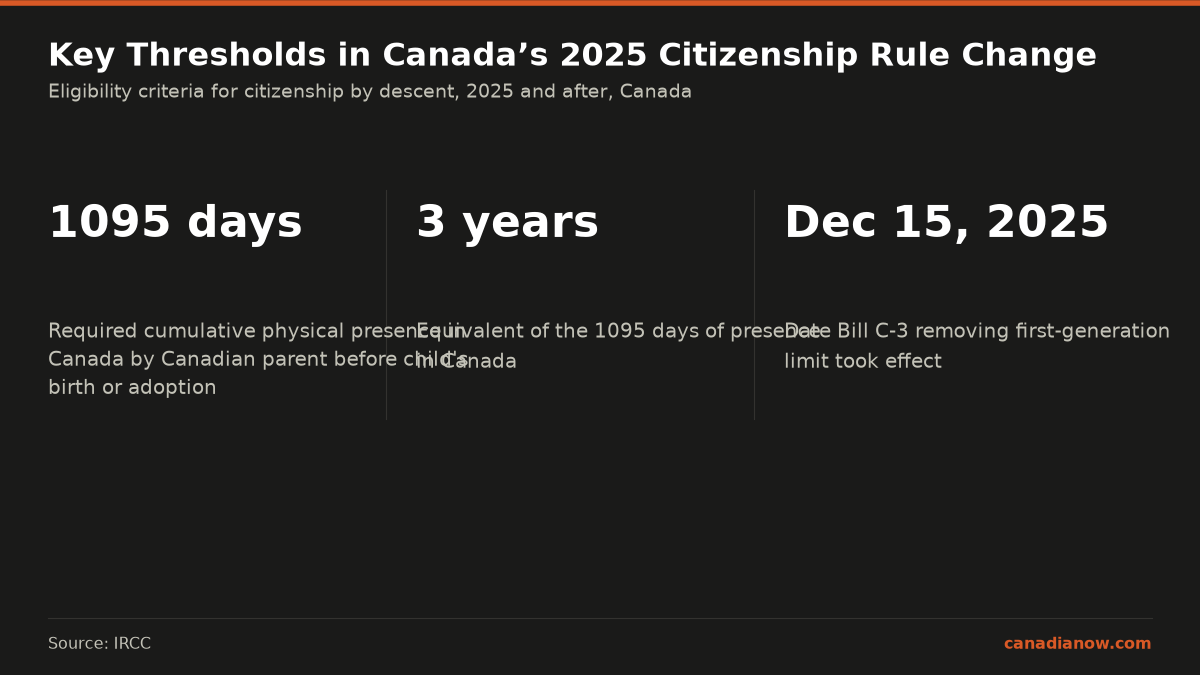
A new “substantial connection to Canada” test applies. Your Canadian parent (who was themselves born or adopted abroad) must have accumulated at least 1,095 days (3 years) of cumulative physical presence in Canada before your birth or adoption for citizenship to pass to you. Each subsequent generation born abroad must independently meet this same test before they can pass citizenship on to their own children born abroad.
Common Scenarios Worth Checking
- You were born in the U.S. and one of your parents is (or is now recognized as) a Canadian citizen
- Your Canadian link runs through a grandparent, and your parent may now be recognized as Canadian because the old first-generation limit no longer applies in some cases
Important limits: if your parent became a Canadian citizen after you were born, you don’t automatically become one too. If you were adopted outside Canada, you’re generally not automatically a citizen — adoption cases follow separate rules and typically require their own application process.
How to Actually Confirm Your Status
Start with IRCC’s official tools to check whether you may be a citizen, rather than assuming based on family history alone. If you don’t already have proof, apply for a citizenship certificate — review IRCC’s document guide first so you know exactly what evidence is expected (typically your birth record and your parent’s own proof of citizenship).
A Citizenship Certificate Isn’t a Passport
Proof of citizenship establishes your status, but it’s not a travel document. Only after you receive proof of citizenship can you apply for a Canadian passport — don’t book urgent travel assuming either document will arrive quickly. If you end up a dual citizen, Canada generally expects you to enter the country on a valid Canadian passport.
Source: IRCC, New citizenship rules for Canadians born or adopted abroad.