Not all Canadian study programs are equally effective for getting permanent residency. Choosing the right program in the right field can determine whether your path to PR takes 4 years or gets blocked entirely. Here is what actually works in 2026.
The Key Criteria for a PR-Effective Program
To maximize your PR pathway through the study route, your program should:
- Be at least 2 years long (to get a 3-year PGWP — maximum work time to qualify for CEC)
- Be at a Designated Learning Institution (DLI) eligible for PGWP
- Lead to employment in a NOC TEER 0, 1, 2, or 3 occupation
- Be in an eligible field of study (for college diplomas — see the field-of-study requirement introduced in 2024)
Best Program Types for PR in 2026
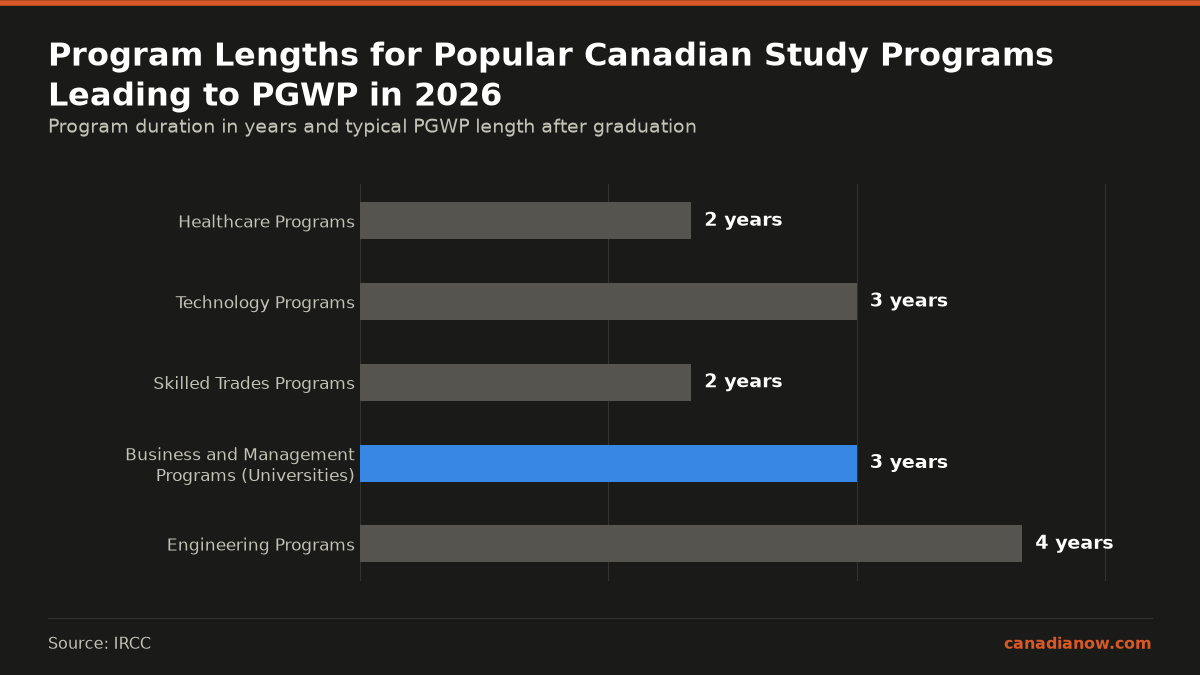
1. Healthcare Programs
Canada is experiencing significant healthcare worker shortages — and IRCC has run dedicated Express Entry draws for healthcare occupations with very low CRS cutoffs.
Strong options:
- Registered Nursing (BScN or college diploma bridge programs)
- Medical Laboratory Technology
- Respiratory Therapy
- Pharmacy Technician
- Personal Support Worker (faster, shorter program — but PGWP duration shorter)
Healthcare workers routinely receive ITAs in category-based Express Entry draws at CRS scores of 350–430 — far below what general draws require.
2. Technology Programs
Canada’s tech sector has ongoing demand and IRCC runs STEM-specific category draws:
- Computer Science degrees (3–4 years — maximum PGWP)
- Software Engineering Technology diplomas (2 years)
- Data Analytics / Data Science programs
- Cybersecurity diplomas
- Cloud Computing / DevOps programs
Tech roles consistently fall in NOC TEER 1–2, qualifying for Express Entry CEC with salaries that boost CRS scores.
3. Skilled Trades Programs
Canada desperately needs skilled trades workers. IRCC now includes trades in category-based draws:
- Electrical engineering technician
- Plumbing and pipefitting technology
- HVAC technician programs
- Welding and fabrication
- Construction management technology
Trades workers often find employment quickly and can earn $65,000–$95,000 after certification.
4. Business and Management Programs (Universities)
University business degrees (BCom, MBA) lead to a 3-year PGWP and qualify graduates for numerous NOC TEER 0–2 roles in finance, management, marketing, and operations.
- Bachelor of Commerce (4 years) — maximum PGWP
- Master of Business Administration (MBA, 1–2 years)
- Accounting and financial management programs
5. Engineering Programs
Engineering degrees remain among the strongest pathways — high NOC TEER levels, strong salaries, and consistent demand:
- Civil Engineering
- Mechanical Engineering
- Electrical Engineering
- Chemical Engineering
- Engineering Technology diplomas (2 years)
What to Avoid
Programs that may create obstacles for PR:
- College diploma programs in fields not on IRCC’s eligible field-of-study list (as of 2024)
- Programs under 8 months (no PGWP eligibility)
- Flight school or aviation programs (excluded from PGWP)
- Purely English/French language programs (no PGWP)
- Some private college programs — verify DLI status and PGWP eligibility before enrolling
Does the School Matter?
For PR purposes, the institution needs to be a PGWP-eligible DLI — which includes most public colleges and universities. The prestige of the institution matters less for immigration than for career outcomes. However, more prestigious programs often lead to higher-paying jobs, which produces better CRS scores.
Frequently Asked Questions
Q: Is a 1-year college program worth it for PR?
A: It generates only a 1-year PGWP — not enough time for most people to accumulate 12 months of skilled work and apply for PR before the permit expires. A 2-year program is significantly more strategic.
Q: Can I study arts or humanities and still get PR?
A: Potentially yes, if you can find employment in a NOC TEER 0–3 occupation after graduation — which is more challenging in arts fields. It is not impossible, but the job market is more competitive and the path less direct.
Q: Should I choose a program based on immigration or interest?
A: Both — ideally a field you are genuinely interested in AND that leads to in-demand occupations. Choosing purely for immigration and hating the work is a poor long-term strategy. Choosing purely for passion without considering the job market is also risky.
Bottom Line
Healthcare, technology, skilled trades, business, and engineering are the most reliable programs for the student-to-PR pathway in 2026. Choose a program that is at least 2 years long, at a PGWP-eligible DLI, in an eligible field, and that leads to employment in NOC TEER 0–3 occupations. Then execute the plan: graduate, get PGWP, build Canadian experience, apply for CEC. The pathway is proven — the program choice is the foundation.
For official, up-to-date details, see IRCC.
Related Reading
- International Student Work Hours in Canada: The 24-Hour Rule Explained for 2026
- IRCC’s June 18 Study Permit Compliance Update: What International Students Must Check Now
- What Happens to Your Work Rights After Your PGWP Expires?
If you'd rather have this mapped out for your exact situation instead of piecing it together yourself, our personalized report covers eligibility, CRS score, and next steps.