
The CRS Points Bilingual Candidates Are Leaving on the Table
Category-Based Draws Specifically for French Speakers
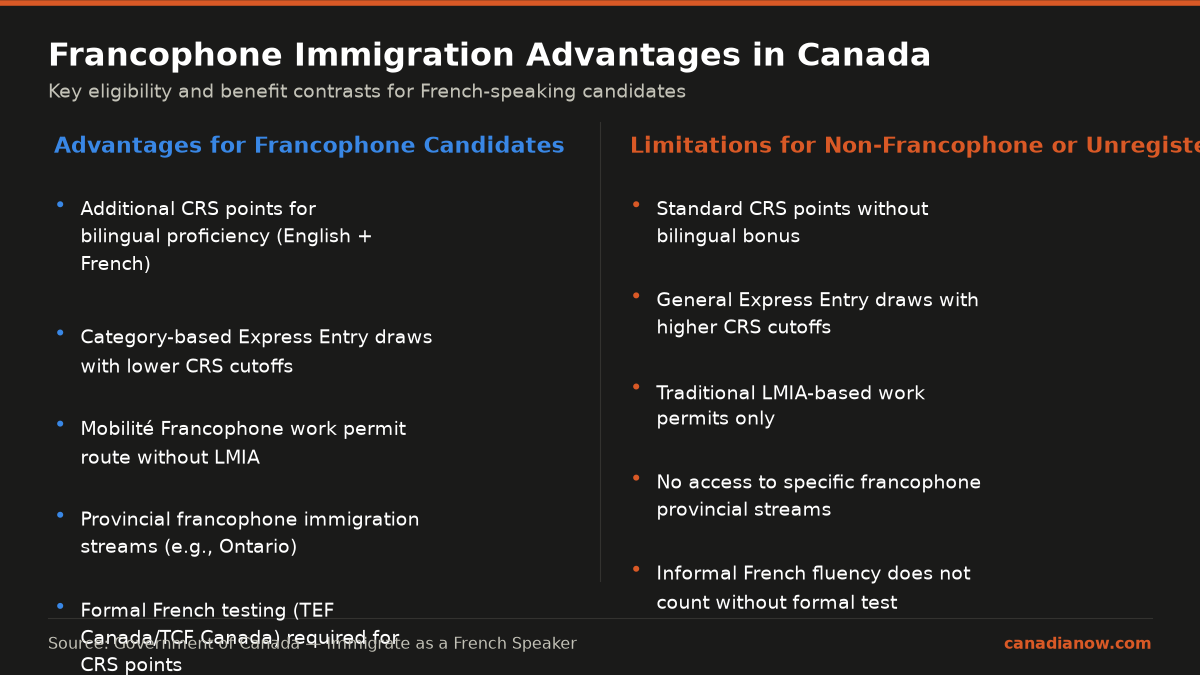
Since 2023, IRCC has run category-based Express Entry draws that invite candidates specifically for French-language proficiency, separate from occupation-based categories like healthcare or trades. These draws have periodically had noticeably lower CRS cutoffs than general draws, because IRCC is deliberately trying to meet francophone immigration targets outside Quebec, which the federal government has set as a specific, tracked policy goal — the target has actually been exceeded in some recent years, which signals sustained federal commitment to running these draws rather than a one-off initiative. This is worth internalizing if you’re a French speaker sitting in the Express Entry pool with a CRS score that feels uncompetitive under general draws — a francophone-specific draw might invite you at a score that would otherwise leave you waiting indefinitely.Mobilité Francophone: A Work Permit Route Worth Knowing
Outside the Express Entry system entirely, Mobilité Francophone is a program that lets employers outside Quebec hire French-speaking foreign workers in NOC TEER 0 to 3 occupations without needing an LMIA, provided the employer can demonstrate the position genuinely requires or benefits from French proficiency. This is a meaningfully faster and cheaper route to a Canadian work permit than the standard LMIA-based process, and building Canadian work experience through this route can then feed directly into Canadian Experience Class eligibility later, layering the francophone advantage across two separate stages of an immigration journey.Provincial Francophone Streams
Several provinces run their own francophone-specific immigration streams alongside the federal programs, particularly Ontario, which has a dedicated francophone stream under OINP aimed at building its French-speaking population outside Quebec. These provincial streams often layer on top of the federal advantages rather than replacing them, giving francophone candidates multiple simultaneous angles to pursue.Testing French Formally: What Actually Counts
IRCC accepts specific approved French tests for Express Entry purposes — primarily the TEF Canada and TCF Canada — and informal fluency, even genuine native-level fluency, doesn’t count toward CRS scoring without a formal test result on file. Candidates who grew up speaking French and assume their proficiency is self-evident sometimes skip this step and lose the points entirely as a result. Booking the test early, well before you plan to submit an Express Entry profile, avoids scrambling later once you realize how much it affects your score.Frequently Asked Questions
Do I need to be fluent in English too, to benefit from French points?
No. Strong French alone, tested at NCLC 7 or higher, earns points even with weaker English, and IRCC’s scoring rewards French-only strength as well as full bilingualism, just at a different level.
Is Mobilitu00e9 Francophone only for Quebec?
No u2014 it’s specifically for employers outside Quebec, since Quebec runs its own separate immigration selection system entirely apart from federal Express Entry and Mobilitu00e9 Francophone.
How much does a francophone Express Entry draw actually lower the CRS cutoff?
It varies by draw and depends on how many eligible francophone candidates are in the pool at the time. Checking IRCC’s published results for recent French-language category draws gives the most accurate current picture rather than relying on an older figure.