Quick Answer
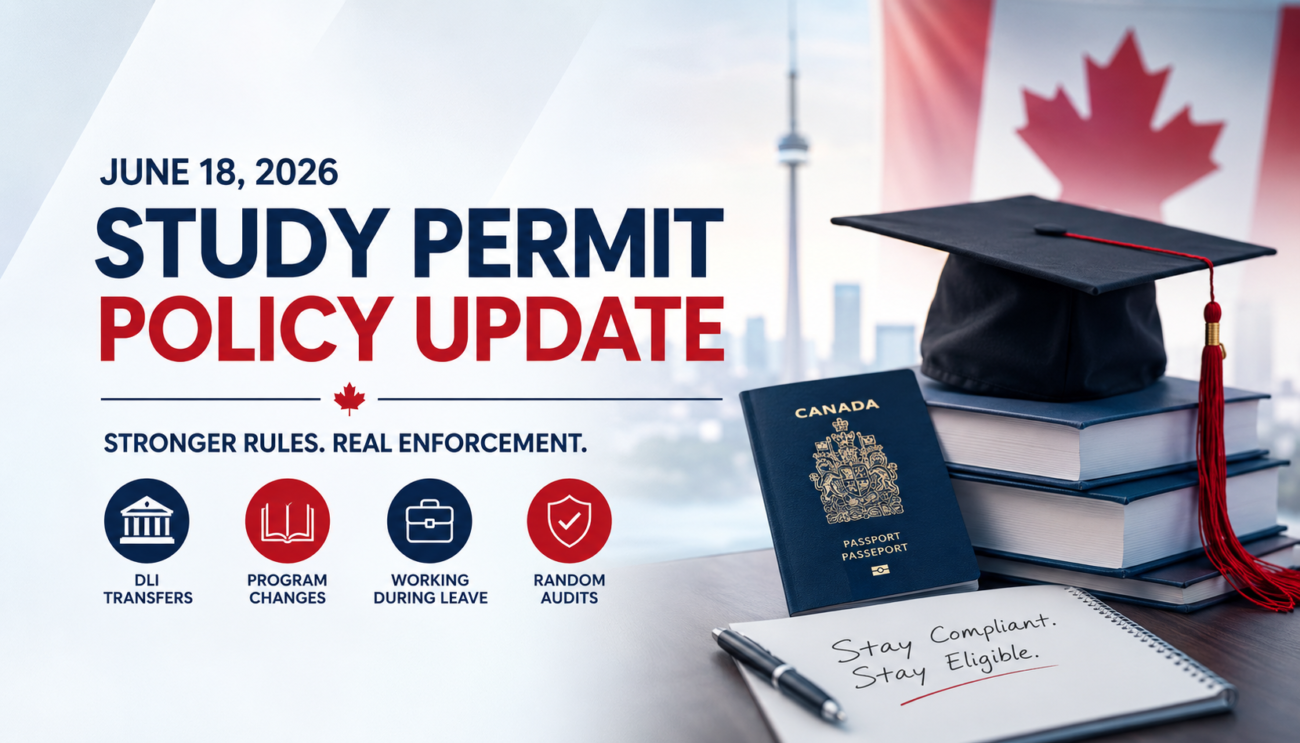
On June 18, 2026, IRCC quietly updated the internal manual its officers use to assess study permit conditions. The changes tighten enforcement on three fronts: unauthorized transfers between schools (DLIs), program changes within the same school, and working during a leave of absence. It also confirms that random compliance audits are active and used — not theoretical. For the roughly 460,000 people holding a study permit, this is an immediate action item, not future planning.
What Actually Changed
The update revised the program delivery instructions titled “Study Permits: Assessing study permit conditions” — the exact document an officer consults when deciding whether you keep your permit, lose it, or get refused on a future application. The key clarifications:
- A new section on students who change DLIs without authorization
- Narrower rules on program-level changes within the same institution
- A defined official study-completion date (critical for the PGWP 180-day window)
- Tighter language on working during authorized leave
- An explicit reminder that random audits are real and active
This guide explains the June 18, 2026 update in plain terms. It is not legal advice. Study permit compliance is now a front-line enforcement priority, and the consequences — a cancelled permit, a refused PGWP, or an exclusion order — are severe and hard to reverse. If anything below raises a question about your situation, get a documented compliance review from a licensed RCIC or immigration lawyer before your next IRCC interaction, not after a Procedural Fairness Letter arrives.
The DLI Transfer Rule (Most Important Change)
Since November 8, 2024, under section R217.1 of the regulations, if your study permit names a specific post-secondary DLI, you must apply for a new study permit before transferring to a different institution. The June 18 update spells out the consequence with unmistakable clarity:
- If you switch DLIs without applying for a new permit first, your previous permit is rendered invalid under paragraph R222(1)(a.1)
- You are then considered to be studying without authorization at the new school
- Officers are now instructed to verify whether your permit conditions prohibited the change
Nuance: if your permit conditions did not explicitly prohibit switching DLIs, you cannot automatically be found non-compliant — but professionals still recommend applying for a new permit anyway to keep your DLI information accurate.
Program Changes Within the Same School
IRCC clarified that the flexibility to change programs applies cleanly only when the new program is at the same level of study:
| Change | General treatment |
|---|---|
| Diploma to another diploma | Usually allowed |
| Bachelor’s to another bachelor’s | Usually allowed |
| Diploma to bachelor’s degree | May require a new study permit |
| Bachelor’s to master’s degree | May require a new study permit |
Officers are also told to look at students who changed schools or programs multiple times and ask whether they are genuinely making reasonable progress toward a credential — or just buying time. Repeated switches without clear academic logic can be treated as non-compliance.
Working During a Leave: Tightened
The update sharpened the rules on working during an authorized leave or school closure:
- If you are not actively studying full-time, you generally cannot work
- This applies during school closures and authorized leaves
- You cannot use a co-op/internship work permit to work during an authorized leave either
Deferrals and leaves also have timing rules: students deferring enrollment must generally resume within 150 days, and if a school closes permanently, students have 150 days to transfer, leave, or change status.
Random Audits Are Real
Under section 220.1(4), an officer can request evidence of compliance for two reasons: a specific suspicion, OR a random audit. The June update explicitly reminds officers this power is actively used. Keep these documents organized and accessible at all times:
- Enrolment letters and current transcripts
- Leave-approval letters from your DLI
- A doctor’s note (if a medical leave)
- Withdrawal or program-change letters
Don’t scramble for these only after a Procedural Fairness Letter arrives — have them ready now.
Your Compliance Checklist
- Confirm whether you changed schools after November 8, 2024
- Check whether you applied for a new study permit before transferring
- Review any program changes within your institution
- Verify your official study-completion date (it starts your PGWP 180-day clock)
- Ensure any leave of absence is officially authorized
- Avoid working during any study leave or closure
- Keep all compliance documents organized and accessible
FAQ
Did the June 18 update change the actual rules?
Mostly it clarified and sharpened enforcement of existing rules (some in force since November 2024). But stricter, clearer guidance usually means stricter, clearer enforcement.
I switched schools without a new permit. What now?
You may be in unauthorized study status. Consult a licensed immigration professional immediately — this can affect your current permit, PGWP eligibility, and future applications.
Can I work while on an authorized leave?
Generally no — including with a co-op work permit. If you are not actively studying full-time, off-campus work authorization typically does not apply.
Canadianow is an independent publisher, not a law firm. Verify your compliance status on canada.ca or with a licensed professional. Last reviewed: June 2026.
Sources
- IRCC — Program delivery instructions: Assessing study permit conditions (updated June 18, 2026)
- IRPR — sections R217.1, R220.1, R222
Written by Caglar Aybas. Last reviewed: June 2026.
For the authoritative source on this topic, see Canada.ca.
Every case is different. If you want a clear, personalized breakdown of your options — CRS score, eligible programs, and next steps — we can put one together for you.