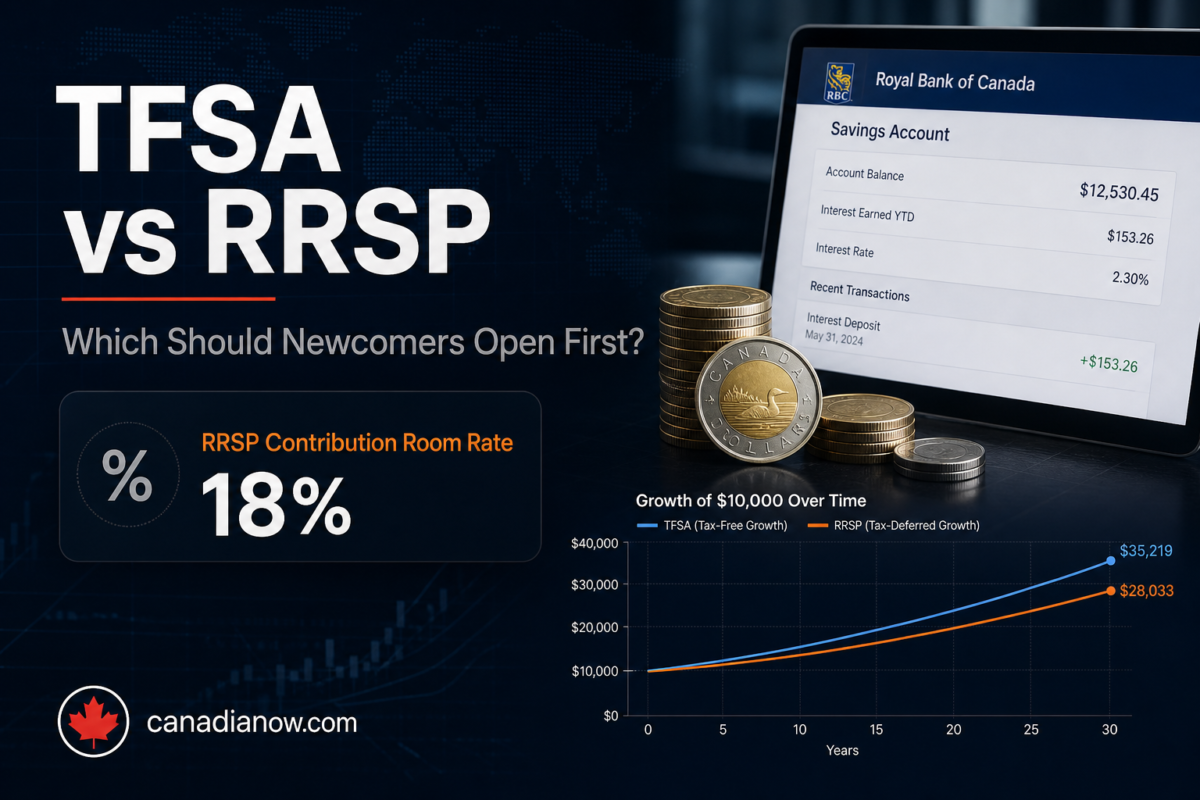
Once you have a Canadian bank account and a paycheque landing regularly, the next question almost every newcomer asks is the same one: TFSA or RRSP first? Both are registered accounts the government gives Canadians (and, with some conditions, permanent residents) tax advantages on — but they work in opposite ways, and opening the wrong one first can mean paying more tax than you needed to during your early years here.
What a TFSA Is and How Contribution Room Works for New PR Holders
A Tax-Free Savings Account (TFSA) lets your investments grow completely tax-free — no tax on interest, dividends, or capital gains, and no tax when you withdraw. The catch that trips up almost every newcomer: you only start earning TFSA contribution room from the year you become a Canadian resident for tax purposes, not from when you turned 18. If you land in 2026, your 2026 contribution room is the annual limit for that year (the CRA sets this annually — verify the current-year figure on the CRA’s TFSA page), not the full accumulated room a lifelong resident would have.
Unused room carries forward indefinitely, and withdrawals free up room again — but not until the following calendar year. This is where the most common newcomer mistake happens.
What an RRSP Is and When It Actually Saves You Tax
A Registered Retirement Savings Plan (RRSP) works differently: contributions reduce your taxable income in the year you make them, but you pay tax on withdrawals later, ideally in retirement when your income (and tax bracket) is lower. RRSP room is based on 18% of your previous year’s earned income, up to an annual maximum set by the CRA.
The key detail for newcomers: RRSP room is also only generated from Canadian-source earned income after you start filing Canadian tax returns. If you land partway through the year, your first RRSP room typically appears the following spring, based on the income reported on your first Canadian tax return. An RRSP contribution is most valuable when you’re in a high enough tax bracket that the deduction meaningfully lowers what you owe — for someone in an entry-level role in their first year, that benefit is often small.
TFSA vs RRSP: Side-by-Side for Someone With No Canadian Credit History Yet
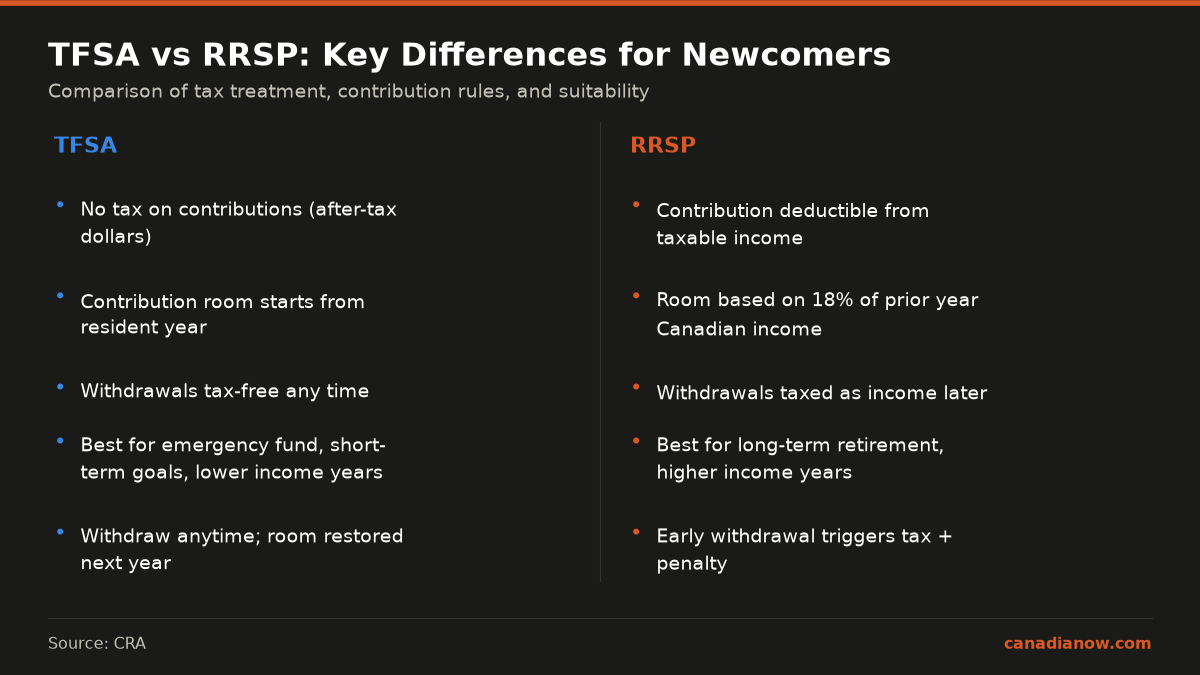
| Factor | TFSA | RRSP |
|---|---|---|
| Tax on contribution | None (after-tax dollars in) | Deducted from taxable income |
| Tax on withdrawal | None, ever | Taxed as income when withdrawn |
| Best for | Emergency fund, short/medium-term goals, lower income years | Long-term retirement saving, higher income years |
| Withdrawal flexibility | Withdraw anytime, room restored next year | Withdrawing early triggers tax + withholding, defeats the purpose |
| Good newcomer fit | Yes — flexible while you’re still building stability | Better once income and tax bracket rise |
Because a TFSA doesn’t penalize you for needing the money back — a real possibility while you’re still establishing yourself, building credit history, and covering moving-related costs — most financial advisors suggest newcomers lean TFSA-first, then add RRSP contributions once income stabilizes.
Common Newcomer Mistake: Over-Contributing Before Understanding Room Carry-Forward
Because TFSA contribution room only starts accumulating from your residency start date, some newcomers who previously lived in Canada on a study or work permit assume they have the same room as someone who’s been a resident for a decade — they don’t, unless they were filing Canadian tax returns and accruing room that whole time. Over-contributing triggers a CRA penalty of 1% per month on the excess amount until it’s withdrawn. Before making a large first-time deposit, confirm your actual available room through your CRA My Account rather than estimating it.
The second common mistake is contributing to both accounts equally without a plan, simply because both are available. Because TFSA and RRSP room don’t share a pool — maxing one has no effect on the other — it’s easy to end up spreading money thin across both without making meaningful progress in either. A better approach for most first-year newcomers is picking one account to fund with intention (usually the TFSA, for the flexibility) and treating the other as a secondary goal once the first is on solid footing.
It’s also worth remembering that both accounts are just wrappers — the TFSA and RRSP themselves don’t determine your return, what you hold inside them does. A TFSA sitting entirely in cash earning close to nothing is not “working” for you in any meaningful way; the tax-free growth benefit only pays off once the account holds investments.
Don’t Forget the FHSA If Homeownership Is on Your Radar
A third registered account worth knowing about, even though it’s not the focus of this comparison, is the First Home Savings Account (FHSA). It combines features of both: contributions are tax-deductible like an RRSP, but qualifying withdrawals toward a first home are completely tax-free like a TFSA. For newcomers who plan to buy property within the next few years, the FHSA often deserves priority over general TFSA investing, since it’s the only one of the three accounts designed specifically around that goal. It doesn’t replace the TFSA-vs-RRSP decision for everyday saving, but it’s worth opening alongside whichever of the two you choose first.
Which One to Prioritize in Your First Two Years in Canada
For most newcomers still stabilizing income, building an emergency fund, and figuring out housing costs, the practical order is:
- Emergency fund inside a TFSA — 3–6 months of expenses, kept liquid, growing tax-free.
- RRSP contributions once your tax bracket justifies it — typically once household income moves into a higher federal bracket, since the deduction is worth more.
- Additional TFSA investing once both an emergency fund and RRSP contributions are on track.
There’s no universally “correct” order — someone with an employer that matches RRSP contributions may prioritize differently than someone without a workplace plan, and it’s worth benchmarking your overall pay — including any employer match — against our average salary in Canada guide to see where your total compensation actually sits. What matters most in year one is not leaving free money on the table through an employer match, and not over-contributing to a TFSA before you actually know your room.
Calculate Your Own Room
Your TFSA room starts in the year you became a resident (and turned 18), and your RRSP room starts the year after your first Canadian earned income. Enter your arrival year and income in the newcomer TFSA, RRSP and FHSA room calculator to estimate all three. Your CRA My Account shows the official figures.