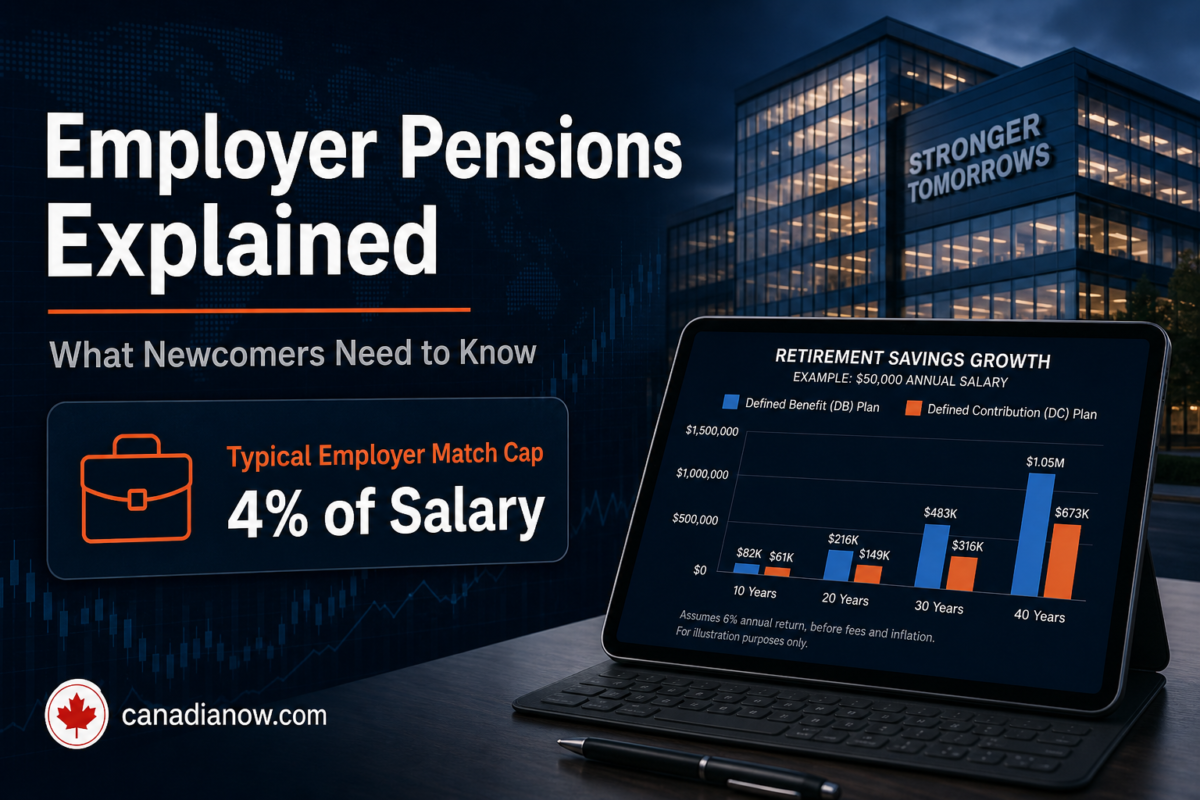
A job offer that mentions “we offer a pension plan” sounds like a nice-to-have until you understand what it’s actually worth in dollar terms — and how different it is from the government-run Canada Pension Plan most newcomers hear about first. Employer pensions are a separate, optional layer on top of CPP, and the type of plan you’re offered can be worth tens of thousands of dollars more over a career than a slightly higher salary with no plan at all.
Defined Benefit vs Defined Contribution Plans Explained
There are two fundamentally different types of employer pension plans in Canada, and the difference matters enormously:
| Type | How It Works | Who Bears the Risk | Common In |
|---|---|---|---|
| Defined Benefit (DB) | Guarantees a specific monthly payout in retirement, usually based on years of service and salary | Employer | Government, healthcare, large unionized employers, universities |
| Defined Contribution (DC) | Employer and employee contribute a set amount; final payout depends on investment performance | Employee | Private sector, tech, most non-unionized workplaces |
A defined benefit plan is generally the more valuable of the two, because the employer absorbs the investment risk and guarantees the outcome — a rare feature in modern compensation. Defined contribution plans are more common for newcomers working in the private sector and function similarly to an employer-sponsored RRSP: what you get out depends on what was put in and how the investments performed.
What “Employer Matching” Actually Means
Employer matching is specific to defined contribution plans (and to employer-sponsored group RRSPs, which work similarly but aren’t technically pensions). A typical structure: you contribute a percentage of your salary, and your employer matches it up to a cap — for example, “we match 100% up to 4% of salary.” If you contribute less than the matched amount, you are leaving free compensation on the table.
Matching is one of the very few actual “free money” components of Canadian compensation, which is why financial advisors almost universally recommend contributing at least enough to capture the full match before prioritizing other salary negotiation or personal savings goals. Skipping a 4% match to instead put money in a TFSA earning market returns is mathematically worse in almost every scenario, since the match itself is an instant, guaranteed 100% return.
What Happens to Your Pension if You Change Jobs or Leave Canada
This is where DB and DC plans diverge sharply. With a defined contribution plan, the money is generally yours (subject to a vesting period, often immediate or within two years) and can typically be transferred to a locked-in retirement account (LIRA) if you leave the employer. With a defined benefit plan, your options are usually either a reduced pension payable starting at retirement age, or a commuted value transfer — a lump sum calculated by an actuary, which can be complex and sometimes less favourable than staying in the plan if you have a long remaining career.
If you leave Canada permanently, employer pension funds are generally not automatically forfeited, but accessing or transferring them from abroad varies significantly by plan administrator and can involve tax withholding. This is a true case-by-case situation, best discussed directly with your plan administrator or a cross-border financial advisor before any move, since the rules differ meaningfully from how CPP contributions are handled if you leave the country.
Is a Job With a Pension Worth More Than a Slightly Higher Salary?
Often, yes — and newcomers comparing two job offers frequently undervalue this. A defined contribution match of 4–6% of salary is effectively a 4–6% raise that most people don’t mentally count as compensation. A defined benefit plan is worth even more, though it’s harder to put a single number on, since its value depends on years of service and the specific benefit formula. When comparing offers, it’s worth asking directly what percentage the employer contributes or matches, and whether the plan is DB or DC, rather than assuming “has a pension” means the same thing at every employer.
That said, a pension isn’t automatically the deciding factor — someone early in their Canadian career who expects to change employers a few times, or who isn’t sure they’ll stay in Canada long-term, may reasonably weight immediate salary more heavily than a long-vesting DB plan they may never fully realize the value of.
How Employer Pensions Interact With CPP and OAS Later in Life
Employer pensions, CPP, and Old Age Security (OAS) are three separate, stackable sources of retirement income in Canada — they don’t reduce each other in most cases. A newcomer building retirement income in Canada is generally working toward all three simultaneously: mandatory CPP contributions from every paycheque, OAS eligibility based on years of Canadian residency after age 18, and whatever employer pension or RRSP savings they build on top. Because OAS eligibility is tied to residency years rather than contribution amount, newcomers who arrive later in life may receive a partial OAS pension — another reason employer pension and personal retirement savings matter more for people who immigrated as adults than for lifelong residents.
In practice, this means a newcomer’s retirement plan usually looks less like “wait for CPP and OAS to cover everything” and more like a three-legged stool: government benefits providing a base, an employer plan (if offered) adding a meaningful middle layer, and personal TFSA or RRSP savings filling whatever gap remains. Understanding early which legs you actually have — and which ones you’ll need to build yourself through personal savings — is the difference between a comfortable retirement plan and an unpleasant surprise decades from now.