Newcomer parents hear about RRSPs and TFSAs almost immediately after landing, but the account that quietly does the most for a family’s long-term finances — the Registered Education Savings Plan — usually doesn’t come up until someone’s kid is already in school. That’s a costly delay, because the RESP isn’t just a savings account. It comes with a government match that effectively hands you free money for every dollar you put in, and the earlier you start, the more of that match you can collect before your child turns 18.
What an RESP Actually Does
An RESP is a tax-sheltered account for saving toward a child’s post-secondary education — university, college, apprenticeship programs, and many trade and vocational certifications all qualify. You (or grandparents, or anyone else) contribute after-tax money, the investments inside the account grow tax-free, and when your child eventually withdraws the funds for education, the growth and grants are taxed in the student’s hands — usually at close to zero, since students rarely earn enough to owe meaningful tax. The lifetime contribution limit is $50,000 per child, and there’s no annual cap forcing you to contribute on a fixed schedule, though waiting too long means missing out on grant money that only pays out on contributions made while the child is still eligible.
The Canada Education Savings Grant: Free Money, With a Catch
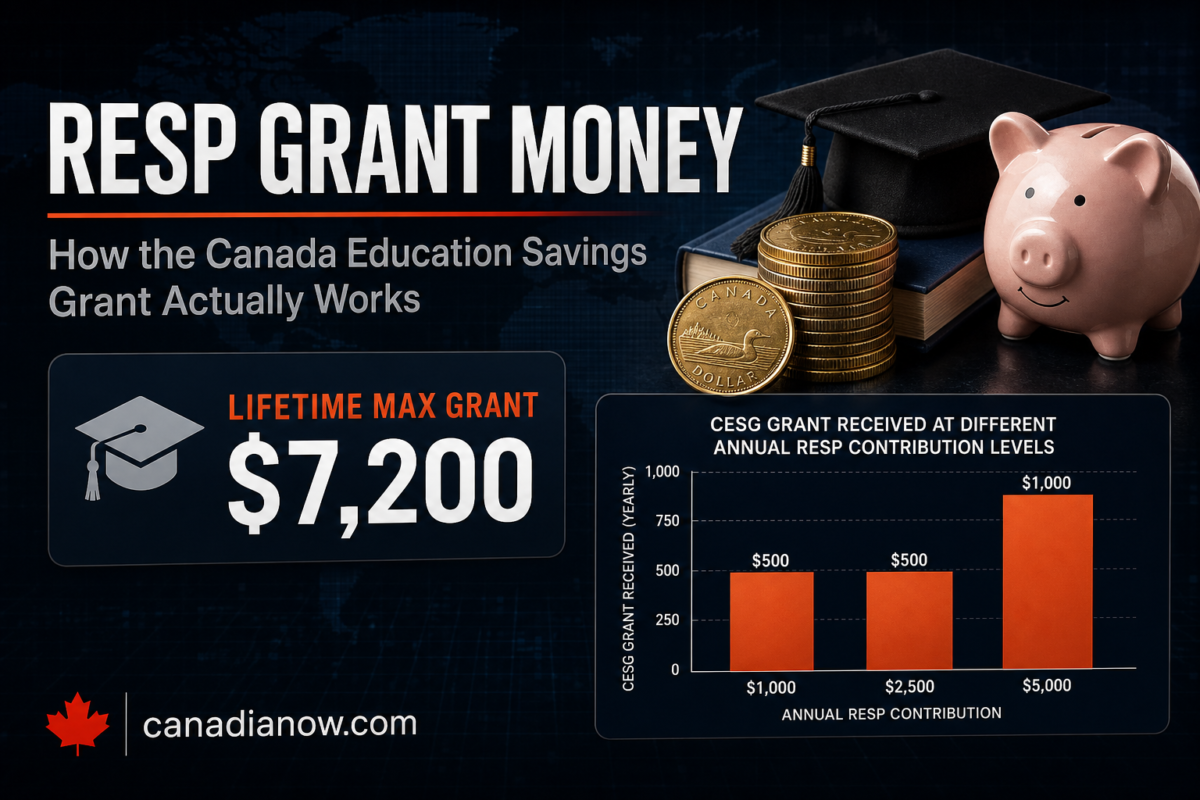
The federal government matches 20% of your RESP contributions through the Canada Education Savings Grant, up to $500 per year, for a lifetime maximum of $7,200 per child. To get the full $500 in a given year, you need to contribute $2,500 — contribute less, and you get proportionally less grant, but you never get penalized for contributing more than $2,500 in a year (you just won’t get extra grant on the excess that year).
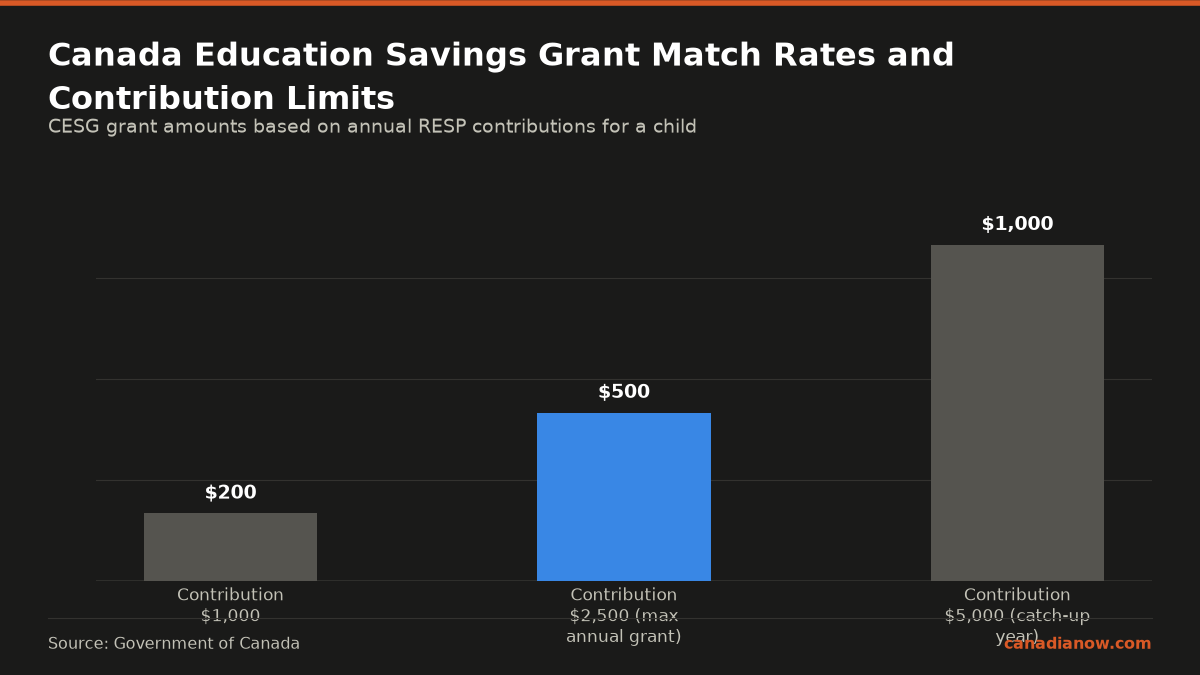
| Contribution That Year | CESG Received | Notes |
|---|---|---|
| $2,500 | $500 | Maximum annual grant |
| $1,000 | $200 | Still 20% match, just smaller |
| $5,000 (catch-up year) | $1,000 | Using one year of carried-forward grant room |
Families with lower adjusted net income get an enhanced rate on the first $500 contributed each year — 40% instead of 20% — which matters for newcomer households in their first few years, when income is often lower than it will eventually be. Check the current income threshold on the CESG program page before assuming you don’t qualify; it’s adjusted periodically and is easy to underestimate.
Newcomer-Specific Timing: You Can’t Backdate Missed Years Indefinitely
This is the part that catches immigrant families off guard. If you land with a 10-year-old, you can’t claim eight years of “missed” grant room retroactively — RESP grant room only starts accumulating once the child has a Social Insurance Number and becomes a Canadian resident for tax purposes. You do get to carry forward one year of unused grant room at a time going forward, so if you miss a year after arriving, you can catch up the following year by contributing more, but you can’t reach back further than that. The practical takeaway: open the RESP and make your first contribution as soon as your child has a SIN, even if it’s a small amount, rather than waiting until you feel financially settled.
Where to Open One
Banks, credit unions, and investment firms all offer RESPs, and the fee structures vary more than people expect. Bank-branch RESPs are the easiest to set up alongside your first newcomer bank account, but self-directed RESPs through a discount brokerage typically carry lower ongoing fees if you’re comfortable choosing your own investments. Group RESP plans, sold by scholarship trust companies, come with restrictive rules and penalties for missed contributions that catch a lot of families off guard — read the contract closely before signing, since these plans are harder to exit without losing money than a standard bank or brokerage RESP.
What Happens If Your Child Doesn’t Pursue Post-Secondary Education
Your original contributions always come back to you, tax-free, regardless of what your child ends up doing. The CESG portion, however, has to be repaid to the government if it’s never used for education — so an RESP is not a general-purpose savings account you can quietly redirect elsewhere. If your child ends up not pursuing further education, you have options: keep the account open in case they change their mind (RESPs can stay open up to 36 years), transfer unused grant money to a sibling’s RESP if you have more than one child, or roll a portion into your own RRSP if you have contribution room available.