Updated July 2026. The federal minimum wage rose to $18.15 per hour on April 1, 2026 — a 2.1% increase matching last year’s inflation. Here’s how that compares across the provinces and territories.
How the Federal Rate Is Set
The federal minimum wage is adjusted every April 1 based on Canada’s average Consumer Price Index from the previous calendar year, rounded up to the nearest $0.05. It only applies to federally regulated industries (banking, telecommunications, interprovincial transportation, and similar sectors) — most workers are covered by their province’s own minimum wage instead. Where a provincial or territorial rate is higher than the federal rate, federally regulated employers must pay the higher amount.
Province-by-Province Comparison (as of the April 2026 update)
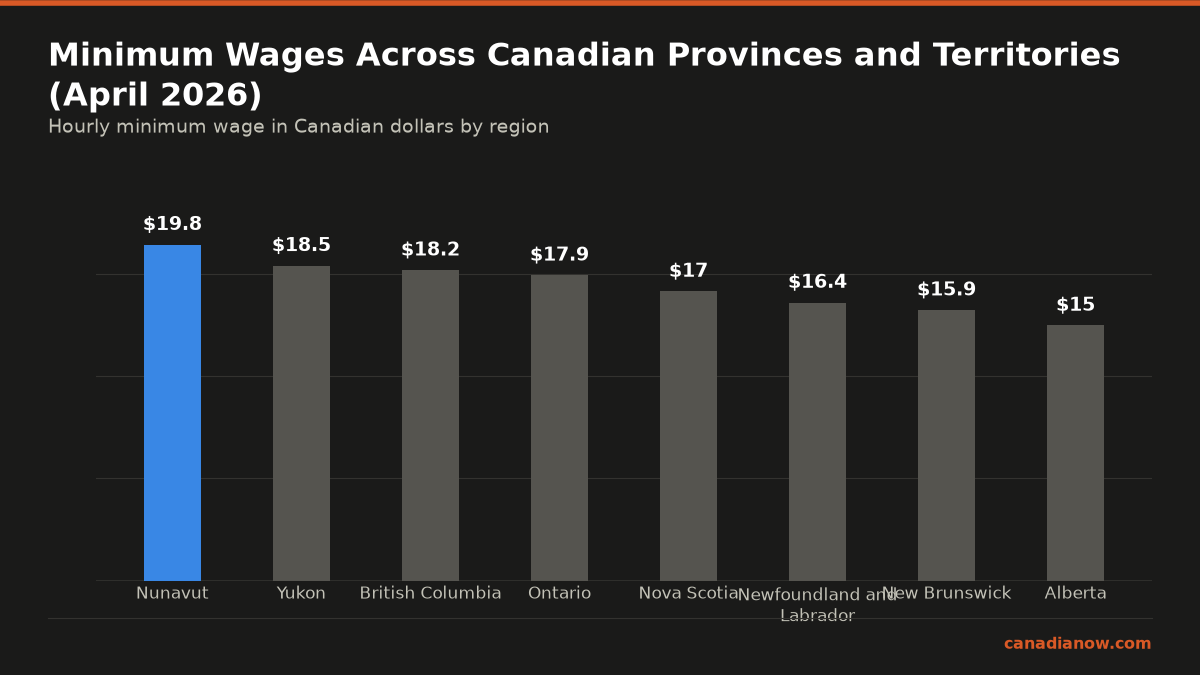
- Nunavut: $19.75 (the highest in the country)
- Yukon: $18.51 (effective April 1, 2026)
- British Columbia: $18.25 (effective June 1, 2026, up from $17.85)
- Ontario: $17.95 (effective October 1, 2026, up from $17.60)
- Nova Scotia: $17.00 (effective October 1, 2026)
- Newfoundland and Labrador: $16.35 (effective April 1, 2026)
- New Brunswick: $15.90 (effective April 1, 2026)
- Alberta: $15.00 (unchanged since 2018 — no 2026 increase announced)
What This Means for Workers
If you work in a federally regulated job, you’re guaranteed at least $18.15/hour regardless of which province you’re in. If you work in a provincially regulated job (the vast majority of positions), your minimum wage depends entirely on your province, and — as the Alberta/Nunavut gap shows — that can mean a nearly $5/hour difference for the same type of work depending on where you live.
If you’re not sure which minimum wage applies to your job, check whether your employer/industry falls under federal jurisdiction (banks, airlines, telecoms, and a handful of other federally regulated sectors) or provincial jurisdiction (everything else, including most retail, hospitality, and service jobs).
For official, up-to-date details, see the CRA.
Related Reading
- Proof of Funds for Express Entry: What Counts, What Doesn’t, and the 6-Month Trap
- Sending Money Abroad from Canada: The Cheapest Way and the Hidden Exchange-Rate Cost
- Ontario’s New Tax Brackets, Rates, And Benefits For 2026
If you'd rather have this mapped out for your exact situation instead of piecing it together yourself, our personalized report covers eligibility, CRS score, and next steps.