Quick Answer
If you’re self-employed, freelancing, or working as an independent contractor in Canada, no employer withholds tax, CPP, or EI from your income — you’re responsible for calculating and paying it yourself. You pay both the employee and employer portions of CPP (a combined ~11.9% on eligible earnings up to the year’s maximum), you generally do not pay into EI unless you opt in voluntarily, and you must set aside income tax yourself and often make quarterly instalment payments to the CRA rather than paying it all at once in April.
Why This Is a Different System Than a Regular Paycheque
An employee’s paycheque already has federal tax, provincial tax, CPP, and EI deducted before the money lands in their account — the employer does the math and remits it to the CRA. As a contractor or freelancer, you’re paid the full amount with nothing withheld, which means the tax bill doesn’t disappear — it just arrives later, in one place, unless you plan for it. This is the single biggest shock for newcomers who move from salaried work to freelance or contract work in Canada: the number in your bank account is not your net income the way it was on a payroll job.
CPP: You Pay Both Halves
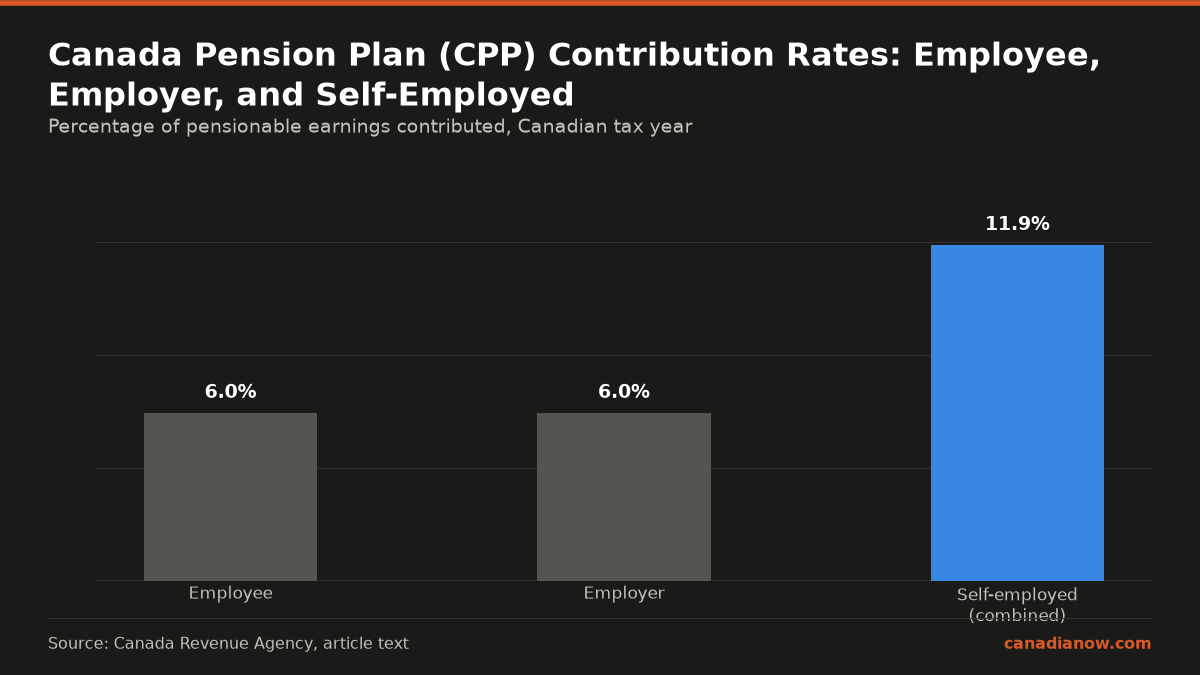
Employees and employers each pay a share of CPP contributions. When you’re self-employed, you are both, so you pay the full combined rate yourself on your net self-employment income above a basic exemption, up to the year’s maximum pensionable earnings.
| Contributor | What they normally pay | Self-employed reality |
|---|---|---|
| Employee | ~5.95% (base + first additional CPP) | — |
| Employer | ~5.95% (matches employee) | — |
| Self-employed | — | ~11.9% combined, calculated on your tax return |
You don’t write a separate CPP cheque during the year — it’s calculated on Schedule 8 when you file your tax return and included in what you owe or in your instalments. You do get a partial offset: half of your CPP contribution is deductible against your income, and there’s a further enhanced-contribution tax credit, which softens the blow slightly, but the cash outlay is still real and needs to be planned for.
EI: Usually Not Required, Optional If You Want It
Self-employed individuals are not required to pay into Employment Insurance and, by default, are not covered by regular EI benefits (job loss). You can opt in to the EI Special Benefits program for self-employed people, which covers maternity, parental, sickness, and caregiving benefits — but not regular unemployment benefits. If you opt in, there’s a required waiting period before you can claim, and opting out later triggers rules about it applying going forward, so it’s a decision worth making deliberately rather than defaulting into or out of.
Income Tax: Instalments, Not One Bill in April
If you owe more than a set threshold in net tax for the current year and either of the two previous years, the CRA generally expects you to pay quarterly instalments throughout the year rather than one lump sum at filing time. Missing instalments can mean instalment interest charges even if you pay the full balance by the filing deadline.
- Common practical approach: set aside 25–30% of every invoice paid into a separate account the moment it lands, covering both income tax and your CPP contribution.
- Track deductible business expenses (home office portion, equipment, software, portion of phone/internet, professional fees) — this is where self-employed income tax differs most from a salaried filing, and it directly lowers what you owe.
- File on time even if you can’t pay in full — self-employed filers have until June 15 to file (though any balance owing is still due by the regular deadline), and filing late compounds penalties on top of what you already owe.
A Simple Example
A freelancer invoices $70,000 in a year with no employer withholding anything. After deductible business expenses bring net income to roughly $58,000, they owe federal and provincial income tax on that net amount, plus the full ~11.9% self-employed CPP rate on earnings above the basic exemption. Setting aside roughly 25–30% of each invoice as it’s paid — separate from spending money — is what keeps that total from becoming an unmanageable bill at filing time instead of a series of manageable transfers made all year.
FAQ
Do I have to pay EI as a freelancer in Canada?
No, not by default. You can voluntarily opt into EI special benefits (maternity, parental, sickness, caregiving), but you are not automatically enrolled and you don’t pay into regular EI.
How much CPP will I actually owe?
Roughly 11.9% of your net self-employment income above the basic exemption, up to the year’s maximum pensionable earnings — calculated when you file, not withheld in advance.
What happens if I don’t make quarterly instalments?
The CRA can charge instalment interest on what should have been paid throughout the year, even if your account is settled in full by the filing deadline.
Can I reduce what I owe?
Deductible business expenses and half of your CPP contribution being deductible are the two biggest legitimate levers — a bookkeeper or tax software built for self-employed filers usually pays for itself here.
Sources
- Canada Revenue Agency — Self-employed individuals and CPP contributions
- Canada Revenue Agency — Instalment payments for individuals
- Employment and Social Development Canada — EI special benefits for self-employed people
Written by Caglar Aybas. Reviewed for accuracy and currency. Last reviewed: July 2026.
If you’d rather have this mapped out for your exact situation instead of piecing it together yourself, our personalized report covers eligibility, CRS score, and next steps.