Canada’s maternity and parental leave system surprises a lot of newcomers — not because it’s ungenerous (it’s substantially more generous than what many countries offer), but because it runs through Employment Insurance (EI) rather than being a direct employer benefit, and eligibility depends on hours worked, not on your immigration status alone.
Eligibility: How Many Insurable Hours You Need Before Qualifying
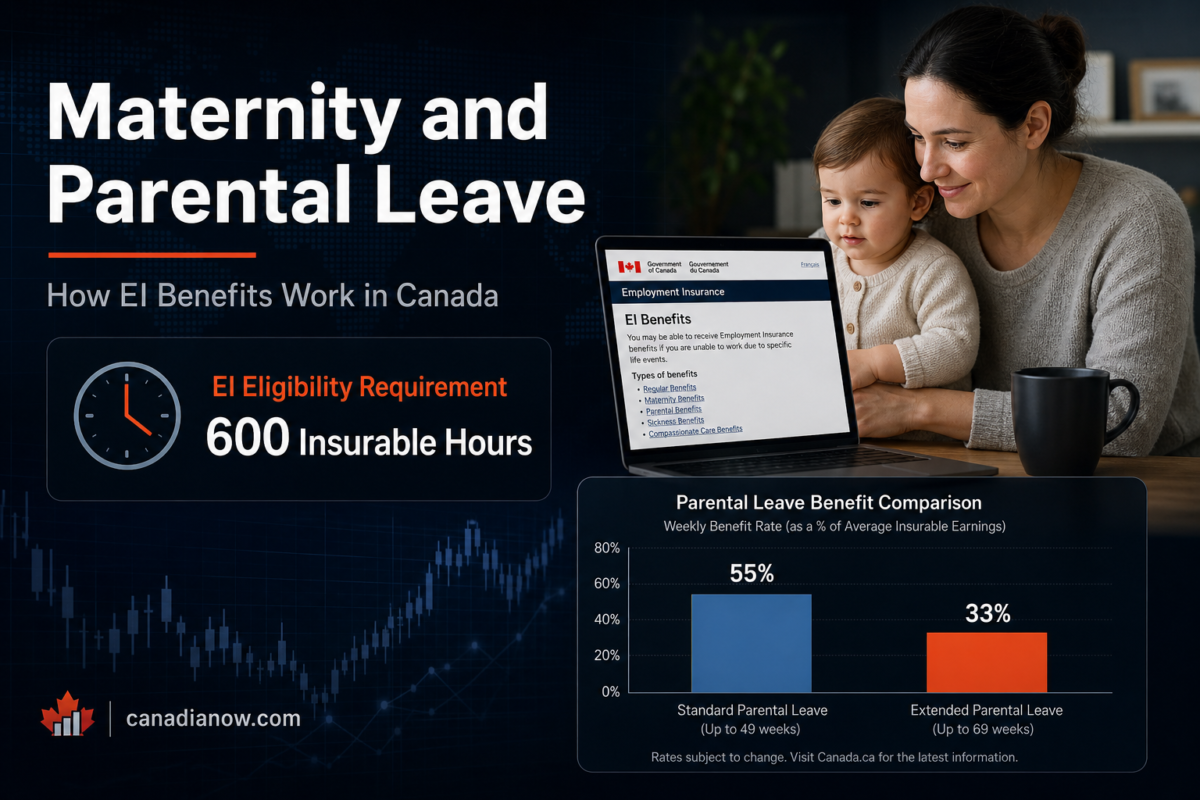
To qualify for EI maternity or parental benefits, you need at least 600 hours of insurable employment in the 52 weeks before your claim (or since your last claim, if more recent). Insurable hours accumulate through any job where you and your employer pay EI premiums — which is virtually all standard employment in Canada, including full-time, part-time, and many temporary positions. Self-employed individuals are not automatically covered; they must opt in to the EI special benefits program in advance, which is a step some newcomers running their own business overlook until it’s too late.
Immigration status itself is not a barrier — permanent residents and, notably, work permit holders both accumulate insurable hours the same way, provided they’re legally working and their employer is deducting EI premiums. What matters is the hours worked and premiums paid, not citizenship or PR status.
Standard (12-Month) vs Extended (18-Month) Parental Leave — Payout Comparison
| Option | Duration | Weekly Benefit Rate | Best For |
|---|---|---|---|
| Standard | Up to 12 months combined (maternity + parental) | 55% of average insurable earnings, up to the annual maximum | Families needing higher weekly income sooner |
| Extended | Up to 18 months combined | 33% of average insurable earnings, up to a lower annual maximum | Families prioritizing longer time at home over weekly amount |
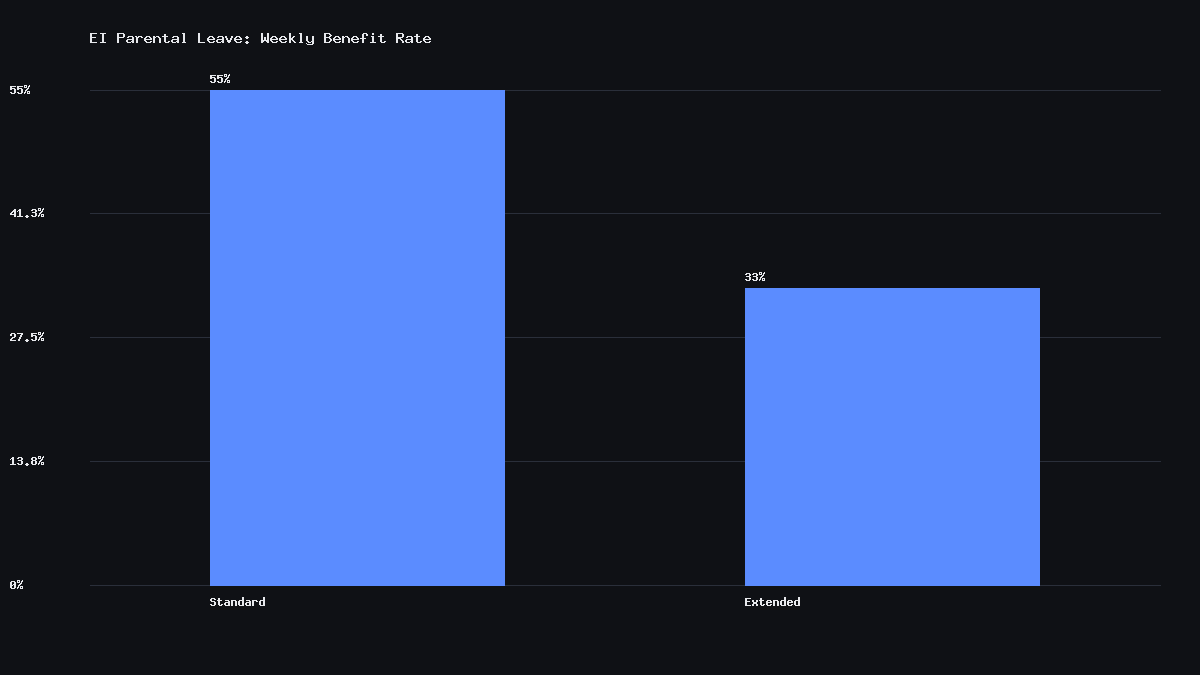
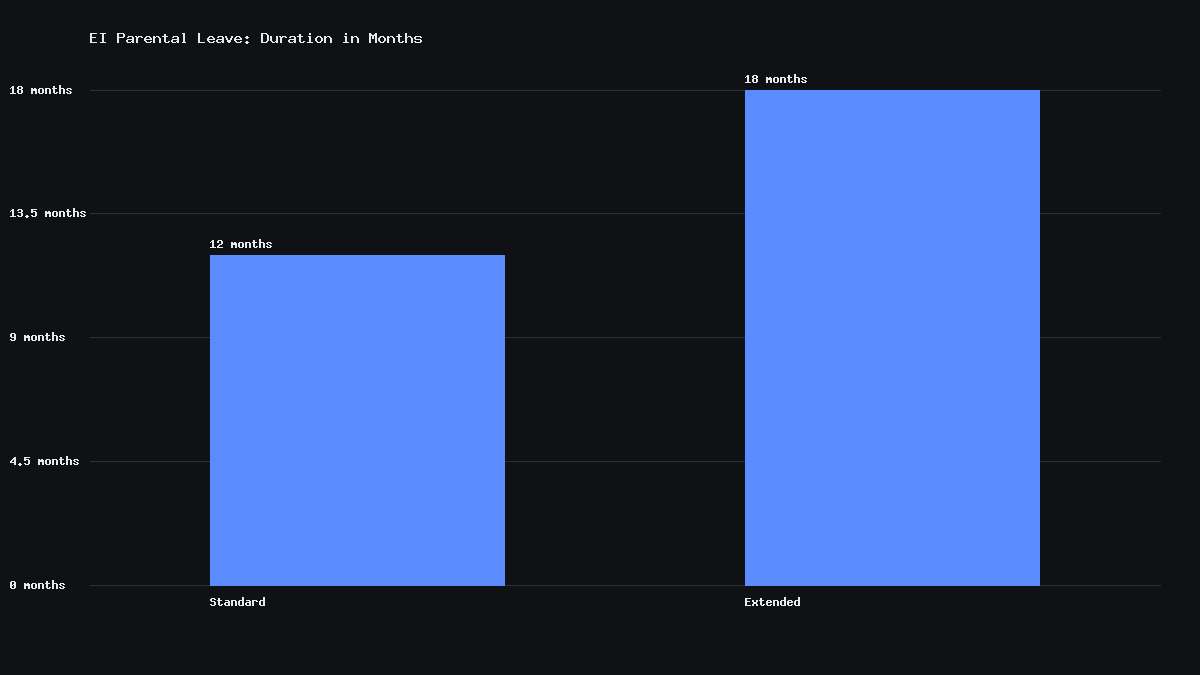
This choice is made once, at the start of the claim, and cannot be changed afterward — a detail that catches newcomers off guard when they don’t realize how binding the decision is. Maternity benefits (available to the birth parent only, up to 15 weeks) can be combined with either standard or extended parental benefits, which can be shared between two parents in two-parent households. For the current dollar caps on weekly benefits, see our breakdown of the maximum EI benefit for 2026, since the numbers above are set annually and directly determine your actual weekly payment.
Can You Work Part-Time While on Leave?
Yes, within limits. EI allows claimants to earn income while on maternity or parental benefits, but earnings above a certain threshold reduce your benefit dollar-for-dollar or by 50%, depending on how much you earn relative to your weekly benefit rate. This flexibility exists specifically so parents aren’t penalized for picking up occasional freelance or part-time work, but it’s not unlimited — earning too much in a given week can reduce that week’s benefit to zero. Anyone considering part-time work during leave should model the numbers against their specific weekly benefit rate before committing to a schedule, since the reduction isn’t always intuitive. It’s also worth staying current on EI rule changes generally — temporary EI adjustments have periodically changed waiting periods and treatment of severance, which can affect exactly when your benefit period starts.
What Happens if You’re on a Work Permit, Not PR, When You Have a Child
This is one of the more consequential newcomer-specific questions, and the good news is straightforward: EI maternity and parental benefits are available to eligible work permit holders on the same basis as PR holders and citizens, as long as the insurable-hours requirement is met. Your child, if born in Canada, is generally a Canadian citizen by birth regardless of your own status — a separate matter from your EI eligibility, but often a related question newcomers ask at the same time.
Where work permit holders do need to plan carefully is around permit expiry and renewal timing relative to their leave — if your work permit is set to expire during your leave period, you’ll need to handle the renewal process proactively, since an expired permit complicates your ability to return to work afterward even though it doesn’t affect EI benefits already in payment.
How Employer Top-Up Plans Interact With EI Payments
Many Canadian employers, particularly larger companies and unionized workplaces, offer a top-up (sometimes called a Supplemental Unemployment Benefit, or SUB plan) that adds to your EI payment to bring your total income closer to your regular salary — commonly topping up to 80–100% of your normal pay for some or all of the leave period. This is entirely employer-discretionary; there’s no legal requirement for employers to offer it, so it’s worth asking about explicitly during salary negotiation or when evaluating job offers, rather than assuming it’s included by default. A generous top-up plan can be worth significantly more than a slightly higher base salary for anyone planning a family within a few years of starting a new role.
One detail that surprises newcomers who assume top-up plans are automatic or legally mandated: they aren’t, at any level of government, and their absence is completely normal, especially at smaller employers or in the private sector generally. If a top-up isn’t offered where you work, your household should plan financially around the base EI benefit rate — either standard or extended — rather than assuming a bridge to full salary will materialize.
2026 Amounts and Newcomer Checklist
- 2026 maximums: maximum insurable earnings are $68,900, so the standard benefit (55%) is capped at $729 a week and the extended benefit (33%) at about $437 a week. See EI and CPP maximums.
- 600 hours: count only insurable hours in the 52 weeks before your claim. Your ROE shows them (ROE codes explained). If you are on a work permit, see EI eligibility for work permit holders.
- Canada Child Benefit: apply when your baby is born. Work permit holders usually qualify after 18 months in Canada, and only one parent needs to meet the status test (CCB for work permit holders).
- PR application pending? A new baby must be added to your application before you land (baby or marriage after applying for PR).
Estimate your weekly amount and total with the EI maternity and parental calculator.